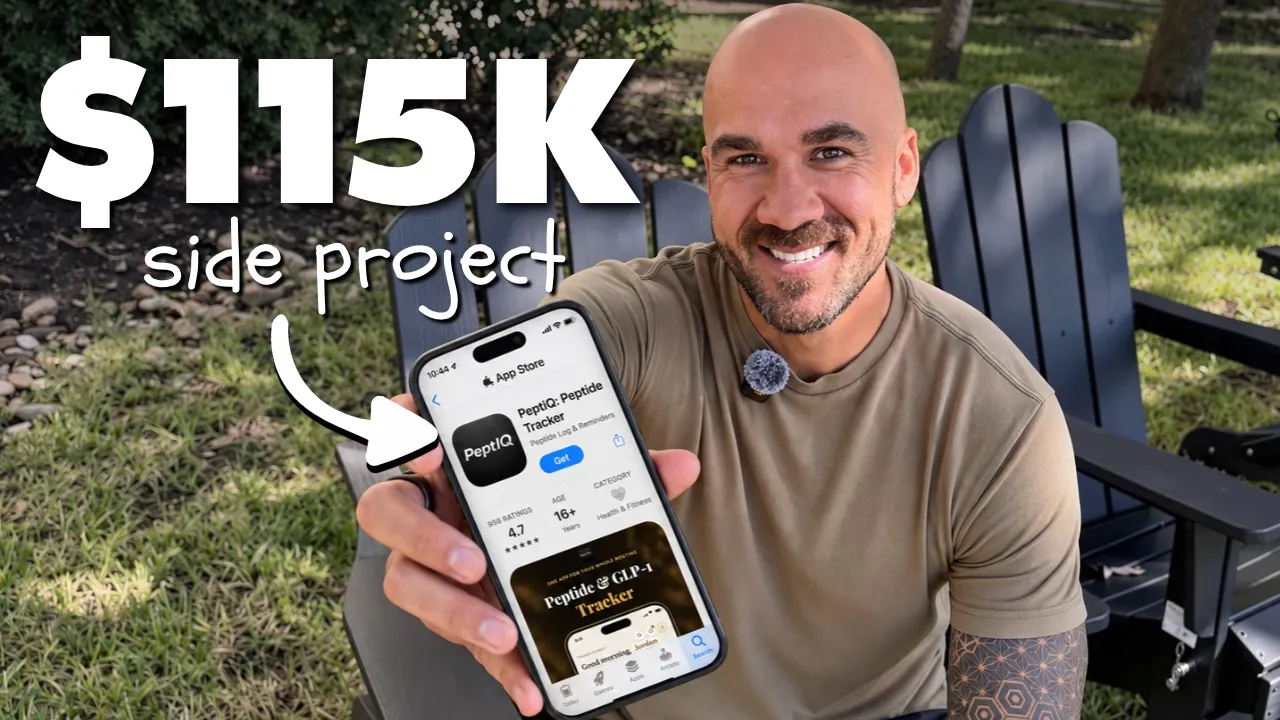
I built this app on the side for fun. It just hit $100K
Starter Story
35,389 views • 2 days ago Save 9 min 4 min read
Video Summary
Chris Chase, a seasoned software engineer, built PeptIQ, an app tracking peptide usage, which has achieved over $115,000 in revenue this year, currently generating $14,000 in monthly recurring revenue. Despite entering a crowded market with existing GLP-1 focused apps, Chase's strategy centered on a slow, organic growth approach through search engine optimization (SEO). By identifying trending topics and user questions around peptides, he created blog content that now drives 70% of his app's traffic and revenue, proving that SEO remains a powerful, cost-effective growth engine for apps, even when paid ads and influencers are ignored.
Chase leveraged his extensive programming experience, developing the app in just a week using Vercel and React Native. He focused on differentiating PeptIQ by offering a personalized experience and valuable tools like a reconstitution calculator, which directly addresses common user queries found on platforms like Reddit. This content-driven SEO strategy, which took about six to seven months to yield significant results, targets an older demographic (45-55 years old) not typically found on newer social media platforms, highlighting the importance of understanding audience behavior for effective marketing.
Short Highlights
- PeptIQ generates over $14,000 in monthly recurring revenue.
- The app targets users interested in peptides, offering tracking and tools.
- A key growth strategy is search engine optimization (SEO).
- SEO drives approximately 70% of the app's traffic and revenue.
- The app was developed quickly using Vercel and React Native.
- Differentiated by offering a personalized experience and a reconstitution calculator.
- Chase advises focusing on passion and identifying market differentiation.
Key Details
The App and Its Success [00:00:00]
- Chris Chase, a software engineer with 25 years of experience, launched PeptIQ earlier this year.
- PeptIQ is a tracker for peptides, offering personalized features and tools.
- The app has achieved over $115,000 in revenue this year and $14,000 in monthly recurring revenue (MRR).
"On the side earlier this year, I built PeptIQ, and I've officially crossed over $115,000 in revenue this year."
PeptIQ's Functionality and Monetization [00:01:20]
- PeptIQ tracks various peptide-related information for users.
- The app employs a hard paywall model, costing $30 per month or $130 annually.
- Recent data shows approximately 70 active trials and nearly $15,000 MRR.
"And now we're at about almost $15,000 monthly recurring revenue."
Market Strategy: Entering a Saturated Space [00:02:30]
- Chase did not invent a new idea but entered a category with existing successful apps.
- He identified the success of GLP-1 apps as validation for the market need.
- Differentiation was key, by analyzing competitor reviews and user feedback on platforms like Reddit.
"He did not try to invent a brand new idea. And instead, he built in a category where there were other apps that were already successful."
Development and Tech Stack [00:04:00]
- The app was coded using Vercel's app, enabling a rapid transition from idea to functional app in about a week.
- The tech stack includes Expo, React Native, TypeScript, Supabase for backend services, and RevenueCat for payments.
- Vercel is used for the marketing website, Postlog for analytics, and Sentry.io for crash reporting.
"I vibe coded it. I actually used vibe code app. It helped me go from idea to living, breathing, working app in about a week."
Growth Through SEO [00:05:30]
- Chase focused on SEO from the beginning, building a marketing website positioned around user questions.
- This long-term strategy took six to seven months to show significant results.
- Currently, Google drives about 70% of the app's clicks and revenue, with no direct cost.
"And so very early on, I built the marketing website in a way that was positioned around that."
Content Creation and SEO Tactics [00:08:00]
- Chase wrote articles himself, used AI for a majority, and hired writers.
- Content addresses common user questions, such as how to reconstitute peptides.
- He integrated a reconstitution calculator tool into articles to drive app engagement and provide value.
"I've either written the articles myself. I've used AI absolutely for a good majority of them. And then I've also hired writers for me."