Building the First Data Centers in Space
Y Combinator
589 views • 1 month ago Save 23 min 13 min read
Video Summary
StarCloud, a company aiming to build data centers in space, has successfully launched its first satellite, StarCloud One, carrying advanced GPUs like the NVIDIA H100. This venture is driven by the escalating energy demands of AI on Earth and the decreasing costs of space launches, particularly with the advent of SpaceX's Starship. The company's initial concept of space-based solar power was abandoned due to significant energy loss during transmission, leading to a pivot towards in-space data centers. StarCloud One faced considerable engineering hurdles, including extreme thermal cycling tests and software glitches, but ultimately proved the viability of running powerful computing hardware in orbit. The company plans to scale up its operations with larger spacecraft and a constellation of satellites, aiming to provide massive compute capacity that could eventually rival Earth-based data centers, while also addressing regulatory challenges and the need for national security-level computing power.
Short Highlights
- Book the first available launch before building anything.
- StarCloud's mission: build data centers in space to solve AI's energy bottleneck.
- StarCloud One launched with NVIDIA H100 and ARM GPUs.
- Pivoted from space-based solar to data centers due to transmission losses.
- Overcame thermal cycling and software issues on StarCloud One.
- Reduced costs significantly compared to traditional space hardware development.
- Future plans include a constellation of 88,000 satellites.
- Addressing engineering challenges: heat dissipation and radiation.
- Partnering with NVIDIA for space-designed chips.
- Initial customers are government and military entities.
- Overcoming investor skepticism towards hard tech and space ventures.
- Building a world-class engineering team is paramount.
Related Video Summary
- This Week in AI: NVIDIA’s Most Powerful Chip, Robotics Reach a New Milestone & AGI by 2026 | EP #202
- How to Make Claude Code Your AI Engineering Team
- AI News: GPT-5.2, Devstral 2, Boom Superpower, MCP Nonprofit and more!
- Claude for Healthcare & Life Sciences: HIPAA-Ready AI with Medical Connectors | Technical Overview
Key Details
Booking the First Launch as a Forcing Function [00:00:00]
- Booking a launch early is crucial for space companies, acting as a deadline and focus.
- StarCloud was founded on January 1st, 2024, and booked a SpaceX rideshare launch on January 2nd.
- This early commitment forced the company to develop a payload, even before fully defining it.
"First thing every space company should do is book the first available launch they can."
The Energy Bottleneck and the Case for Space Data Centers [00:01:00]
- AI's rapid growth is creating an energy bottleneck on Earth, limiting new energy projects.
- StarCloud aims to build data centers in space to access abundant, low-cost solar energy.
- Decreasing launch costs, driven by vehicles like Falcon 9 and Starship, make space infrastructure more feasible.
"So we are very quickly running up on constraints on where we can build new energy projects terrestrially."
Genesis of the Idea: Starbase and Future Launch Capacity [00:02:00]
- Philip Johnston's insight came from observing the rapid decline in launch costs and massive capacity build-up at Starbase.
- He visited Starbase before Starship's first launch and saw the potential for thousands of times current launch capacity.
- This led to envisioning what would become viable with significantly lower launch costs and higher capacity.
"And I could see that they were just building an enormous capacity."
Exploring Alternatives: Manufacturing, Mining, and Hotels in Space [00:03:00]
- The company considered various space-based ventures like manufacturing, asteroid mining, and space hotels.
- These ideas were evaluated based on their viability with significantly reduced launch costs.
- Data centers emerged as a preferred choice due to the absence of a complex re-entry requirement.
"We looked at basically anything which could make sense if the launch cost was a lot lower than it is today."
Pivoting from Space-Based Solar to Data Centers [00:04:00]
- StarCloud initially focused on space-based solar power, then called Lumen Orbit.
- A major challenge was the 95% energy loss during transmission from space to Earth.
- Rerunning calculations with a target launch cost of $500/kg revealed data centers as a more viable business.
"The problem with space-based solar is you actually lose 95% of the energy in transmission from space to Earth."
StarCloud One: A High-Stakes Launch [00:06:00]
- StarCloud One, launched in November 2025, carried five GPUs, including NVIDIA and ARM chips.
- The team performed extreme thermal cycling tests on an NVIDIA H100, submerging it in ice baths and using heat guns.
- This unconventional approach, driven by tight deadlines, highlights startup agility.
"It is a miracle that it works to be honest."
Cost Efficiency and Startup Agility [00:07:00]
- A quote from a prime contractor estimated StarCloud One's cost at $75-100 million.
- StarCloud completed StarCloud Two, including launch, for just $2 million.
- This demonstrates the significant cost savings achievable by startups compared to established players.
"They said 75 million to a hundred million dollars. And we did the whole of star cloud two, including the launch for $2 million."
Launch Day and Deployment Success [00:08:00]
- The StarCloud One separation video was exceptionally well-received, showcasing a perfect deployment.
- This footage was prominently featured by Jensen Huang at the GTC conference.
- The successful deployment was a significant emotional moment for the 12-person team and their supporters.
"Star cloud one separation confirmed."
Post-Launch Challenges: Contact and Commissioning [00:10:00]
- The team made first contact 12 hours after launch, faster than the typical 24 hours.
- A two-week commissioning period revealed software issues, including satellite restarts every two hours.
- Identifying and fixing the specific failure triggers required meticulous testing over several days.
"And then it's like a two week commissioning period. And we had a whole bunch of software issues we had to work through."
Future Constellation and Compute Capacity [00:13:00]
- StarCloud plans a network of satellites, starting with StarCloud Four, to cover the Earth.
- From StarCloud Three onwards, 88,000 satellites will form a constellation, providing immense compute capacity.
- The ultimate goal is to deploy up to 10 terawatts of compute capacity in sun-synchronous orbit.
"From star cloud three onwards, we'll have 88,000 and they'll all fly."
Key Engineering Challenges: Heat and Radiation [00:15:00]
- The two primary engineering challenges are dissipating heat in a vacuum and ensuring chips function in high-radiation environments.
- StarCloud is developing large, low-cost, low-mass deployable radiators for thermal management.
- Extensive ground testing in particle accelerators is used to understand and mitigate radiation effects on chips.
"The two biggest ones that are outstanding, and most of our engineering, our engineering team is split basically 50-50 down these two lines, is number one, as you mentioned, how do you get rid of this heat in a vacuum?"
Innovative Solutions: Immersion Cooling and Component Selection [00:18:00]
- StarCloud One uses immersion cooling by submerging components in phase change material to manage heat.
- For radiation tolerance, the team selects off-the-shelf automotive-grade components tested rigorously.
- This approach avoids the high cost of specialized space-grade components, similar to SpaceX's strategy.
"So everything on Star Cloud One is submerged in this phase change material."
Phased Product Rollout: From MVP to Hyperscale [00:21:00]
- The journey includes booking a launch (MVP), developing StarCloud Two for compute sales, and StarCloud Three for hyperscale data centers.
- StarCloud Two is a 10kW spacecraft for government and military compute.
- StarCloud Three will be a 200kW, three-ton spacecraft capable of fitting 50 per Starship, offering 10MW of compute capacity.
"Second step is producing something which is like a product we can sell to customers."
Market Validation and Investor Skepticism [00:24:00]
- Initially, the idea of space data centers was met with skepticism, with many VCs rejecting the company.
- Investors struggled to visualize a future with low-cost launch and found the concept too "sci-fi."
- The increasing difficulty of building terrestrial data centers due to regulations has shifted investor perception.
"For a very long time, their reactions was, this is the dumbest thing I've ever heard."
The Power of a Strong Engineering Team [00:27:00]
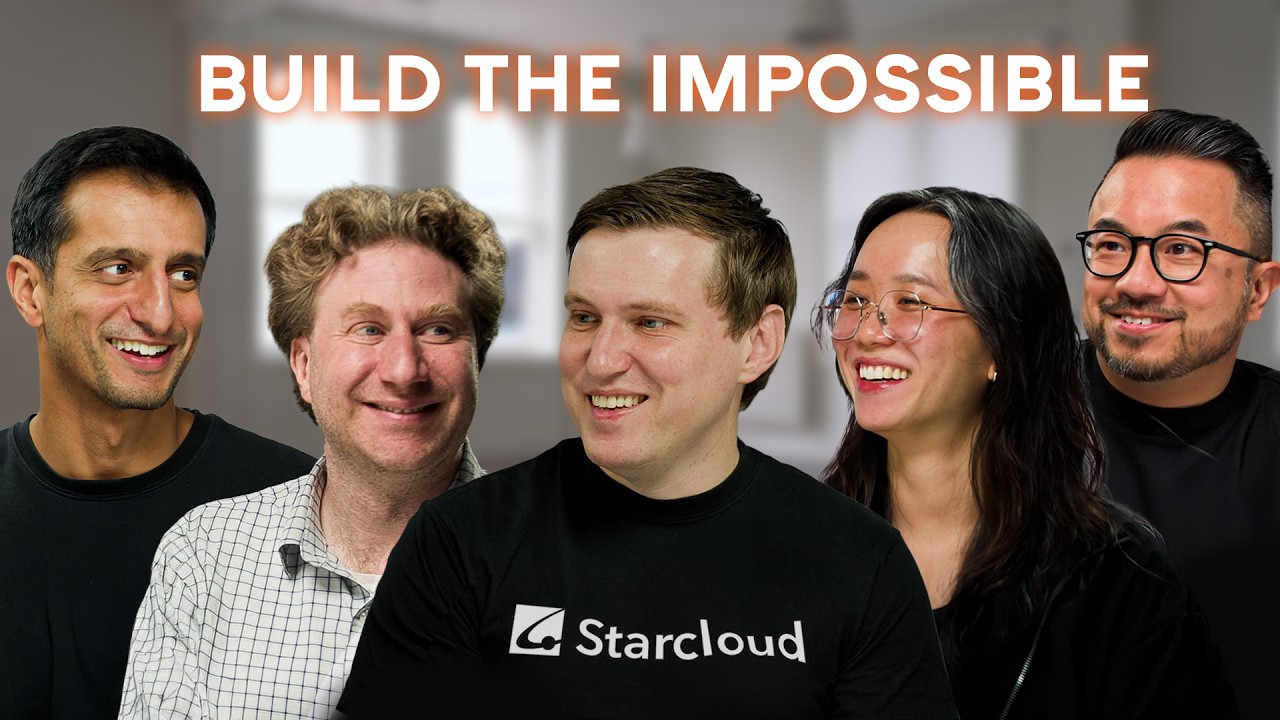
- Confidence in the idea stems from having a world-class engineering team with backgrounds from SpaceX and NASA.
- Co-founders Addy and Ezra, with deep space engineering expertise, were crucial in validating the concept.
- The ability of this team to solve complex engineering problems instills confidence in the project's feasibility.
"If you have the world's best space engineers saying this is possible, and to be frank, my background isn't as a space engineer."
The YC Approach: Booking Launch First [00:29:00]
- The core YC advice for space companies is to book the first available launch immediately.
- This strategy acts as a powerful forcing function, driving product development and decision-making.
- StarCloud's rapid booking of a launch shortly after its founding exemplifies this approach.
"The first thing every space company should do is book the first available launch they can."
Overcoming the "Impossible": Running H100s in Space [00:31:00]
- Many believed it was physically impossible to run power-dense chips like the H100 in orbit due to thermal and radiation challenges.
- StarCloud's innovative immersion cooling and rigorous component testing proved these assumptions wrong.
- This success opens doors for future advancements in space-based computing.
"The amount of people who said it was physically impossible to run a chip that's that power dense in orbit."
The Future of Compute: StarCloud's Scaled Vision [00:33:00]
- StarCloud aims for commercial-scale, profitable data centers in space through a phased approach.
- StarCloud Three will offer 10MW of compute per Starship, with a planned constellation of 88,000 satellites.
- This could eventually provide 20GW of compute capacity, dwarfing the largest terrestrial data centers.
"So that's the star cloud three, we can it's 200 kilowatt, three ton spacecraft about six meters long."
Timetable and Launch Vehicle Dependencies [00:35:00]
- The company's ramp-up is heavily dependent on the launch cost and cadence of vehicles like Starship.
- Estimates suggest Starship deployment could be by late 2027 or early 2028.
- Competition from other launch vehicles like New Glenn and Neutron also plays a role.
"And so, you know, the estimates for starship, if you believe Elon, it will be end of this year, but let's say it could be end of next year, early 2028 for starship deploying, you know, ramping up the launch cadence."
Initial Customers and In-Space Data Processing [00:37:00]
- Initial customers are government and military entities requiring secure and high-performance compute.
- StarCloud's satellites will process vast amounts of satellite imagery and SAR data on-orbit.
- This allows for rapid downlink of insights, such as vessel coordinates, rather than raw data.
"So right now, many satellites are very constrained with the amount of data they can downlink."
NVIDIA Partnership and Space-Designed Chips [00:39:00]
- StarCloud is collaborating closely with NVIDIA on designing chips for the space environment, like the Space Rubin 1.
- They modified the H100 by stripping non-essential components and hardening the board for radiation tolerance.
- This partnership provides NVIDIA with valuable data on high-powered GPU operation in space.
"So we're working very closely with NVIDIA. We recently announced this Space Rubin 1 chip that we're working with them on."
Decentralized Compute and Broader Applications [00:41:00]
- The technology developed for space data centers can also be applied to terrestrial GPU data centers using solar power.
- Direct DC power from solar panels avoids energy loss from AC-DC conversion.
- This innovation could benefit companies building GPU data centers on Earth, underwater, or in space.
"Because you can actually do very simple things to make these chips way more effectively, effective to run in space."
StarCloud Two: Expanding Capabilities [00:42:00]
- StarCloud Two will include a Bitcoin mining ASIC, generating significant excitement in the crypto community.
- It will also carry more H100s and BlackRodship GPUs, and AWS Outpost hardware for military customers.
- The company humorously warns against unofficial "StarCloud meme coins."
"Yes, we will be flying a Bitcoin mining ASIC next year, which the crypto community is very excited about."
The Shift in Hard Tech Investment [00:44:00]
- Raising funding for hard tech and space companies was challenging until recently.
- Investor appetite has increased due to software's perceived lack of moat and the growing geopolitical importance of AI.
- The rapid shift in public market sentiment towards AI and hard tech influenced demo day investments.
"Deep tech and hard tech and space were definitely not a cool thing to invest in back then."
Securing Benchmark Investment Amidst Conflicts [00:46:00]
- Raising the large round from Benchmark was not easy, partly due to SpaceX's parallel efforts creating potential conflicts for investors.
- Chetan, the partner at Benchmark, was impressed by the strong technical team and the potential of the venture.
- Benchmark's investment signals a growing confidence in the viability of ambitious space ventures.
"I think basically he saw a really, really strong technical team doing something that if it worked could be incredible."
Building a World-Class Engineering Team [00:48:00]
- StarCloud's success hinges on its exceptional engineering team, with many members from SpaceX and hyperscalers.
- The company is extremely selective in hiring, prioritizing top talent even if it slows down the process.
- This focus on engineering excellence is seen as the core of the company's strategy.
"We literally have the best freaking engineering team in the world in Redmond building the stuff."
From Skepticism to Industry Embrace [00:50:00]
- The company faced significant skepticism, with many viewing space data centers as an unworkable idea.
- Public statements from industry leaders like Elon Musk and the growing regulatory hurdles for terrestrial data centers have validated StarCloud's vision.
- This shift represents a surreal validation for the team's persistent belief in the future of space-based computing.
"So if you go back through my Twitter feed, I've been like shouting from the rooftops for the last like three years about this."
A Non-Traditional Path to Space Entrepreneurship [00:52:00]
- Philip Johnston's background in software, math, and physics, with some exposure to space projects at McKinsey, was unconventional for a space founder.
- He recognized the need for world-class space engineers and prioritized building that team first.
- This contrarian approach, focusing on talent before a fully defined idea, was guided by YC principles.
"My pitch to Addy and Ezra was essentially, if you have any ideas that would make sense, if the launch cost was 10 X less than it is today."
The Regulatory Advantage of Space Data Centers [00:54:00]
- The increasing political unpopularity and regulatory restrictions on building AI data centers on Earth make space a more attractive alternative.
- New York's blocking of data center construction highlights the growing challenges on Earth.
- Building in space offers a path around these terrestrial regulatory hurdles.
"Building these things in space will definitely be much easier from a regulatory perspective."
Myth-Busting Data Center Misconceptions [00:55:00]
- A common misconception is that data centers consume vast amounts of water daily.
- In reality, with sufficient power, data centers can operate with minimal or no daily water consumption, often using closed-loop systems.
- The water usage of a large data center is comparable to that of a McDonald's, making it a non-issue according to the speaker.
"Water is really actually just a function of power."
Data Centers as a National Security Imperative [00:57:00]
- Access to intelligence and advanced computing is becoming a critical national security issue for the West.
- Restrictive tech policies could hinder progress and cede advantages to adversaries.
- StarCloud's ability to bring compute and AI online positions it as a key player in this national security landscape.
"It's become basically a national security issue, you know, for America and for the West to have access to intelligence is sort of the most important tech tree of the next hundred years."
Early Innings of an Enormous Space Industry [01:00:00]
- The space industry is in its very early stages, with immense growth potential in the coming years.
- The projected increase in launch capacity is staggering, creating unprecedented opportunities.
- The advice for aspiring hard tech founders remains: prioritize technical talent and the founding team.
"We're really at the like very early innings with what's going to be this enormous industry in space."