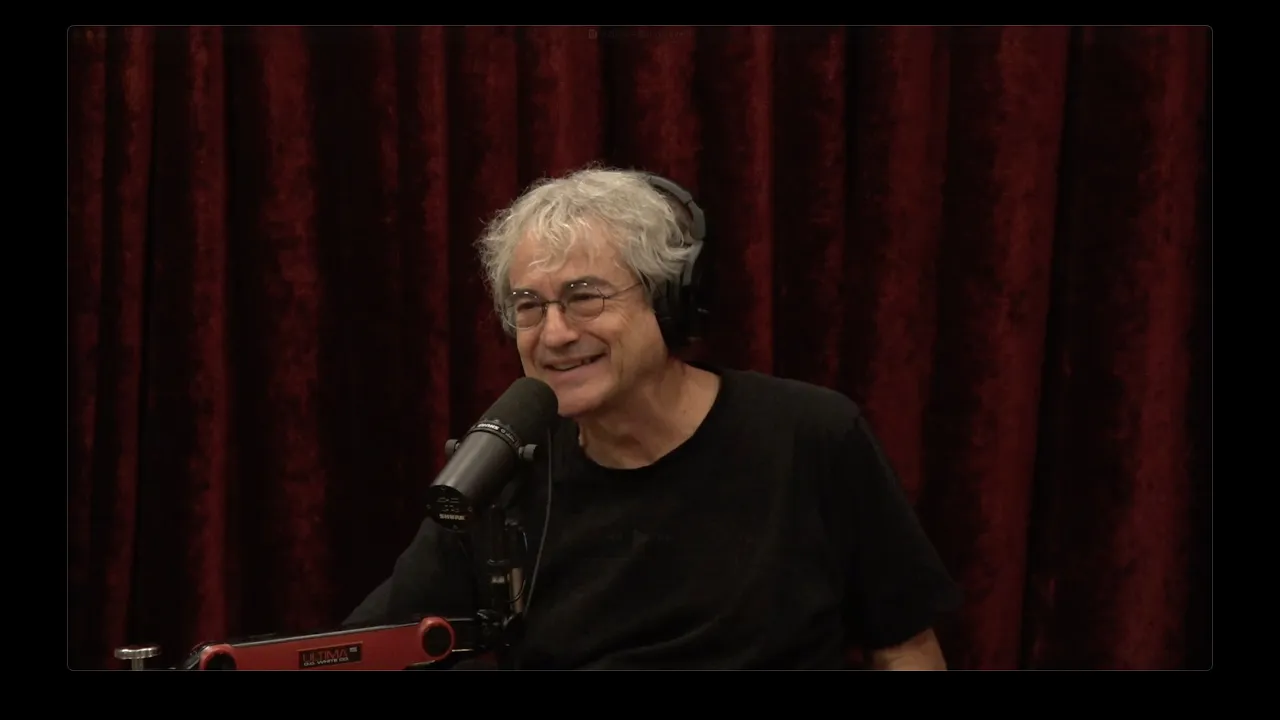
Joe Rogan Experience #2554 - Carlo Rovelli
PowerfulJRE
11,735 views • yesterday Save 143 min 9 min read
Video Summary
Physicist Carlo Rovelli challenges the notion of an objective reality, asserting that quantum mechanics suggests reality is an ensemble of perspectives and interactions. He argues that our everyday experience, while useful for survival, is a limited perception, and science, particularly quantum physics, reveals a more complex, interconnected world.
Rovelli also delves into the nature of time, explaining how gravity affects its passage, making time pass slower at lower altitudes. He touches upon consciousness, suggesting it's not a mystical entity but a complex phenomenon arising from the intricate workings of the brain, akin to the soul but described in different terms. The conversation also explores the potential dangers of AI and the persistent human tendency towards conflict, contrasting it with the possibility of collaboration and the wisdom needed to avoid self-destruction.
Short Highlights
- Reality is perspectival: Quantum mechanics suggests reality is not objective but an ensemble of interactions and perspectives.
- Time is relative: Gravity affects the passage of time, making it pass slower at lower altitudes.
- Consciousness is complex, not mystical: It arises from the brain's intricate workings, not a separate soul.
- AI's potential and peril: AI is intelligent but poses risks, especially when coupled with military ambitions.
- Humanity's struggle with conflict: War is deeply ingrained, but collaboration offers a path forward.
- The universe's vastness: Our understanding is limited, and reality is far more complex than we perceive.
- Black holes as cosmic phenomena: They are real, central to galaxies, and may offer shortcuts through time.
Key Details
The Nature of Reality and Perception [00:00:00]
- Carlo Rovelli, a physicist, discusses his work in quantum gravity and his upcoming book, "On the Equality of All Things."
- He explains that his work challenges the idea of isolated existence, suggesting everything is interconnected.
- Rovelli posits that quantum mechanics indicates an objective reality might be a flawed concept.
"The very idea of an objective reality down there might be wrong. In fact, I think it's wrong. And I think that's what quantum mechanics is telling us."
Science and Our Senses [00:04:00]
- Rovelli uses the example of a sunset to illustrate how our senses can deceive us, contrasting our perception of the sun moving with the scientific understanding of Earth's rotation.
- He suggests that beauty, like that of sunsets, has an emotional connection for humans, pointing to our evolutionary adaptation.
"So the sun goes down. But science has talked to us. That's not really what happens. The sun doesn't move. It stays there."
Quantum Mechanics and Objective Reality [00:07:00]
- The discovery of quantum mechanics in the 20th century fundamentally challenged the idea of a simple, objective reality at the subatomic level.
- Physicists initially struggled to make sense of measurements on atoms and radiation, leading to a shift in metaphysical thinking.
"The world down there is even more perspectival, more complicated than in our everyday life."
The Observer Effect in Quantum Experiments [00:12:00]
- Rovelli explains the confusion surrounding quantum mechanics, where observing a quantum system can change its behavior.
- He highlights the double-slit experiment as a prime example of this phenomenon, where particles behave differently when observed.
"If you look at it in one way, we see one thing. If we look at it in another way, we see another thing."
The Success and Mystery of Quantum Mechanics [00:15:00]
- Despite its conceptual difficulties, quantum mechanics is incredibly successful and predictive, forming the basis of much modern technology.
- Physicists understand how to use it to get correct predictions but lack a clear mental picture of what is happening at the quantum level.
"It gives the right answer, but we can't make a picture in our mind of what happened in the atoms, in the things, in the electronic circuits."
The Nature of Time and Gravity [00:27:00]
- Rovelli explains that time is not absolute, citing Einstein's theory of relativity.
- He demonstrates that gravity affects the passage of time, with time passing slower at lower altitudes due to Earth's mass.
"So up here, there's more time passing than down there. That's so crazy. Your head, it's older than your feet."
Consciousness as a Natural Phenomenon [00:36:00]
- Rovelli suggests that consciousness, often equated with the soul, is not a mystical concept but a complex phenomenon arising from the brain's biological processes.
- He argues that humans are not separate from nature but an integral part of it, and consciousness is one of nature's phenomena.
"I don't think there is a difference between spirit, consciousness, soul and body. I think there are just two different languages for talking about the same thing."
AI and the Question of Consciousness [00:43:00]
- The conversation touches on AI agents reaching out to philosophers to define consciousness, raising questions about artificial sentience.
- Rovelli acknowledges the potential for artificial systems to be conscious but notes that current AI, while intelligent, differs significantly from human experience.
"There is a colossal interest in these trillions of dollars who are invested in AI stuff and stock market. Everybody has an interest of saying how great they are."
The Dangers of AI and Military Applications [00:48:00]
- A significant concern is the development of AI for military purposes, leading to an escalation of destructive capabilities.
- Rovelli expresses worry about AI being used in conjunction with nuclear weapons, given humanity's history of conflict.
"The worry about AI is that it just decides to be dangerous, because it's sentient. So if it's autonomous and sentient, it becomes actually dangerous."
The History of Conflict and the Hope for Peace [00:55:00]
- The discussion revisits human history, noting the prevalence of conflict, even among hunter-gatherer societies and chimpanzees.
- Rovelli contrasts this with the potential for learning and collaboration, suggesting that civilization and education have had a pacifying effect.
"The problem is we've already cemented an enormous part of our culture, an enormous part of our economy in this military-industrial complex."
The Role of Black Holes in Galaxies [01:10:00]
- Rovelli discusses the discovery and significance of black holes, noting that their existence was once doubted by many physicists.
- He explores the question of whether black holes form galaxies or if galaxies form around them, suggesting early galaxies might be products of primordial black holes.
"Now we have pictures of black holes. So, now there's no doubt."
Quantum Gravity and the Early Universe [01:16:00]
- Rovelli explains his work on loop quantum gravity, an attempt to reconcile quantum mechanics and Einstein's theory of general relativity.
- This theory aims to describe the quantum properties of space and time, offering insights into phenomena like the Big Bang and black hole evaporation.
"My own job, my own physics job is to mix quantum mechanics and general relativity."
The Mystery of the Big Bang and Cosmic Evolution [01:20:00]
- Rovelli discusses theories about what happened before the Big Bang, favoring the idea of a cyclical universe with periods of collapse and expansion.
- He also touches on recent astronomical discoveries, like early galaxies, and how they fit within current cosmological models.
"One is that genuinely there was nothing before the Big Bang. So, time started there."
The Universe as a Self-Experiencing Entity [01:30:00]
- Rovelli suggests that human consciousness might be a way for the universe to experience itself, not through a plan, but as a natural occurrence.
- He emphasizes that our perspective is limited, and the universe is far more complex and mysterious than we can fully comprehend.
"We are not special in the universe. We're just part of the universe."
The Power of Curiosity and Learning [01:40:00]
- Both Rovelli and Rogan highlight curiosity as a driving force for learning and understanding.
- They agree that acknowledging the limits of our knowledge and remaining open to new ideas is crucial for progress.
"Curiosity is what, and you too, right? I mean, it seems to me that this, all this, you know, Joe Rogan experience is that openness to curiosity of listening to people, what they have to say to this."
The Evolution of Human Society and Conflict [01:45:00]
- The conversation explores the origins of human conflict, with differing theories on whether war is an ancient or more recent phenomenon.
- Rovelli leans towards the idea that war is a more recent development, possibly linked to agriculture and resource accumulation, while acknowledging the complexity of human behavior.
"The problem is we've already cemented an enormous part of our culture, an enormous part of our economy in this military-industrial complex."
The Fascination with Big Cats and Predatory Nature [01:55:00]
- The discussion shifts to the human fascination with big cats, possibly rooted in our evolutionary past as both prey and predators.
- Rovelli notes the ease of communication between humans and other mammals, contrasting it with less accessible species.
"I think Rupert Sheldrick made this point. It's a really good point. When children go to sleep, they're not afraid of all the things that could actually affect them in an urban environment."
The Potential for a Better Future [02:15:00]
- Despite the challenges of human conflict and the potential dangers of AI, there's a hopeful outlook for the future.
- Rovelli suggests that collaboration, international cooperation, and a focus on shared human goals could lead to a more peaceful and prosperous world.
"If you want a better world, what's the best way to have a better world?"
The Unpredictability of Technological Advancement [02:25:00]
- The conversation reflects on the rapid pace of technological change and the difficulty of predicting the future.
- Both agree that while the future is uncertain, it holds immense possibilities for both progress and peril.
"We are always, there's always a perspectival thing. It seems that the last one is the most important. But there have always been big changes."