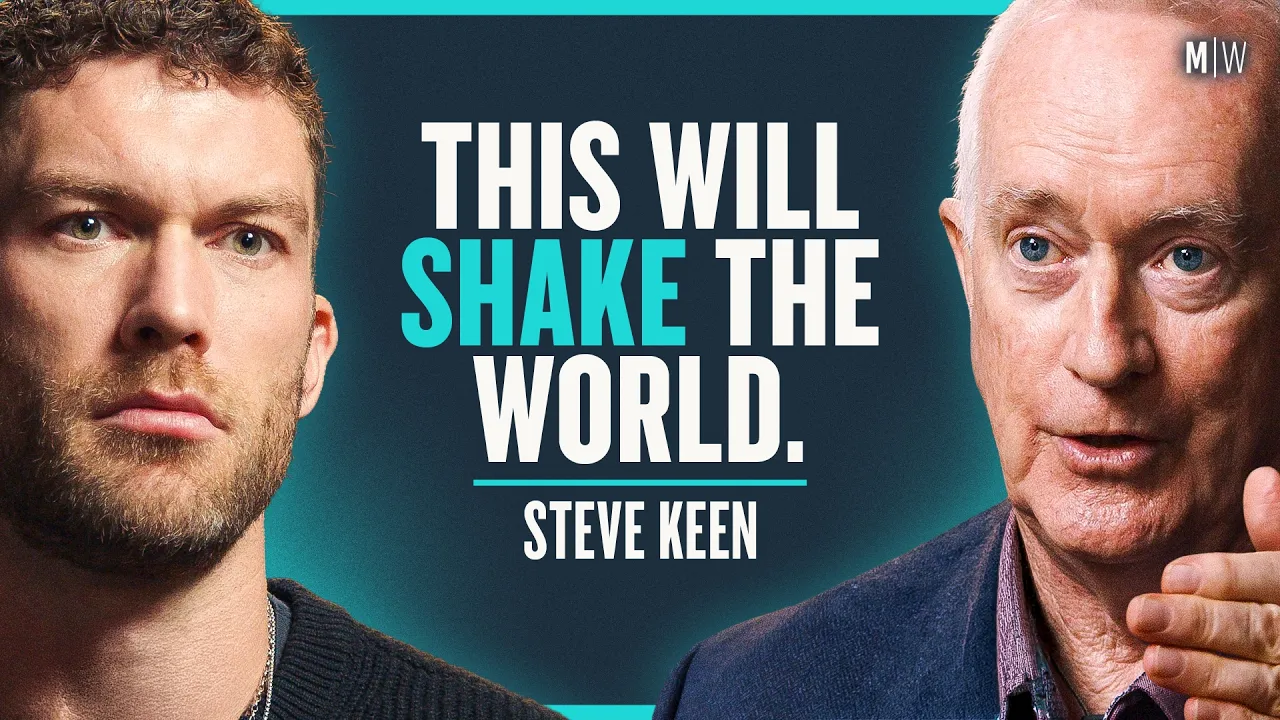
The Perfect Storm Reshaping The Global Economy - Steve Keen (4K)
Chris Williamson
213,840 views • 5 days ago Save 74 min 15 min read
Video Summary
The global economic landscape is in chaos, driven by a confluence of wars, the lingering effects of the 2008 financial crisis, a dramatic shift in global manufacturing from the West to China, and the escalating threat of global warming.
Economist Steve Keen argues that conventional economic theories are failing to address these crises, particularly climate change. He highlights how neoliberal policies since the 1970s, promising growth through deregulation, have instead led to slower per capita income growth and increased precarity for younger generations. This has shifted income from workers to bankers, exacerbating inequality and fueling social unrest. Keen predicts that the current AI investment bubble is unsustainable and will likely lead to a significant economic slump, mirroring past technological booms and busts. He also warns of impending global famines due to disruptions in fertilizer supply chains caused by geopolitical conflicts and the severe, underappreciated threat of climate change, which he believes economists are dangerously misinterpreting.
Short Highlights
- Global Economic Disruption: Wars, the aftermath of the 2008 financial crisis, the rise of China, and global warming are creating a "perfect storm."
- Failure of Neoliberalism: Policies since the 1970s promised growth but delivered slower income increases and greater insecurity for younger generations.
- Worker vs. Banker: Income distribution has shifted from workers to bankers, largely due to rising private debt.
- AI Investment Bubble: The current AI boom is unsustainable and likely to end in a significant economic slump.
- Climate Change Catastrophe: Economists are dangerously underestimating the existential threat of global warming, ignoring scientists' warnings.
- Impending Famines: Geopolitical conflicts are disrupting fertilizer supplies, threatening global food security and potentially leading to widespread famine.
- The UK's Decline: The UK is singled out as an example of de-industrialization and financialization leading to a severe decline in quality of life.
Related Video Summary
- ‘ZOMBIE APOCALYPSE!” Prof Jiang on Biggest Threat To Humanity | Dog Beats Blues With Support Duck
- Is China seeking to copy Iran’s Strait of Hormuz blockade around Taiwan? | 101 East Documentary
- “I’m F—-ing Terrified” - Economist REFUSED To Have Kids Over Climate Change
- Global Meet-Up #8 (Hong Kong): The Occult of the Meritocracy
Key Details
Global Economic Chaos [00:00:00]
- The current global economic environment is chaotic, influenced by ongoing wars, the lingering effects of the 2008 financial crisis, a major shift in manufacturing from the West to China, and global warming.
- El Niño events are being "turbocharged" by global warming, leading to rapid increases in global temperatures.
"And I think you couldn't get more of a perfect storm than what's coming our way right now, including El Nino, of course, being the next major storm."
Economists' Climate Blindness [00:01:30]
- Economists are criticized for producing "bullshit on climate change" and failing to grasp its severity.
- The planet has absorbed 90% of excess heat into the oceans, and El Niño events bring this heat to the surface, significantly raising global temperatures.
- The average global temperature increase, even by a couple of degrees, is a critical issue that economists fail to address.
"Economists don't know that because they produce absolute bullshit on climate change. And that's what I'm trying to expose."
Generational Economic Disparity [00:02:30]
- Young people today face unique financial and economic challenges, particularly regarding housing and job security.
- Compared to previous generations, the current youth face a much tougher economic landscape, despite overall societal improvements.
- The speaker contrasts his own experience in the 1970s, with a 1.5% unemployment rate and job security, to the current situation.
"If I go back to when I was a 20 year old, the unemployment rate in Australia, because I was Australian, at the time I was 18 at university, was one and a half percent."
The Failure of Neoliberalism [00:03:30]
- Since the 1970s, economic management shifted from prioritizing low unemployment to controlling inflation, driven by neoliberal policies.
- The promise of neoliberalism was that deregulation would lead to faster economic growth and higher wages, making social safety nets unnecessary.
- However, per capita income growth has actually fallen since 1975, from approximately 3% to 1% annually.
"The promise of that time, the promise of what we call neoliberal policies, was that the economy will grow so much faster if we get rid of all these terrible government regulations and all those controls, get rid of them, and the economy will grow so much faster and your wages will rise so quickly."
Erosion of Worker Bargaining Power [00:05:30]
- De-unionization and the rise of gig economy jobs have severely weakened workers' bargaining power.
- The promise of deregulation leading to prosperity has resulted in massive insecurity and angst for modern youth.
- The gap between the promises of neoliberal policies and the actual outcomes is a key reason for current youth anger.
"So the promise was that by privatizing and by deregulating and getting rid of government intervention, yada, yada, yada, we ended up in a better world, we ended up in a worse one."
The Unattainable Dream of Homeownership [00:07:00]
- It is now virtually impossible for a single income to support a family and buy a house, unlike in the 1970s.
- Young people are forced into debt for education and housing, excluded from the wealth accumulation experienced by previous generations.
- The housing market has become more profitable to own than to work in, but this is unsustainable as it relies on ever-increasing borrowing.
"You've got to have two income earners. You can't afford to have kids, okay?"
The Housing Market Bubble [00:08:30]
- The housing market's sustainability depends on the ratio of household debt to income continually rising.
- The proportion of the population that can afford a house is shrinking, while the number of people considering mortgages is increasing.
- The belief in indefinitely rising house prices has proven to be a fiction, leading to current price falls and unaffordability.
"Now you have to save for 10 years worth of income to buy that house."
Loss of Worker Bargaining Power and Income Shift [00:10:00]
- Economic growth has stopped translating into improved quality of life for ordinary people primarily because workers have lost bargaining power.
- The "rising tide lifts all boats" argument is false; without bargaining power, workers do not share in economic gains.
- The decline of mass trade unions has left workers unable to bargain effectively against large employers, shifting income distribution from workers to bankers.
"The reality is if you don't have the bargaining power, you don't get to bargain that your boat goes up while the others go down."
The Banker as the True Class Enemy [00:12:00]
- Research indicates that rising private debt leads to a fall in the share of income going to workers.
- Modeling financial instability revealed that as private debt rises, more income goes to bankers, and less to workers.
- Ironically, Marx was correct: the level of investment determines income distribution, and bankers, not capitalists, are the primary beneficiaries of rising debt.
"So the rising level of private debt has actually caused the decline in workers' share of GDP."
The Cost of Raising a Family [00:14:00]
- Many people struggle to maintain their pre-child lifestyle after having children due to increased expenses.
- This is exacerbated by the privatization of services like education and healthcare, which used to be state-funded.
- Real wages for the working class have stagnated for 50 years, making it difficult to afford these new costs.
"What you didn't have to pay for in the past is now coming out of your wage."
The UK's Economic Decline [00:17:00]
- The UK is highlighted as a country that has performed poorly in aligning working people's quality of life with their wages.
- The speaker recounts a personal experience of being a highly paid professor in the UK earning significantly less in real terms than in Australia.
- The UK is described as heading towards "third world status" due to its economic policies and de-industrialization.
"If I had to say any country in Europe is headed towards third world status, it's the UK."
De-industrialization and Financialization [00:20:00]
- The UK's de-industrialization over the past 40-50 years is a primary source of its economic angst.
- The shift to a financialized economy, with money made in services like creating private debt, has not compensated for the decline in manufacturing.
- The myth that services could replace manufacturing has led to a failure to maintain productivity and support the population.
"The industrial might has moved to China. The designers are being done there, not here."
The AI Revolution and its Economic Impact [00:25:00]
- AI is an epochal technology that could automate research and clerical positions, potentially replacing entire social classes.
- This could lead to a need for universal basic income (UBI) or a dystopian scenario akin to "The Hunger Games."
- The speaker predicts the AI investment bubble has less than a year left, based on historical patterns of technological booms and busts.
"And that means that the one reason that workers got employment in the past history of capitalism would cease being how they got employment."
The AI Investment Bubble and Schumpeter's Theory [00:27:00]
- New technologies initially cause economic booms as entrepreneurs borrow money to innovate.
- However, overinvestment and the disruption of existing industries lead to a subsequent slump.
- The current AI investment, estimated at 2-3% of GDP, is substantial and could lead to a significant decline in demand if it halves, similar to the dot-com bubble.
"So boom and bust cycle is a natural part of bringing in a major transformative technology."
The Overestimation of Market Desire [00:30:00]
- Capitalism's lack of central coordination leads to overestimation of market demand for new technologies, with multiple entrepreneurs assuming they will be the sole survivor.
- This creates "hot, bubbly markets" and price inflation.
- Economists' belief in market equilibrium is a myth, and systems like capitalism inherently produce boom and bust cycles.
"What that means is 10 entrepreneurs go into an industry, which is going to support one."
AI's Impact on Production vs. Distribution [00:32:30]
- AI is transformative for production but poses a danger to the demand side of the economy by potentially eliminating jobs.
- The main challenge with AI lies in its impact on income distribution, amplifying the reduction in bargaining power for those without capital.
- If AI eliminates a significant portion of jobs, UBI becomes a necessity.
"So I think the main challenges with AI don't relate so much to how it alters production as how it alters distribution of income."
Government Money Creation and Infrastructure [00:35:00]
- Governments create money, they do not borrow it, challenging conventional economic analogies with households and firms.
- The focus on government inefficiency distracts from the real issues of misplaced priorities, such as funding wars over infrastructure.
- Privatization has been destructive, particularly for long-lasting infrastructure like dams, as private sector incentives prioritize short-term profit over long-term maintenance.
"The whole idea the government is doing excessive spending and excessive debt, yada, yada, yada, that's based on making an analogy between what households and firms are like to what the government is like."
The Existential Threat of Climate Change [00:40:00]
- Economists have dangerously underestimated the impact of global warming, using flawed spatial analysis to predict temporal effects.
- Climate scientists warn of catastrophic and existential risks from warming, while economists predict only minor GDP reductions.
- Politicians, trusting economists, are failing to act decisively, believing the consequences are centuries away, while scientists warn of immediate dangers within decades.
"The economists haven't got a fucking clue. But politicians don't know that, they trust the economists, those are the advisors they turn to."
Climate Models and the AMOC [00:45:00]
- Climate scientists use sophisticated non-linear models, similar to weather forecasts, to predict climate change impacts.
- Research indicates the Atlantic Meridional Overturning Circulation (AMOC) could shut down soon, leading to drastic temperature drops in Europe.
- A shutdown of the AMOC, combined with warming, could lead to a 70% fall in arable land area, causing global famine.
"Now, if that does, the temperature of Europe will fall by 10 degrees Celsius over three decades."
Geopolitical Instability and its Economic Fallout [00:50:00]
- The current geopolitical climate is highly kinetic, dangerous, and unpredictable.
- The war in Iran is a "huge own goal" due to the country's geography, preparedness, and strategic importance.
- The conflict is exacerbating a decline in global fertilizer production, leading to a potential global famine within years.
"So the only thing I can say in favor of him, it's like a wake the fuck up call."
Supply Chain Disruptions: Fertilizer, Helium, and Oil [00:55:00]
- The war in the Middle East is disrupting the supply of fertilizers, essential for global food production.
- Helium, crucial for semiconductor manufacturing, is also affected by the conflict, threatening the production of AI-related hardware.
- The availability of specific types of oil and lubrication oils is impacted, potentially leading to shortages and price hikes.
"So at some point, you won't have enough helium to produce the number of chips that are being demanded."
The Military-Industrial Complex and War [01:00:00]
- The military-industrial complex benefits from wars, as working-class people die while the wealthy profit.
- This complex creates a bias towards conflict and the production of weapons, fostering a climate of fear.
- The war in Iran is seen as a manifestation of this complex, with potential ulterior motives like distracting from political scandals.
"So they actually want wars, because working class people die in wars, rich people make money in wars."
Inequality and Wartime [01:03:00]
- During World War II, inequality decreased due to full employment (military service or factory work) and government price controls.
- The post-war era focused on maintaining full employment and preventing a return to the mass unemployment of the Great Depression.
- The current era has seen a return to the "stupid mentality" that led to the economic crises of the 1920s and 30s.
"The recorded level of unemployment in the United States as a percentage of the population was zero."
Guaranteed Basic Income vs. Universal Basic Income [01:06:00]
- A Guaranteed Basic Income (GBI) provides a safety net for those who lose their jobs, ensuring they can survive.
- UBI, where everyone receives the same amount, could lead to inflation and is only necessary if most people cannot find employment due to automation.
- The speaker advocates for GBI as a more practical solution for the current economic climate.
"So I get a, you know, I get a thousand pounds a month and so does Rupert Murdoch, that sort of thing."
The Future of Work and Human Nature [01:08:00]
- If machines perform all necessary labor, society could become a utopia of philosophers and artists or a psychological disaster.
- Historically, humans lived in smaller communities where status was gained through contribution and generosity.
- Modern society's discombobulation and focus on work for necessity have created a disconnect from our innate social nature.
"So people did things because it gave them status and respect in the community they're in, and you were very tightly bonded with the people you related to."
Redefining Worth Beyond Economic Value [01:11:00]
- Society currently defines personal worth by one's job, rather than passions or interests.
- Questions like "What keeps you busy?" are better alternatives to "What do you do for a living?"
- A future society could focus on pursuits like philosophy, art, or even spectating, rather than solely on economic productivity.
"My favorite question is an alternative to that at a cocktail party is, what keeps you busy?"
Science as a New Religion [01:13:00]
- Humans are more wired for story and archetype than dry scientific facts, which has historically given religion an advantage.
- To gain broader buy-in, science needs to be "sexed up" and presented with compelling narratives and personification.
- Figures like Carl Sagan and the "pale blue dot" image could serve as modern secular icons, emphasizing the preciousness of life and humanity's place in the universe.
"We need a world in which science becomes our religion."
Bitcoin's Unsustainable Energy Consumption [01:17:00]
- Bitcoin's significant energy consumption is a major flaw, especially in the context of impending energy crises.
- The idea of Bitcoin replacing fiat currencies is unrealistic, as it would lead to mass starvation for those without it.
- In a crisis, Bitcoin is likely to be banned to conserve energy, leading to its collapse.
"And I just thought that's just ridiculous in terms of energy."
The Next Five to Ten Years: Crisis and Uncertainty [01:19:00]
- The next few years will likely see significant impacts on productive capabilities due to climate change and geopolitical conflicts.
- Food shortages and potential famines are expected in various regions, including the UK, due to fertilizer scarcity and climate volatility.
- The potential shutdown of the AMOC could signal the end of Western civilization.
"So this is something which we're going to see in the next year. And in some countries, it will lead to mass famines."
Juxtaposition of Futures [01:21:00]
- Humanity stands at a crossroads, with the potential for a bountiful future driven by AI or a disastrous future due to climate damage.
- The resolution of these crises depends on choices made now, highlighting the critical nature of the current historical moment.
"We have these tiny turning points. So we could have gone the AI direction and we have a bountiful future where the machines do the work and we're all philosopher kings."
Where to Find Steve Keen [01:22:30]
- Steve Keen shares his work on YouTube, Patreon, and Substack under the name "Prof. Steve Keen."
- He also offers an online course on S-K-O-O-L, listed as "Steve Keen."
"So YouTube, Patreon, Substack and school."