How Robert Kiyosaki Uses Debt to Build Wealth and Reduce Taxes
The Rich Dad Channel
4,067 views • 23 hours ago Save 26 min 7 min read
Video Summary
Robert Kiyosaki and tax advisor Tom Wheelwright challenge the notion that paying taxes is patriotic, arguing instead that understanding and legally minimizing taxes is key to becoming a capitalist. They posit that the U.S. was founded on a tax revolt and that historical events like the creation of the Federal Reserve and the 16th Amendment in 1913 fundamentally changed the relationship between citizens, debt, and taxes.
Wheelwright, a seasoned tax expert, explains the "cashflow quadrant" where employees and self-employed individuals (E and S) pay the highest tax percentages, often up to 60%, while big businesses (B) pay around 20% and investors (I) can legally pay zero. He emphasizes that tax incentives are essentially a roadmap provided by the government for specific actions like investing in oil, solar energy, or job creation, and that by aligning with these incentives, individuals can significantly reduce their tax burden. Kiyosaki illustrates this by detailing how drilling for oil or leveraging real estate through debt can generate substantial tax-free income, contrasting this with the limitations of traditional retirement accounts like 401(k)s and IRAs.
Short Highlights
- Paying taxes is not patriotic; understanding and legally minimizing taxes is the capitalist way.
- The U.S. was founded on a tax revolt, with 1913 being a pivotal year for the Federal Reserve and the 16th Amendment.
- The "cashflow quadrant" reveals that employees and the self-employed pay the highest taxes, while big business and investors can pay significantly less.
- Tax codes are filled with incentives encouraging specific actions like investing in oil, solar, or job creation.
- Leveraging debt legally, particularly in real estate, can generate substantial tax-free income.
- Traditional retirement accounts like 401(k)s and IRAs have restrictions and do not offer the same tax advantages as direct investments.
- Financial education is crucial for fighting against Marxist principles and achieving financial freedom.
Related Video Summary
Key Details
The Myth of Patriotic Taxation [0:00]
- Robert Kiyosaki challenges the idea that paying taxes is patriotic, calling it a major lie.
- He traces the founding of the U.S. to a tax revolt in 1773, suggesting a historical basis for questioning tax obligations.
- His mentor, Tom Wheelwright, is introduced as an expert in legally avoiding taxes.
"So if you have real red, white and blue blood cursing through your veins and you think paying taxes is patriotic, your blood may turn cold right now because you've been lied to."
Debt and the Existence of Taxes [0:40]
- Taxes can only exist if there is debt, and the U.S. dollar is a form of debt.
- The Federal Reserve, created in 1913, is described as neither federal nor a bank, and its creation coincided with the 16th Amendment allowing taxation.
- Understanding debt and taxes is presented as fundamental to financial education.
"Taxes can only exist unless there's debt. And the US dollar is debt. And the way they pay get the money back is via taxes."
The Cashflow Quadrant and Tax Burdens [2:30]
- Kiyosaki introduces his "cashflow quadrant" concept: E (Employee), S (Self-employed/Specialist), B (Big Business), and I (Investor).
- Employees and the self-employed (E and S) pay the highest taxes, often around 40% or more, with specialists potentially reaching 60% by paying both employee and employer shares.
- Big businesses (B) typically pay around 20%, incentivized by job creation.
"The more degrees you have, the more tax you pay. It's thank God, most of your friends, Tom, are like me see students."
The Investor's Advantage [4:15]
- Investors (I), particularly "inside investors," can legally pay zero tax.
- This is contrasted with public market investments like 401(k)s and IRAs.
- The program aims to educate viewers on how to legally move to the 'I' quadrant.
"So if you enjoy being over here, you can tune out right now. But if you want to find out how to get over here, this is your program."
Tax Cheats vs. Legal Tax Avoidance [5:00]
- Wheelwright identifies the 'S' quadrant (self-employed) as the biggest group of tax cheats, often engaging in illegal practices like not reporting cash income or using dual sets of books.
- This is compared to Al Capone's downfall due to tax evasion.
- The program emphasizes that legal tax reduction is achievable through proper knowledge and advice.
"The biggest crux are on this side here. No, this side. And the legal guys are on this side here."
Tom Wheelwright's Expertise [6:00]
- Wheelwright details his extensive background: accounting degrees, seven years at Ernst & Young, experience as an in-house tax advisor, teaching at Arizona State University, and building CPA firms.
- He highlights that the principles of capitalism and tax reduction are universal, despite people claiming "you can't do that here."
- The core issue is often a mindset problem rather than legal impossibility.
"And everybody comes up to us, no matter what you country are in. And this is pretty universal. Okay. These guys are capitalists. And these guys work for money here."
Capitalism and Incentives [9:00]
- A capitalist commodifies labor, hiring others to make money, which is why they receive tax breaks.
- Governments offer tax incentives for actions they want done, such as creating jobs, investing in specific industries (like oil or solar), or building housing.
- These incentives are a roadmap within the 6,000 pages of tax law, with 99.9% of it being instructional.
"So, so really there's only one line in the tax law that raises revenue. It says all incomes taxable, unless we say it isn't."
Oil Drilling and Real Estate Leverage [13:00]
- Kiyosaki shares an example of drilling for oil, which provided significant tax breaks, allowing him to pay no tax on substantial income.
- This is contrasted with investing in an oil company like Exxon, where the benefit is different.
- Real estate is presented as another avenue for significant tax advantages, using debt and tenant income to generate tax-free cash.
"So if you invest in Exxon, you're not doing anything to produce additional oil. You're just trading in a in a paper asset, right? Just trading in security."
Fighting Marxism with Financial Education [22:00]
- Kiyosaki contrasts capitalism with communism, citing Marx's "Communist Manifesto" and "The Capitalist Manifesto."
- He argues that a heavy or progressive income tax is a tool for communism, while capitalism allows for wealth creation and freedom.
- Financial education is presented as the primary weapon against Marxist ideology, enabling individuals to become capitalists and achieve freedom.
"So if you want to be a communist, you stay on this side here. You want to be a capitalist, you come to this side here."
The Power of Debt and Education [27:00]
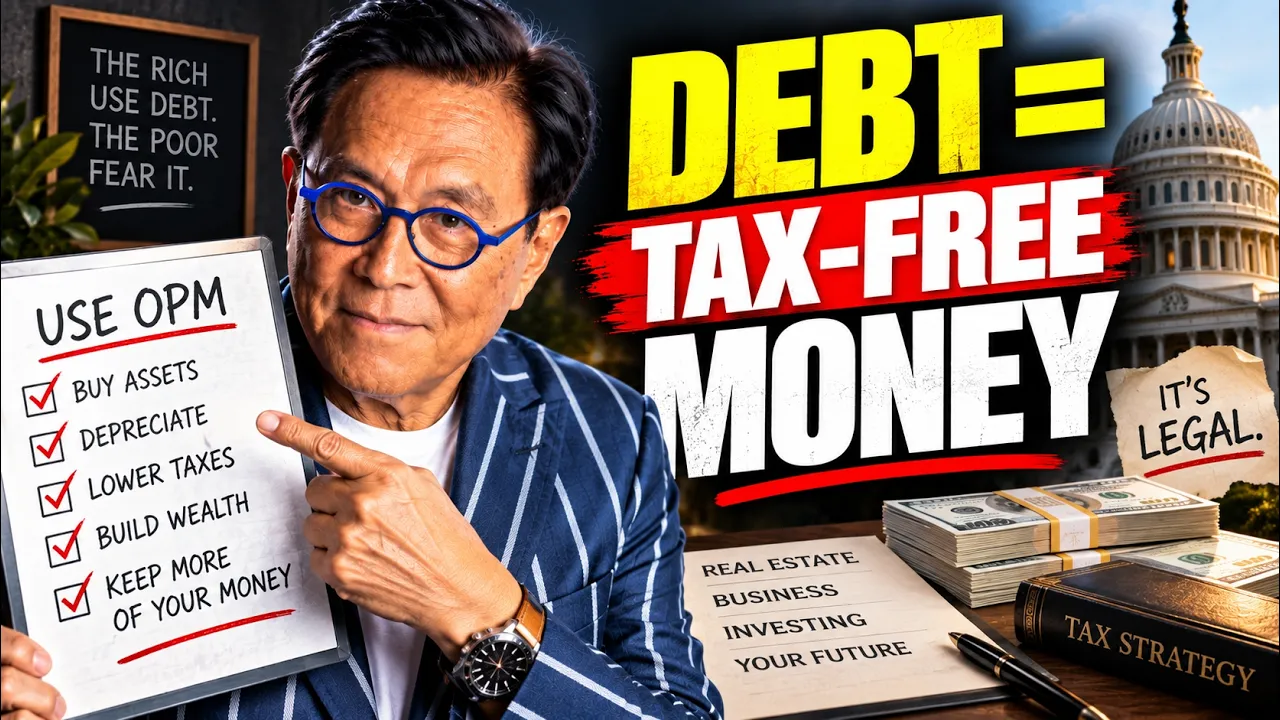
- Kiyosaki explains that he is deeply in debt, but it's "tax-free money" and a strategic capitalist move.
- He contrasts his approach with Dave Ramsey's advice to live debt-free, stating that capitalists want as much legal debt as possible.
- A refinance on an apartment building yielded $2 million in tax-free cash, which Kiyosaki invested in a gold mine.
"The more debt you have, the less tax you pay."
Capitalism Lifts All Boats [30:00]
- Tax incentives, while benefiting individuals, also provide a return on investment for the government.
- Capitalism, unlike communism, offers opportunities for anyone to become rich, regardless of background.
- Financial education is essential for the poor and middle class to participate in capitalism and achieve freedom, preventing them from remaining on the "Marxist side."
"So while the rich are getting richer, so are the poor in the middle class, and they're getting opportunities that they wouldn't otherwise have."