What Really Caused Ethereum's EPIC Rally
Coin Bureau
37,386 views • 1 month ago Save 12 min 4 min read
Video Summary
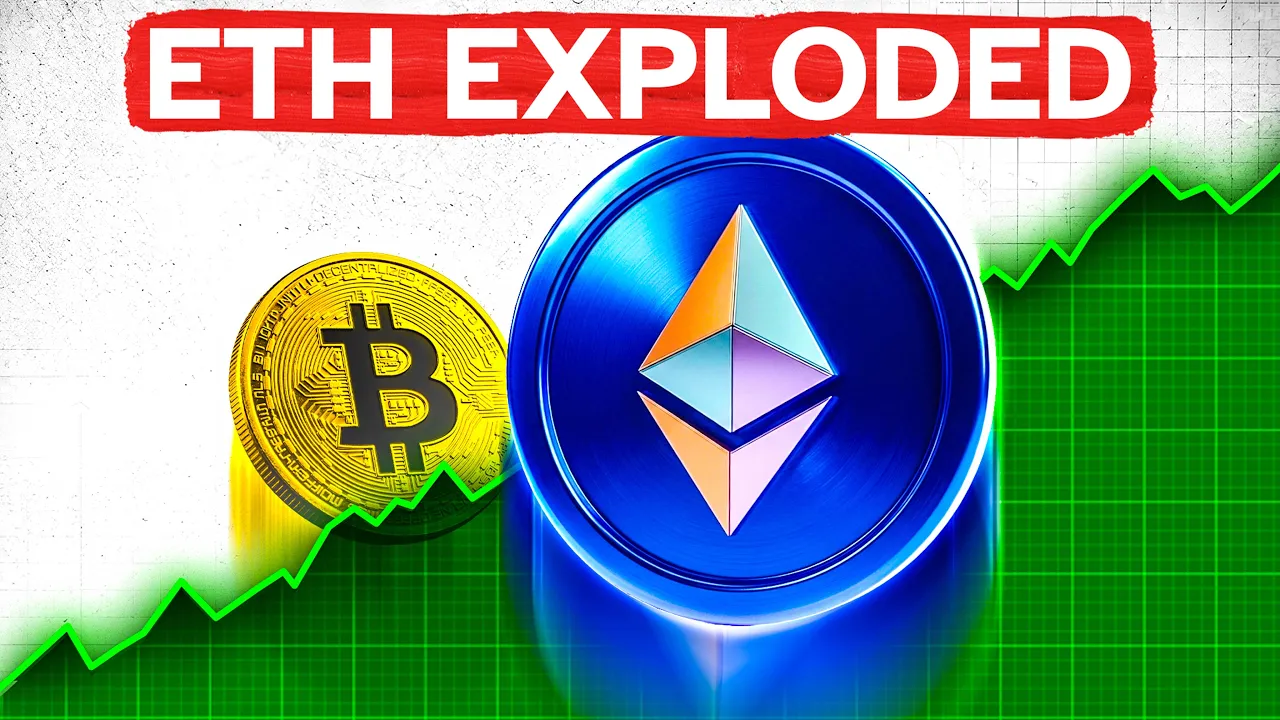
A massive short liquidation event on August 20th saw over $2.7 billion in cryptocurrency positions forcibly closed within 24 hours, with Ethereum accounting for a staggering $1.13 billion. This marked the largest one-sided short liquidation since November 2021, humbling traders who had bet heavily against the market.
The prevailing bearish sentiment, focused on declining Ethereum mainnet activity due to the rise of Layer 2 solutions, missed a crucial point: these lower fees were a planned outcome of Ethereum's ongoing roadmap. Upgrades like EIP-4844 and the upcoming Glamsterdam upgrade are designed to enhance scalability and efficiency, positioning Ethereum as a robust settlement layer for stablecoins and tokenized assets. Meanwhile, the SEC's proposed crypto rulebook could revitalize token launches in the U.S., potentially channeling more capital back to Ethereum.
Short Highlights
- Massive Short Liquidation: Over $2.7 billion in crypto shorts were liquidated in a 24-hour window around August 20th, with Ethereum comprising $1.13 billion of that total.
- Concentrated Shorting: This event was the largest one-sided short liquidation since November 2021, indicating a strong consensus bet against the market.
- Bearish Thesis Flawed: The belief that Ethereum was losing relevance due to Layer 2 solutions was a misinterpretation of its long-term roadmap.
- Technical Upgrades: Ethereum's ongoing upgrades, such as EIP-4844 and the upcoming Glamsterdam, are enhancing its capacity and efficiency.
- Strong Fundamentals: Ethereum's dominance in stablecoin supply and settlement volume, coupled with increasing institutional adoption, underpins its value.
- SEC Rulebook Impact: A new SEC proposal could create a pathway for token launches in the U.S., potentially benefiting Ethereum.
Key Details
The Great Short Squeeze [0:16]
- On August 20th, a trader known as PensionUSDT.eth saw a $24 million short position in ETH liquidated in seconds.
- This was part of a larger cascade where over $2.7 billion in shorts were liquidated within 24 hours, with Ethereum accounting for $1.13 billion.
- The event represented the largest one-sided short liquidation since November 2021, signaling a dramatic reversal of market consensus.
"About $24 million gone, which is about half of everything that trader had ever made shorting crypto, liquidated in four tranches with the final 1,417 ETH absorbed by the exchange's backstop fund."
Anatomy of the Liquidation [1:20]
- The total liquidations reached up to $4 billion over 48 hours, with longs only making up about $300 million.
- A second 24-hour window added another $1.24 billion, with around $1 billion of that being forced short closures.
- While not the largest liquidation event in crypto history by gross dollar terms, its concentration on shorts made it significant.
"Nine out of every $10 liquidated belonged to somebody positioned against the market."
Why Ethereum Bore the Brunt [2:37]
- Ethereum had significant net short open interest relative to Bitcoin, with negative funding rates for weeks.
- Bitcoin had been trading sideways, encouraging systematic traders to fade rallies, while ETH's supply on exchanges had decreased.
- A thin order book and crowded short positioning created a vacuum when buying pressure emerged.
"Less spot ETH sitting on exchanges means less resting supply available to absorb a wave of short covering."
The Misunderstood Bearish Thesis [4:36]
- The bearish argument centered on Layer 2 networks cannibalizing Ethereum's mainnet activity, leading to fewer fees and less ETH burned.
- This thesis contributed to the ETH-BTC ratio hitting its lowest levels in nearly a year.
- While base layer fees had indeed fallen, this was a deliberate outcome of Ethereum's roadmap, not a sign of decline.
"Less activity on the base layer means fewer fees. Fewer fees means less ETH burned. And less ETH burned means Ethereum has no economic engine."
Ethereum's Scalability Roadmap [6:09]
- EIP-4844 made it cheaper for L2s to post data to Ethereum, and the Dencun upgrade (Fusaka) increased data handling capacity.
- These changes led to a more than 90% reduction in transaction fees on major rollups.
- The upcoming Glamsterdam upgrade aims to significantly increase Ethereum's activity handling capacity by raising the gas limit and optimizing transaction processing.
"The goal is to massively increase how much activity Ethereum can handle."
Fundamental Strength and SEC Proposal [9:21]
- Ethereum hosts nearly half of the global stablecoin supply and a significant share of settlement volume.
- Institutional adoption is growing, with substantial ETH holdings in ETFs and staking contracts.
- A new SEC proposal, aiming to create a framework for crypto securities law, could revitalize token launches in the U.S., potentially channeling capital back to Ethereum.
"Simply put, if bullish momentum is truly returning to crypto, both the price action and the fundamentals line up very nicely for ETH."