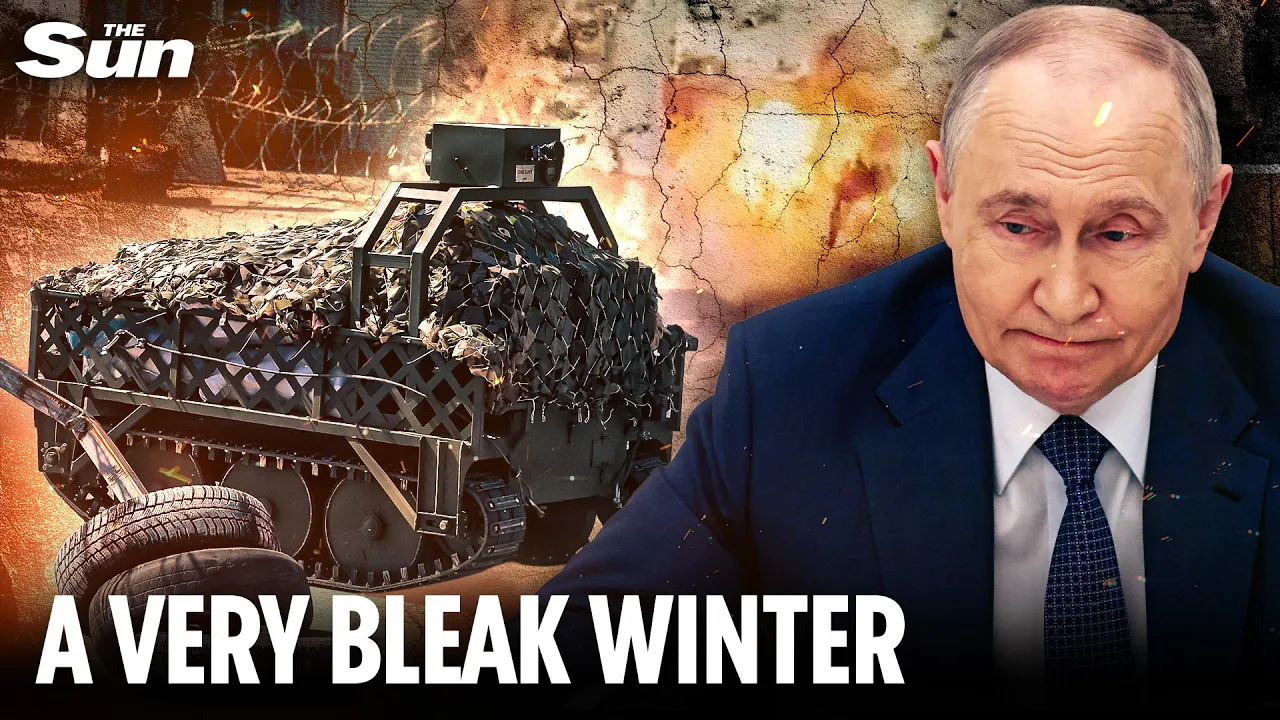
How Operation Vivaldi laid the groundwork for a brutal winter (round 2 will crush Russian troops)
The Sun
20,741 views • 22 hours ago Save 17 min 4 min read
Video Summary
Operation Vivaldi, Ukraine's fifth major counter-offensive, has successfully pushed back Russian forces north of Liman, reclaiming territory despite facing a 10-to-1 numerical disadvantage. This operation exploited a poorly defended Russian salient, leveraging difficult terrain and Russian logistical weaknesses. The success highlights Ukraine's adaptability in 21st-century warfare, particularly in drone utilization and electronic warfare, contrasting sharply with the untrained, poorly supplied Russian 'pedestrians' who suffer disproportionately high casualties.
Ukraine's strategy involved meticulous planning, exploiting Russian disorganization and poor supply lines, and maintaining secrecy to manipulate the Russian information environment. This approach blinds Russian command, preventing effective resource allocation. As winter approaches, Ukraine aims to further isolate Russian forces by targeting river crossings, while Russia faces mounting challenges with deteriorating weather, a depleted logistics fleet, and the ineffectiveness of its vaunted Kinzhal hypersonic missiles, which Ukraine has developed countermeasures against.
Short Highlights
- Operation Vivaldi is Ukraine's fifth major counter-offensive.
- Russia suffers catastrophic casualties, estimated between 1.35 and 1.45 million.
- Ukraine leverages advanced drone warfare and electronic countermeasures.
- Russian forces are described as untrained 'pedestrians' with poor morale and logistics.
- Ukraine's secrecy blinds Russian command, hindering resource allocation.
- Russia's Kinzhal hypersonic missiles have proven ineffective against Ukrainian defenses.
- Winter weather is expected to further hamper Russian logistical capabilities.
Related Video Summary
- Russia begins rationing fuel after massive drone strike as Ukrainian tech trumps Putin’s jet drones
- Storm Shadow strike rocks Russian army HQ and Ozon Warehouses burn as CIA visits Moscow
- British nationals accused of RAF terror plot aren't the only fanatics in the UK | Will Geddes
- The US Dollar Is Being DISMANTLED
Key Details
Operation Vivaldi: A Strategic Success [00:00:00]
- Operation Vivaldi is Ukraine's fifth major counter-offensive, targeting a Russian salient north of Liman that has existed for approximately 24 months.
- Despite facing a 10-to-1 numerical disadvantage, Ukrainian forces have pushed back Russian lines, with some reports indicating contact on the Zerebets River or gains of 75 to 100 square kilometers.
- The operation's success is attributed to Ukraine ceding difficult-to-hold terrain with little cover, which required Russian logistics to cross a river, making them vulnerable.
"Russian numerical superiority in that area of operations was estimated at 10 to 1."
The Changing Face of Warfare [00:01:30]
- This conflict is characterized as the first 21st-century war to see fundamental changes in land and naval warfare tactics, particularly complicating ground maneuver warfare.
- Drones, especially ISR (Intelligence, Surveillance, and Reconnaissance) drones, have revolutionized battlefield intelligence, providing a comprehensive view of operations.
- Drones are described as the "nervous system of the battlefield," enabling both vertical and horizontal communication, allowing trained soldiers to react to information and seize opportunities.
"But the real money shot is the ISR drones. That's intelligence, surveillance, and reconnaissance."
Russian Military's Critical Deficiencies [00:03:00]
- Unlike Ukrainian forces, Russian soldiers are largely untrained, often recruited and sent to the front with minimal preparation, leading to short combat durations.
- Russian troops are characterized as "pedestrians" who are not trained to take initiative and last only an average of 23 minutes in combat.
- The overall Russian casualty figures are staggering, estimated between 1.35 and 1.45 million killed, wounded, and missing, marking a significant disaster in Russian military history.
"You get recruited. You get a seven day bus ride from your recruitment point to Ukraine. They hand you a rifle and you go into combat."
The Impact of Weather and Logistics [00:06:00]
- The onset of autumn and winter in Ukraine will significantly impact battlefield mobility due to rain and mud, further straining Russian logistics.
- Russia has lost nearly 50,000 logistical vehicles, forcing troops to rely on less efficient transport like motorcycles, bicycles, and even donkeys.
- Western armies estimate a combatant requires 5,000 calories daily in winter; failure to supply food will degrade performance, with extreme cold and wet conditions rendering soldiers unable to fight within hours.
"And I'll even go as far as to say, that's why you see Russians using donkeys on a 21st century battlefield."
Ukrainian Tactical Superiority [00:08:30]
- Ukrainian forces excel at reacting to battlefield opportunities at all levels, from squad to battalion.
- The principal weapon on the modern battlefield is identified as the first-person drone, which has been instrumental in inflicting heavy losses on Russian invaders.
- Ukraine's strategy involves attacking where the enemy is weakest, disorganized, and poorly supplied, as demonstrated by the meticulous planning of Operation Vivaldi.
"Because the principal weapon on this 21st century battlefield is no longer the rifle or the indirect fire weapons, mortars, artillery."
Deception and Countering Advanced Weapons [00:11:00]
- Ukraine maintains secrecy around its successes, playing on the Russian military's tendency to inflate battlefield reports to the Kremlin, thus hindering effective Russian resource allocation.
- Ukraine has developed an electronic warfare solution, "Alpha," to counter Russia's Kinzhal hypersonic missiles, forcing them to alter course and break up mid-air.
- The failure of the expensive Kinzhal program has led Russia to repurpose S-400 anti-aircraft missiles as imprecise area-attack weapons, primarily used for terror tactics against civilian areas.
"What Ukraine is doing is playing on the Russian information environment."