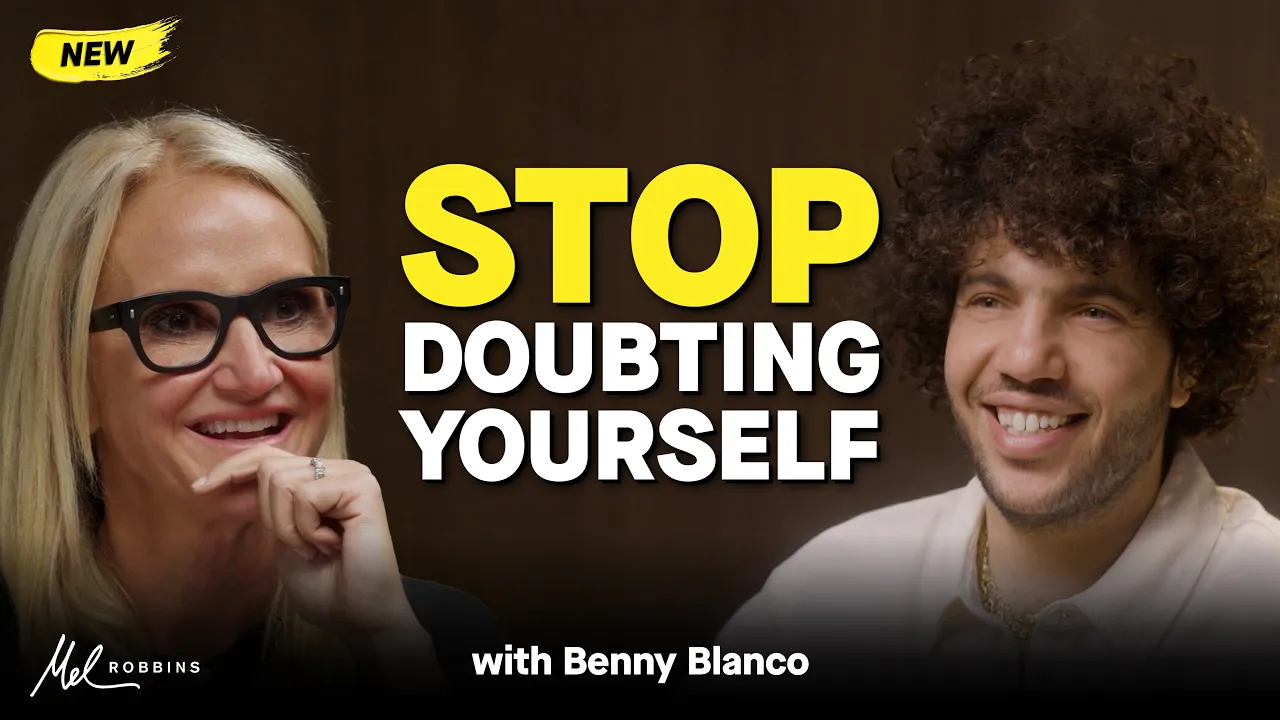
Give Me 60 Minutes and I'll Eliminate Your Self-Doubt Forever | Benny Blanco and Mel Robbins
Mel Robbins
478,957 views • 1 month ago Save 49 min 11 min read
Video Summary
Benny Blanco, the Grammy-nominated songwriter and producer, reveals the secrets to overcoming self-doubt and achieving success. He emphasizes that failure is not an endpoint but a stepping stone, urging listeners to embrace it and learn from setbacks. Blanco shares his own journey, detailing how he overcame imposter syndrome and fear, even developing an "amnesia to failure" to keep moving forward.
He stresses the importance of simply starting, even with small steps, and not waiting for perfect conditions. Blanco illustrates this with his own experiences, from cold-calling record labels as a teenager to his painstaking process of launching his artist project, "East Side." He asserts that consistent effort, resilience in the face of rejection, and a willingness to push through challenges are the true keys to unlocking potential and achieving one's goals. Blanco also touches on the importance of balance, self-awareness, and defining personal success beyond career achievements.
Short Highlights
- Embrace failure as a crucial part of success.
- Overcome self-doubt and imposter syndrome by taking action.
- Start small and consistently move forward, even with tiny steps.
- Don't wait for perfection; begin now.
- Develop "amnesia to failure" to keep pushing forward.
- Success requires hard work and persistence, not innate talent.
- Define success holistically, including relationships and health.
Key Details
The Power of Starting [00:00:00]
- Benny Blanco emphasizes that most people are stopped by "what-ifs" and fear of embarrassment.
- He advises taking small, actionable steps, even just 3.5 inches forward, to begin.
- The initial action might not be the final goal, but it leads to cool opportunities.
"I'm asking you to move it 3 1⁄2 inches forward. So just 3 1⁄2 inches forward today, if you can do that, just start to do it."
Embracing Failure [00:01:47]
- Failure is presented as the key to success, with every hero having failed numerous times.
- Nobody is keeping score of your failures except yourself.
- The advice is to embrace failure and never look back.
"Embrace failure and never look back."
Overcoming Fear of Embarrassment [00:02:38]
- People fear embarrassment, leading to inaction and countless excuses.
- Benny Blanco shares that he fails every single day.
- A friend's advice about "amnesia to failure" highlights forgetting setbacks to move on.
"You have an amnesia to failure, meaning you forget about failure?"
The Blank Board Metaphor [00:03:56]
- Blanco uses a visual metaphor of a board representing failure.
- By "erasing" failures, one can create a blank slate and move forward.
- This symbolizes looking past past mistakes to a fresh start.
"But if we just go like this and we go like that and we go like that and you just pretend that I'm really good at erasing and there's none of those little specks of failure there anymore, right now, we have a blank board."
Success is Not About Innate Talent [00:05:50]
- Blanco asserts he has no special powers and is just a normal guy who works hard.
- He uses Michael Jordan's approach to shooting as an analogy for persistence.
- The key is to keep going despite missed shots or failures.
"I'm just a normal guy who works really hard and gets what I want."
Pushing Through Brick Walls [00:07:00]
- When faced with a "brick wall," most people turn back.
- Blanco's approach is to break through, jump over, or find a way forward, even if it means risk.
- This requires motivation and ignoring naysayers.
"Me, I get to the brick wall and I like, I like, I like throw it to the ground. I run, I jump through it. I might break my neck or something, but I'm going to die trying to do it."
The Self-Imposed Barrier [00:08:15]
- Often, the only person stopping you is yourself, driven by fear.
- The consequence of not starting is simply staying where you are.
- Even if you fall, you can climb back up.
"The only person that's actually stopping you from doing something is you. And you're stopping yourself because you're scared and you don't need to be scared."
Mel Robbins' Personal Struggle [00:09:31]
- Mel Robbins shares her experience of being $800,000 in debt after her husband's business failed.
- She describes hitting rock bottom, blaming others, and feeling disgusted with her stagnation.
- This led to a moment of decision to change her life.
"I literally got just disgusted with myself and the stagnation and the self-loathing that I just had this moment where I just said, if I actually want to change my life, prove it."
The Importance of Showing Up [00:11:00]
- Blanco emphasizes that the first step is simply to show up, even without knowing exactly what to do.
- Consistent presence can lead to opportunities and learning.
- Finding the "room," whether physical or digital, is crucial.
"I just show up, not even, maybe I don't know even what I'm doing, but if I show up and eventually, if I show up, there might not be the other guy there, and they just need the next best thing."
Cold-Calling and Building Relationships [00:13:00]
- Blanco describes cold-calling record labels, pretending to be an associate of famous artists.
- He built relationships with interns and phone answerers, which proved valuable long-term.
- His current manager is someone he met at 16 through these efforts.
"I would call up and I'd say, is Jimmy Iovine there? Jimmy Iovine ran Interscope Records, I'd say, is Jimmy Iovine there?"
The First Step is Today [00:17:00]
- Waiting to feel ready is a common trap that leads to stagnation.
- Success involves going all-in with conviction, even without all the answers.
- The moment before acting is scary, but the decision to "fuck it" and go for it is key.
"You're never going to feel ready to start. If you wait around until you feel prepared or like you have enough experience or like you know how it all works, I will come back to check on you in five years. And you will still be standing exactly where you are right now."
Rejection Isn't the End [00:20:00]
- Blanco asks how badly rejection hurt, suggesting it's often less severe than perceived.
- He argues that rejection is temporary and not a valid excuse for inaction.
- Hardship and failure are expected parts of the process.
"It sucked. It sucked for a second. It wasn't that bad. Okay. So rejection's not that bad. So that's not your excuse."
The Real Cost of Quitting [00:21:40]
- Quitting opens the door for others pursuing the same goal.
- The path to success is often much harder and more exhausting than anticipated.
- Constant effort and pushing through exhaustion are necessary.
"The second you quit, you actually just. Open the door for someone else."
Success Beyond Career Achievements [00:24:00]
- Blanco shares a story about coming home exhausted but still engaging with his wife, Selena.
- He frames this connection as a sign of success, not a failure.
- This highlights the importance of relationships and presence.
"And yet sometimes I come home and I'm exhausted and, and, and I know I have to give that to her because she wasn't, she wasn't part of that day. She, her day is just starting now with me."
The Three Pillars of Life [00:33:00]
- Blanco introduces a "stool" analogy with three legs: family, purpose/impact, and health.
- Neglecting one leg can destabilize the entire life structure.
- Achieving balance among these pillars leads to greater stability and fulfillment.
"Now you have three legs. A stool is made of three legs. Okay. Now, Mel, when you're, when you're thinking of what three things are that make up your life, what, what, what, what are they?"
Timing and Readiness [00:35:00]
- Blanco's relationship with his wife, Selena, developed over 15 years through multiple encounters.
- He emphasizes that timing and personal readiness are crucial for relationships and success.
- Waiting and developing slowly can sometimes lead to a better outcome.
"We always talk about how it never would have worked out if it were at a different time or place in our lives, because neither one of us would have likely been ready."
Defining Your Ideal Partner [00:37:00]
- Blanco created a list with his therapist to define his ideal partner.
- Key criteria included being age-appropriate, nice, compassionate, and generally happy.
- This exercise helps in not settling for less than one deserves.
"First, he said, I want you to write down what you think your ideal partner should be. Okay."
The Actionable First Step [00:41:00]
- Blanco urges listeners to write down something they want to do and focus on one item.
- Create a list of steps needed to move that item forward.
- Take one small step today, not tomorrow, to build momentum.
"And I want you today, not tomorrow, today, go like this and move it even a centimeter forward."
The Secret is Not Quitting [00:43:00]
- Success is guaranteed if you don't quit.
- Failure is only possible if you give up.
- Persistence is the ultimate key.
"It works out if you don't quit. Like, you can't fail if you don't quit. You can't."
Benny Blanco's Journey to Artist [00:27:00]
- Blanco, a successful songwriter, felt stuck and wanted to release his own music.
- He faced numerous rejections and delays in getting his song "East Side" released.
- Despite setbacks, he persisted, eventually collaborating with artists like Halsey and Khalid.
"The Defiant Ones had just come out by, it's a documentary with Dr. Dre and Jimmy Iovine. And I remember sitting backstage at Gillette Stadium with Ed Sheeran, and it was his first time ever playing a stadium show."
The Long Climb to Success [00:31:00]
- "East Side" had the longest climb to number one in radio history.
- This illustrates that success often takes time and sustained effort.
- Blanco emphasizes that he could have given up but chose to keep going.
"And it was the longest climb to number one in radio history. The longest it's ever taken for a song to get from the bottom to the top."
Overcoming Fear of Flying [00:22:00]
- Blanco recounts a terrifying flight experience in 2009 that led to a severe fear of flying.
- He resorted to trains, buses, and even boats to travel for years.
- He eventually forced himself to fly again for his book tour, demonstrating courage despite fear.
"And I remember I took a train home. So I took a train back to New York from Florida. From Florida? Yeah."
Practicing What You Preach [00:23:00]
- Blanco took a seven-and-a-half-day boat trip to London with Ed Sheeran to work on an album.
- This was a conscious effort to overcome his fear and practice what he preaches about facing challenges.
- He acknowledges that the fear still haunts him, but he finds ways to manage it.
"And we watched the Titanic on the boat while we cuddled together. You are a glutton for punishment."
Imposter Syndrome Persists [00:26:00]
- Blanco admits to still experiencing imposter syndrome, even when walking into the podcast studio.
- He questions why people would listen to him, highlighting that self-doubt is common.
- This vulnerability helps listeners realize they are not alone in their struggles.
"I still have imposter syndrome. You? I do."
The Skill is Showing Up Anyway [00:32:00]
- The biggest misconception about success is that it gets easier.
- The true skill is continuing to show up for decades, even when it's hard and you question yourself.
- This consistent effort, not ease, leads to achieving goals.
"The skill is not that you just start and you keep going and then suddenly it gets easier. The actual skill that creates the things that you want is continuing to wake up for decades and not feel like it, continuing to have it be really hard, continuing to question what you're doing."
Defining Life's Goals [00:36:00]
- Blanco wrote a list with his therapist to identify what he wanted in a partner.
- This exercise helped him clarify his needs and avoid settling.
- He advises listeners to create their own lists to understand their desires.
"And we came up with some guidelines and a list. Okay. First, he said, I want you to write down what you think your ideal partner should be. Okay."
Be Yourself [00:44:00]
- Blanco's parting words encourage listeners to pursue what fulfills them.
- He advises against blindly following societal norms or textbook advice.
- Being authentic is essential, as everyone else is already taken.
"Try to do what you want. That's going to like fulfill you and don't just go along with what you were taught to by like some archaic thing in a textbook and yeah, be yourself because everyone else is taken."