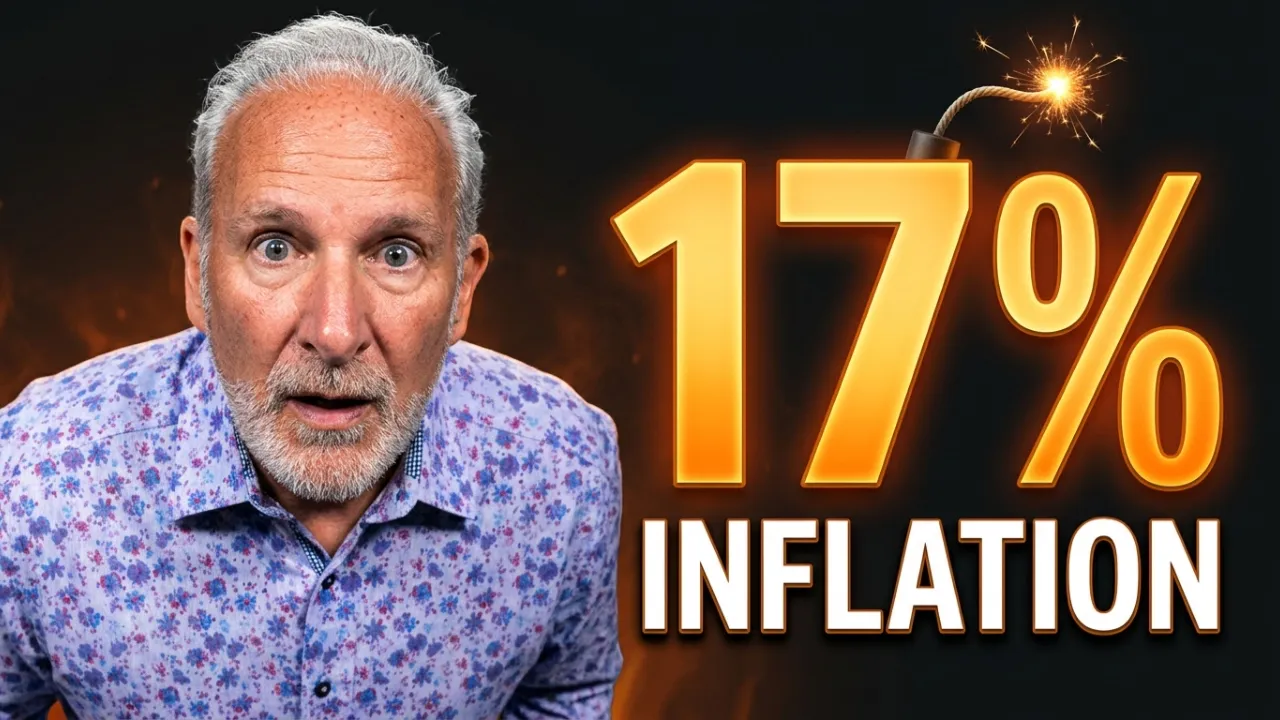
2008 and 2021 Are Hitting at the Same Time... The Inflation Bomb Is Lit
Peter Schiff
187,905 views • 6 days ago Save 56 min 5 min read
Video Summary
The U.S. is facing a dual crisis of soaring inflation and a collapsing housing market, mirroring conditions seen before the 2008 financial crisis and the 2021 inflationary surge, but occurring simultaneously.
Producer prices have surged by 1.3% in one month, annualizing to 17%, while export prices jumped 2.2%, exceeding the annual inflation target in a single month and annualizing to 30%. This inflationary pressure, coupled with a housing market slump where pending home sales are at historic lows and new homes are selling for less than existing ones, signals a severe economic downturn. The speaker warns that the cost of living crisis is set to worsen dramatically, exacerbated by government policies and a Federal Reserve that has been slow to react, potentially leading to a financial and currency crisis far exceeding that of 2008.
Short Highlights
- Inflationary pressures are escalating rapidly, with producer prices up 1.3% in one month (annualizing to 17%) and export prices up 2.2% (annualizing to 30%).
- The housing market shows alarming signs of collapse, with pending home sales at historic lows and new homes priced below existing ones.
- Government policies, including massive monetary and fiscal stimulus during COVID-19, are identified as the root cause of the current inflation.
- The Federal Reserve's response has been inadequate, characterized by a slow reaction and a
Key Details
Inflationary Pressures Mount [0:00]
- Producer Price Index (PPI) for September increased by 1.3% month-over-month, which annualizes to 17%.
- Export prices saw a significant rise of 2.2% in one month, exceeding the 2% annual inflation target.
- This surge in export prices annualizes to a staggering 30% inflation rate.
"But look at the export prices, up 2.2%. That's more than the entire 2% one-year inflation target in a single month. That annualizes to 30% inflation."
Oil Prices and Commodity Surge [0:38]
- Oil prices reached a new five-month high of $110 per barrel.
- Forecasts suggest oil prices could climb towards $150 and beyond.
- The price increases are expected to extend beyond oil to all energy-related commodities.
"Oil prices hit a new five-month high today. We've hit $110 a barrel. So oil prices are going to go up towards $150 and then higher."
Housing Market Echoes 2007 [1:00]
- Current housing data is described as alarmingly poor, reminiscent of 2007, prior to the financial crisis.
- The situation suggests a parallel to the 2008 housing market crisis is unfolding concurrently with inflation issues.
"The housing data is so bad. It reminds me of 2007, before we had a financial crisis."
Historical Parallels and Complacency [1:25]
- The current economic climate evokes memories of past periods where warnings were ignored due to mainstream complacency.
- These parallels are drawn for both inflation and housing market trends.
"This relates to both inflation and housing. And I'm going to start with inflation."
Early Inflation Indicators Ignored [1:55]
- The period of late 2020 to early 2021 saw rising CPI, PPI, and import-export prices.
- Producer and import-export prices showed larger increases than CPI, serving as leading indicators.
- Import-export prices were considered more reliable due to less subjective manipulation.
"We talked about the CPI numbers on the podcast. We hadn't gotten the PPI numbers or the import-export prices. They came out the following two days."
Federal Reserve's Inflation Averaging Target [2:45]
- During Trump's presidency, rising inflation was met with the Fed's adoption of an inflation averaging target.
- This policy aimed to allow inflation to rise above 2% to compensate for past periods of low inflation.
- The speaker criticizes this justification as nonsensical.
"And nobody thought it was of any concern. In fact, that's when the Fed initially adopted its inflation averaging target because inflation rose above 2%, even as measured by the CPI."
Critiques of Fed's Inflation Averaging [3:30]
- The Fed's justification for targeting 2% inflation included avoiding deflation.
- The speaker argues that avoiding deflation in prior years meant there was no need to "make up" for low inflation.
- The inflation averaging policy is seen as an excuse not to tighten monetary policy.
"And again, one of the other reasons that I remember was a bogus justification for targeting 2% inflation is the Fed said, we want to make sure that we don't have deflation."
Unleashing Inflationary Policies [4:50]
- The most inflationary monetary and fiscal policies in U.S. history were enacted during the COVID-19 pandemic.
- This unleashed inflationary pressures, which should not have been a surprise.
"And I was talking about this. I called this out. Remember, most of the mainstream economists and strategists, when they looked at the pandemic, they thought it was deflationary."
Pandemic Stimulus and Inflationary Impact [5:15]
- Contrary to deflationary expectations, the pandemic stimulus was highly inflationary.
- Enhanced unemployment benefits exceeded previous earnings, incentivizing not working.
- Government money flooded consumers, leading to increased spending without corresponding production.
"The government replaced their paycheck with unemployment benefits that exceeded what they were earning. This was for the first time ever where it was better to lose your job than have your job because you actually got more money being unemployed than you got working."
Unprecedented Fiscal and Monetary Expansion [6:30]
- Government actions, including rent and student loan payment freezes, freed up massive amounts of money for spending.
- The Paycheck Protection Program (PPP) provided


