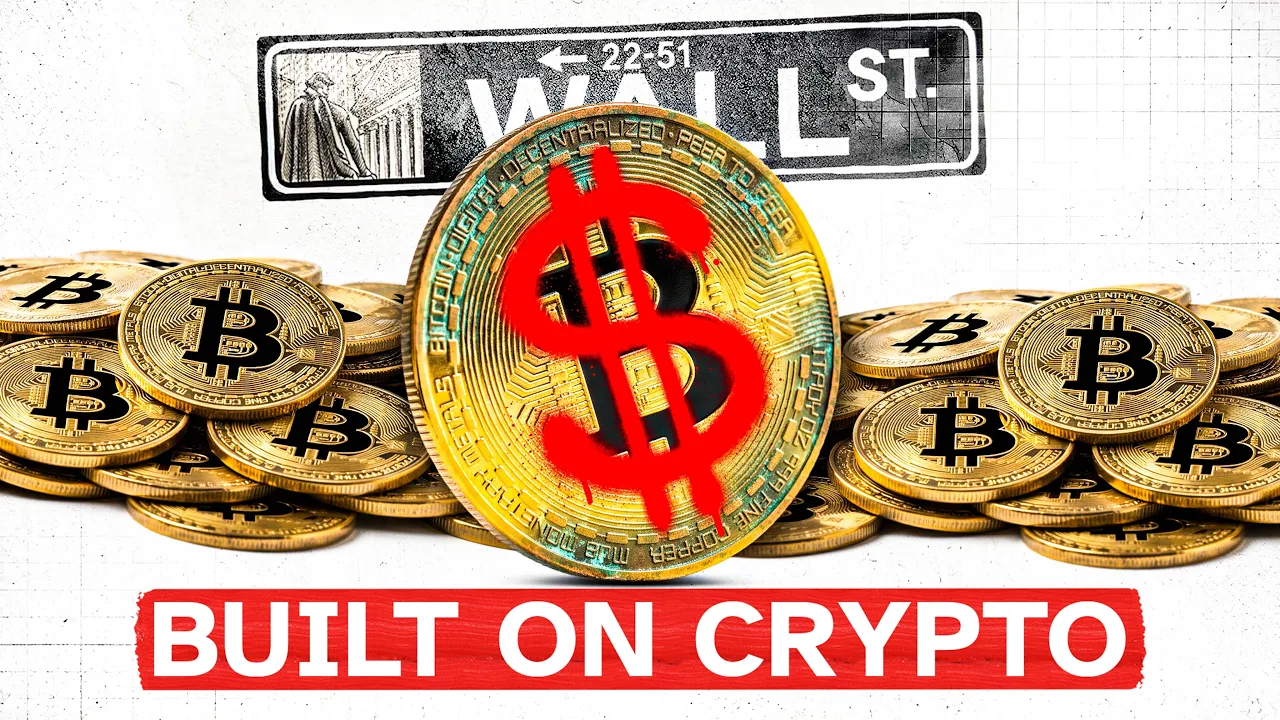
‘40-50% Stock Market Crash Coming’: This Is Your Last Exit | Edward Dowd & Michelle Makori
Miles Franklin Media
262,333 views • 5 months ago Save 43 min 15 min read
Video Summary
The video discusses significant economic risks, primarily focusing on a potential market downturn of 40-50%, comparable to the Great Financial Crisis and dot-com bubble. Key concerns include an overvalued housing market (30% overvalued), a bursting AI bubble, and a deteriorating Chinese economy. The speaker argues that geopolitical tensions, like the Iran war, add to existing risks but do not change the underlying economic cycle, which has already turned. The private credit market is highlighted as the first indicator of trouble, effectively frozen and poised to spread contraction. Furthermore, the video touches on the Federal Reserve's difficult position with inflation and oil price shocks, and the notion of gold being suppressed.
An interesting fact from the video is that China's GDP, priced in dollars, has shrunk to 60% of the US's since COVID, with effectively zero growth in dollar terms despite reported growth figures.
Short Highlights
- A market correction of 40-50% is predicted, akin to the Great Financial Crisis and dot-com bubble.
- Home prices are 30% overvalued, with the housing market showing signs of rolling over, representing 20% of the US economy.
- The AI bubble is suspected to be in the process of bursting, with financing costs rising and revenue not matching investment.
- China is identified as a significant, overlooked problem, with its GDP priced in dollars now at 60% of the US's and effectively zero growth.
- The private credit market is frozen, acting as the first canary in the coal mine for a broader credit contraction.
- Geopolitical events like the Iran war add new risks but do not alter the fundamental economic cycle that has already turned.
- The Federal Reserve is in a difficult position, unable to effectively combat inflation without exacerbating economic contraction.
- A 40-50% stock market drawdown could take two years, and it takes a 100% gain to recover from a 50% loss.
- Gold is viewed as a long-term buy opportunity, potentially reaching $10,000 by 2030, despite short-term price suppression.
- China's demographic decline and reliance on exports are driving deflationary pressures globally.
Key Details
Market Downturn Forecast [0:00]
- The speaker predicts a market downturn of at least 40-50%, comparable to the Great Financial Crisis and the dot-com bubble.
- If the correction exceeds 50%, significant problems are anticipated.
- These risks have not diminished; the Iran war introduces an additional layer of risk.
- The AI bubble is believed to be already bursting.
- Home prices are 30% overvalued, with signs of the housing market weakening, which accounts for 20% of the US economy.
- Private credit is frozen, signaling an impending credit contraction that will spread.
- China is considered a major, underdiscussed problem, contrary to narratives of its overtaking the US.
- The speaker anticipates wishing for cash if a 40-50% correction occurs.
"So, if my forecasts are right, a minimum of a 40 to 50. If it's more than 50, we got problems."
Core Macro Thesis and Identified Risks [02:39]
- The core thesis centers on the US and global economies entering an early phase of a downturn, with a recession potentially occurring in 2026.
- This assessment was made before the Iran war, which only adds to the existing risks.
- Three primary risks identified:
- Housing Market: Home prices are 30% overvalued, and the market is showing signs of decline. This sector represents 20% of the US economy and is expected to create recessionary problems.
- AI Bubble: Stock market valuations are at dot-com levels, implying potential for zero 10-year forward returns and a significant drawdown. The AI bubble is already in the process of bursting.
- China's Economy: China has been experiencing a real estate problem since 2020-2021, with the acute phase now occurring, leading to serious economic issues projected into 2026.
- These factors combined point to a global slowdown, a growth recession, and increasing deflationary forces, which the war is likely to accelerate.
- Even without the conflict, the underlying economic cycle has turned, and markets are unprepared.
"So, we're already in motion before the war."
Housing Market Weakness and Dynamics [05:18]
- Housing is considered the backbone of the thesis and the "canary in the coal mine," already showing cracks.
- The COVID era saw a tremendous housing bubble fueled by the Fed's liquidity injections and the reissuance of mortgage-backed securities.
- Rapid interest rate hikes by the Fed from zero to 5.5% have impacted new housing starts and permits since 2022.
- An influx of illegal immigrants initially supported the rental market, but home prices have stagnated in real terms and are now declining, particularly in the Southeast.
- Rents are plummeting, signaling further declines in home prices, especially in the Northeast as economic problems intensify.
- The real estate market is described as "dead," with a significant gap between homes for sale and homes sold (around 600,000), which will only close through price reductions.
- Data indicates nearly 630,000 more sellers than buyers in the US housing market, the largest gap since 2013, though this doesn't reflect true affordability for Americans due to rising prices and uncertainty.
- A stalemate exists between sellers unwilling to lower prices and potential buyers, which will likely break due to time and worsening economic fundamentals, particularly if the stock market bubble bursts.
- Homes are estimated to be 30% overvalued due to stagnant income growth and rising costs of ownership (real estate taxes, insurance).
- Mortgage rates are less critical than price adjustments; they will only stimulate recovery when significantly lower, coinciding with Fed rate cuts.
"The only thing that fixes this is price. And eventually price will will will come lower."
Systemic Risks and the 18-Year Housing Cycle [09:52]
- The current housing situation is problematic, but not necessarily a systemic risk like in 2008.
- There is a natural 18-year housing cycle, with the last one peaking 18 years ago, pointing towards a cycle peak in 2026.
- Demographic shifts, with a retiring and dying baby boomer generation, are leading to more homes coming to market via estate sales with fewer buyers.
- The US overbuilt during the COVID boom, now facing approximately 9.7 months of new home supply, a level seen leading into the 2008 crisis.
- Job growth figures over the last couple of years are considered "fictional," with non-farm payrolls repeatedly revised downwards, indicating a non-robust economy.
- The average consumer is struggling and cannot afford homes, leading to a stalemate that will eventually break with price adjustments.
- A twin problem of a deflating stock market and housing market could feed on each other.
- Loan growth in the past two years has largely gone to non-depository financial institutions (private credit and private equity).
- This private credit market began to freeze before the war due to opaque and risky loans, with JP Morgan marking down loan values and restricting credit, signaling a broader freeze.
- This situation mirrors the subprime market issues in 2007, where a frozen market led to credit contraction spreading across the economy.
"Private credit is the first canary in the coal mine. It's frozen effectively and that credit contraction will spread."
The Fed's Dilemma and Intervention [13:01]
- The oil price shock puts the Fed in a difficult position, as cutting rates would typically help with housing and private credit but could also fuel inflation.
- Before the oil shock, the Fed was estimated to be 100 basis points too tight.
- The oil price shock makes the Fed ill-equipped to act; holding rates is contractionary given the shock.
- Raising rates would hasten a deflationary bust, while cutting rates risks stoking inflation.
- The Fed's only immediate option is to wait for credit markets to break before easing policy.
- Government intervention via Fannie Mae and Freddie Mac to buy $200 billion in MBS is seen as a "drop in the bucket" and insufficient to address the core affordability issue, which is driven by prices being 30% too high relative to incomes.
- The total cost of ownership, including insurance and taxes, has also doubled, exacerbating the affordability problem.
- A booming jobs market and growing incomes are needed to fix the housing market, but the trend is the opposite.
"The Fed by doing nothing actually got money got tighter and it's going to get it's going to it's going to exacerbate throughout the economy."
AI Bubble and Its Implications [16:33]
- AI was a growth engine for the market in the past year, but that story is now cracking.
- The NASDAQ has traded sideways for months, indicating a loss of upward momentum.
- Financing markets are questioning the AI ecosystem, with rising costs of financing (e.g., Oracle's rising CDS, Coreweave's issues).
- OpenAI has faced financing difficulties, highlighting the tightening credit environment for AI companies.
- Similar to the dot-com bubble, capital expenditure (capex) funded by debt is crucial for AI growth.
- Many competing AI models are becoming commodities, requiring massive investment with revenues not matching investor expectations.
- Debt markets are the first to reflect these issues, leading to higher expected returns for investors.
- OpenAI is reportedly seeking $4 billion at a high 17.5% guaranteed return, indicating expensive capital.
- A significant bottleneck for AI infrastructure buildout is the lack of power and water, in addition to chip supply.
- Pausing capex spending will reverberate through the economy and likely lead to a bubble collapse.
- A bubble collapse means a sell-off in stocks, potential business shutdowns, and investors losing money.
- Assets from failed companies will be acquired by others, similar to the dark fiber companies after the internet bubble.
- AI is here to stay, but the initial hype cycle is ending, similar to past tech cycles where later-stage companies (e.g., Google, Facebook) emerged stronger after the bust.
- Nvidia, a public-facing AI bubble poster child, is expected to eventually miss earnings like Cisco did during the telecom boom and its stock to decline significantly.
"So what's going to happen is there's going to be a bursting of the uh speculative investment. People will get hurt."
Stock Market Outlook and Economic Environment [26:05]
- The stock market is considered overvalued with bubble valuations, poised for a decline as capital flows reverse and multiples contract.
- The beginning of an economic cycle, characterized by companies missing earnings, layoffs, and decreased expectations, is expected.
- Layoffs in big tech are already occurring, partly due to AI capex crowding out other budgets, though companies claim AI is replacing human roles.
- Job growth has been poor for the past two years, and the average consumer is struggling, often working multiple gigs to make ends meet.
- A recession (two quarters of negative GDP growth) is considered baked in and will likely be accelerated by the oil price shock.
- The oil price shock will cause a temporary price increase (inflation), followed by demand destruction, a recession, and then deflation as people lose jobs and reduce spending.
- Corporate margins will be squeezed as costs rise but cannot be fully passed on to consumers, leading to more layoffs.
- A 40-50% stock market drawdown is anticipated, potentially over two years, similar to the dot-com bust.
- The Fed might intervene to prevent extreme declines, but the underlying structural issues (stock market bubble, housing problem) remain.
- A 50% market drop requires a 100% gain to break even, making prior gains vulnerable.
"So, if my forecasts are right, a minimum of a 40 to 50. If it's more than 50, we got problems because the investment math gets even more scary the lower you go."
Best-Case Scenario and Market Reaction [31:51]
- In a best-case scenario where the Iran conflict resolves quickly and favorably, a massive relief rally in oil and stocks is expected, potentially leading to brief new all-time highs.
- However, structurally, the issues in private credit, housing, and China will remain unresolved.
- This rally would be an opportunity to raise cash, as many on Wall Street see the same structural issues and plan to "fade" (sell into) the rally.
- This suggests that even positive geopolitical news may not fundamentally alter the negative economic outlook.
"So, if we get a rally, they plan on uh fading that because they see the same structural issues that I do."
China's Economic Challenges and Global Impact [34:05]
- China's economic situation is significantly weaker than perceived.
- Prior to 2020, China's GDP was 80% of the US's in dollar terms, with projections of overtaking the US.
- Since 2020, China hit a demographic wall, with its working-age population declining significantly.
- This demographic shift has impacted its real estate market, which began its decline in 2021, with housing starts down 70%.
- While construction had held up due to long-term projects and exports, new construction contracts are now falling sharply.
- China's internal net fixed investment growth has fallen below zero year-over-year for the first time, a stark indicator of internal economic contraction.
- China's GDP priced in dollars is now only 60% of the US's, with effectively zero growth in dollar terms.
- The utility power consumption growth is also rolling over, threatening to go below zero for the first time.
- The narrative of China overtaking the US is false; they are in deep trouble with demographic decline and a massive debt problem.
- China is exporting deflationary pressures globally to sustain its economy, leading to trade wars.
- The "de-dollarization" narrative is unlikely to succeed as China's economy is too weak and its currency is depreciating.
- Gold will be part of a new monetary system, but China will play a small role.
- China's situation is 10 times the size of Japan's, meaning the implications of exporting deflation are severe for the world.
"They are in deep deep trouble. Their demog demographic decline is pretty stark and amazing."
Gold's Performance and Future Outlook [40:51]
- Gold has experienced a significant run-up and subsequent pullback, with weak hands exiting positions and liquidity concerns amid the Middle East conflict.
- Despite short-term price suppression and liquidity crunches causing asset sales, gold is viewed as a long-term buying opportunity.
- Central bank buying and demand from various sources suggest a long-term bullish outlook, with a potential target of $10,000 by 2030.
- The current pullback is compared to the Great Financial Crisis, where gold also fell before reaching new highs.
- Gold's price is influenced by dollar strength; the dollar has rallied during the war as it was oversold, but the long-term sovereign debt bubble suggests gold's role in a new monetary system is assured.
- The speaker believes gold is part of the solution to the global sovereign debt crisis and advises owning, not trading, gold, suggesting it should be 5-10% of long-term assets.
- While manipulation in financial markets exists, it cannot continue indefinitely.
"Long term, if I look at the charts and know what is going on behind the scenes with gold and central bank buying, I view this as a buying opportunity."
Geopolitical Conflict and Economic Cycles [46:11]
- The US will not relinquish dollar dominance without a fight.
- The credit creation system requires constant growth, and crises are escalating.
- The timing of the Iran war is suspicious, occurring just as private credit markets began experiencing serious problems.
- The war may serve as cover for financial collapse and justify increased spending and liquidity injections to keep the credit system alive.
- Funding a prolonged war will require trillions in debt, which could sustain the system but still necessitate a reset.
- The conflict is seen as a mechanism to "kick the can down the road."
- While a systemic collapse like 2008 is not predicted, some bank consolidation is possible.
- A significant drawndown in the stock market is viewed as a necessary "reset and reclensing."
"So, you know, we need what we need even more credit creation. So, one way to do that is happen have a war."
War Escalation and Market Impact [48:43]
- The speaker's "spidey senses" suggest the conflict will likely extend, despite news of potential peace plans.
- Ground troops moving into the war scenario indicate a potential for prolonged engagement.
- A perceived victory for the US could strengthen the dollar, as it is backed by military power and the ability to maintain sea lanes.
- A stronger dollar narrative would not necessarily hinder gold's long-term bull market, as other global economies face severe debt and demographic issues.
- Even with a near-term rally from positive war news, it would be an opportunity to derisk, not a confirmation of fundamental strength.
- The cycles predicted are not predicated on geopolitical conflict and are already in motion.
"So, if you get a relief rally and you believe what I'm saying, I'd use it as an opportunity to raise cash."
Extreme Positioning and Capital Preservation [52:30]
- The speaker is currently positioned in cash, gold, and long bonds, with zero equity exposure, which is an extreme stance.
- This strategy prioritizes the "return of capital" over the "return on capital," especially given the current environment and past issues with private credit funds that failed to mark to market.
- The advice for the average person is to increase cash holdings (e.g., to 40-50%) rather than attempting to short the market, which is difficult and often leads to being early and wrong.
- Holding cash, while seemingly losing purchasing power daily, becomes crucial during significant market downturns.
- Opportunities will abound on the other side of a market washout, but liquidity will be key.
- The highest conviction assets for outperformance by the end of 2026 are cash and the 30-year bond.
"Cash is trash until it isn't. When it isn't, you want to be there."