I’ve Wanted This Robot for 10 Years
Linus Tech Tips
974,729 views • yesterday Save 9 min 4 min read
Video Summary
A year-long wait culminates in the unboxing of a high-tech badminton training robot, promising to revolutionize practice by offering unparalleled accuracy and complex pattern drills.
This advanced feeding machine, controlled via a tablet and app, boasts a 360-shuttle capacity and dual feeders for enhanced flexibility. Despite initial setup complexities and the significant ongoing cost of shuttlecocks—estimated at $2,000 for a master carton—the robot's precision in replicating human-like feeds, even at high speeds, impresses early testers. The technology aims to overcome the limitations of human coaches, providing consistent, repeatable, and challenging practice scenarios previously unattainable.
Short Highlights
- Advanced Training Capabilities: The robot offers precise, repeatable shuttlecock feeds with customizable patterns, speeds, and heights, surpassing human limitations.
- High Capacity and Dual Feeders: It holds 360 shuttlecocks and features two feeders, enabling faster feeds and more complex training sequences.
- Tablet Control and App Integration: A touchscreen interface and app allow for programming and adjusting various training parameters.
- Shuttlecock Cost: The ongoing expense of shuttlecocks is significant, with an estimated $2,000 cost for a master carton.
- Durability and Design: The machine incorporates features like chain-driven mechanisms and delicate gripper surfaces to handle fragile shuttlecocks.
- Setup and Operation: Initial setup involves connecting devices and placing the machine correctly, followed by selecting or programming training patterns.
- Performance: The robot demonstrates remarkable accuracy, hitting specific court locations consistently, even at high speeds.
Key Details
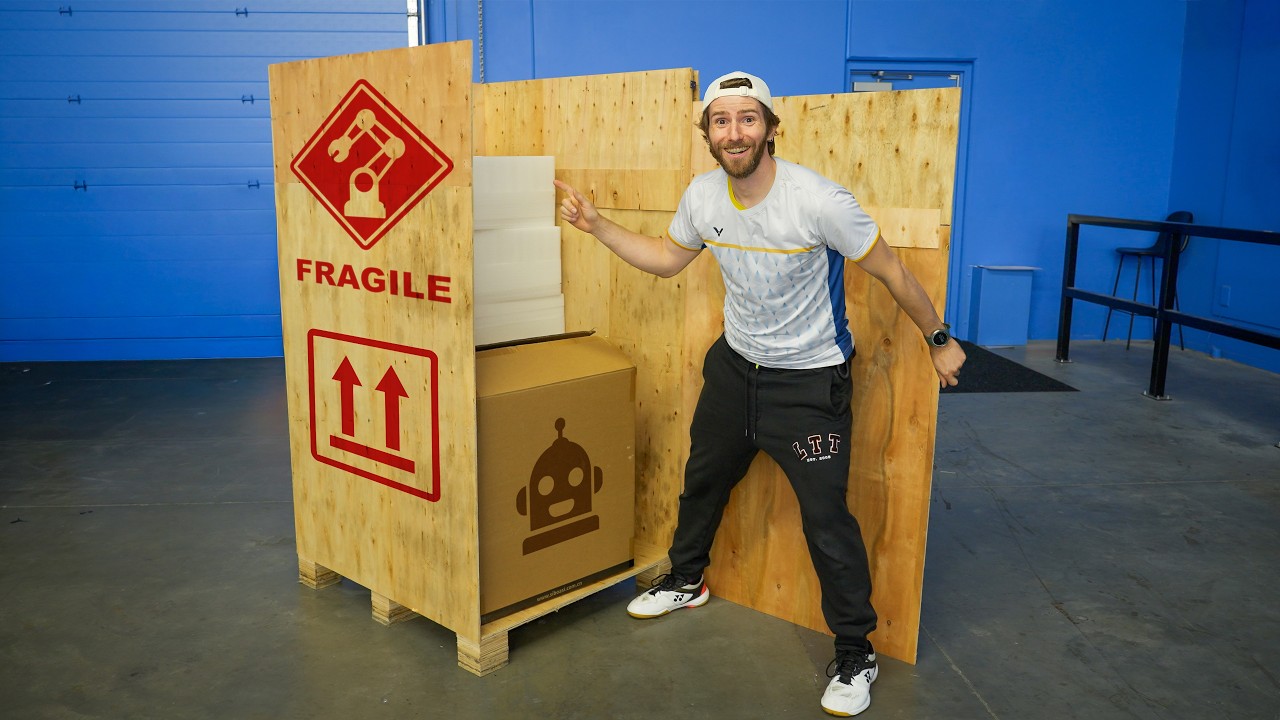
Unboxing the SIBUASI Robot [0:00]
- The speaker finally receives a badminton feeding robot after a year-long wait.
- The robot is presented as a tool, not a toy, designed to combine technology and badminton.
- It features a touchscreen interface, app control, and flexibility for training.
"Mine is you really bought yourself a robot as a toy but this is no toy. This is a tool."
Initial Impressions and Setup [3:31]
- The robot arrives in multiple boxes, with the brand SIBUASI noted as a premium manufacturer.
- Unlike older analog machines, this model is controlled by a tablet, which is included.
- The user manual is brief, suggesting either simplicity or poor instructions.
"What do you got there? Oh, fascinating. By it's controlled by a tablet."
Shuttlecock Handling Challenges [5:02]
- Badminton's shuttlecock presents unique challenges due to its irregular shape and fragility compared to balls in other sports.
- The robot needs a mechanism to fling shuttlecocks at high speeds without causing excessive wear.
- The hopper holds 360 shuttlecocks, reducing the frequency of reloads.
"Unlike many sports that use more traditional ball shaped balls like tennis or baseball badminton uses a shuttlecock, which is not only more irregularly shaped, but also extremely fragile."
Dual Feeders and Design Considerations [7:08]
- The robot includes two feeders, allowing for increased feeding speed and more complex patterns.
- The grippers have a delicate surface, possibly made of a hybrid leather and rubber material, to handle shuttlecocks gently.
- Cable management is neat, and power outlets near courts are beneficial for operation.
"The reason it comes with two of these hoppers is because unlike some of their more basic models, this one actually includes two feeders."
First Test and Pattern Programming [14:40]
- The robot is powered on, and initial device connections are successful.
- Placement instructions are given: center line, half a meter from the front T line.
- The machine's height adjustment is surprisingly high, exceeding expectations.
"Two devices connected successfully. Put the device on the center line of the court, half a meter away from the front T line."
Programmed Patterns and Accuracy [17:10]
- The robot comes with pre-programmed patterns, including a simple square pattern and a fast mode.
- Parameters like frequency, speed, and height can be adjusted.
- The first test run shows incredible accuracy, hitting the line consistently.
"It's hitting the line every time. First impressions? It's very accurate."
Adjusting Patterns and Skill Development [21:30]
- The speaker notes that the initial pattern's timing between high and net shots is not ideal.
- Individual machine speeds can be adjusted, and parameters for each shot (vertical and horizontal coordinates) can be modified.
- A new pattern is programmed to practice defense with alternating high and net shots.
"So we make a square pattern and then for the front ones, we turn the frequency down, right? Yeah."
Advanced Play and Conclusion [25:00]
- A more experienced player, Jaden Sang, tests the robot with increased frequency.
- The robot performs impressively, even with powerful smashes from Jaden.
- The speaker expresses excitement about the potential for extensive practice with the 360-shuttle capacity.
"Kind of sick. That was sick. Pretty excited. I'm great. Yeah. Yeah."