Why We Stopped Striving to Win — and How the Greeks Fix It
Tom Bilyeu
1,829 views • 21 hours ago Save 36 min 10 min read
Video Summary
The speaker champions a return to foundational Western values and a positive national narrative, drawing parallels between ancient Greece and modern America. He argues that a clear vision of identity, rooted in history and emphasizing excellence, is crucial for societal strength and progress. This perspective is framed against the backdrop of a perceived decline in Western confidence, marked by a focus on mistakes rather than achievements, leading to a weakening of resolve and a vulnerability to external pressures.
The speech highlights figures like JFK and Rubio, praising their ability to articulate inspiring visions grounded in reality. It critiques a modern tendency to prioritize safety and avoid risk, which stifles potential and mediocrity. The core message advocates for embracing ambition, competition, and the pursuit of excellence as essential for a vibrant civilization, urging a conscious choice to emphasize the positive aspects of Western history to navigate future challenges.
Short Highlights
- Great leadership requires a positive, reality-grounded vision.
- Western decline stems from a lack of clear identity and historical understanding.
- Ancient Greece provides foundational concepts for Western civilization.
- Emphasis on excellence, ambition, and competition is vital for progress.
- A positive, unifying national narrative is essential for societal cohesion.
- Modern society risks stagnation by prioritizing safety over striving.
- Reclaiming historical lessons is key to confronting future challenges.
Key Details
The Need for Great Leadership [0:00]
- Great leadership is defined by a positive vision of a country's potential, grounded in reality.
- Effective leaders acknowledge difficult choices and necessary discomfort.
- Leadership that relies on "bread and circus" or aggression is not inspiring.
"The kind of leadership that inspires people to follow you is the point of the stars like JFK did and say that we're not going to do this because it's easy. We're doing it because it's difficult."
The Crisis of Western Identity [0:55]
- The West suffers from a lack of positive vision and a fragmented understanding of its past and future.
- This identity crisis leads to internal conflict and division.
- Humans are "meaning making machines" who need compelling narratives.
"We are meaning making machines. There is a reason that humans need stories and you need leadership that understands the power of a well-crafted true narrative."
Rubio's Vision Through Greek Antiquity [1:47]
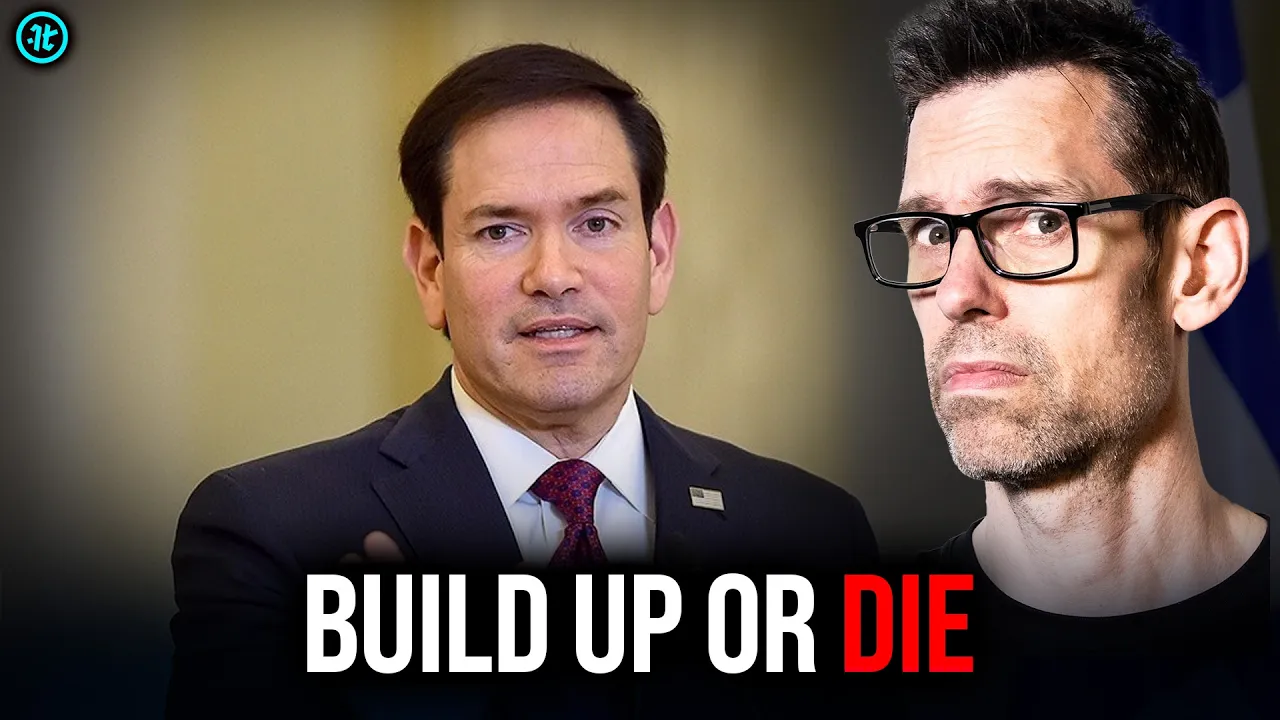
- Senator Rubio's speech, inspired by a trip to Greece, offers a pro-America perspective through a pro-Greek lens.
- It reinterprets antiquity by focusing on its positive contributions rather than its failures.
- This approach connects the foundations of Western intellectual tradition to modern prosperity.
"He obviously had a trip to Greece. And at some point, he had the brilliant idea of basically just giving a pro-America through the lens of a pro-Greek speech, pro-antiquity speech."
The Enduring Power of the Acropolis [3:06]
- While many ancient ruins represent exhausted civilizations, the Acropolis retains a captivating hold.
- Generations have looked to it with wonder and awe.
- The Greeks of antiquity possess a "mystical hold" because their stories are retold.
"But the Greeks of antiquity, they seem to have an almost mystical hold. They have that mystical hold only because we retell the stories."
Teaching History's Meaning [4:04]
- Modern school systems often teach history in a way that is easy to test but not meaningful.
- There's a critical need to understand "who we are" and what parts of the past define us.
- Focusing too much on mistakes leads to a loss of self-belief.
"We teach history in a way that's easy to test, but we don't teach it in a way that shows how meaningful history is, how much it matters to our sense of self today."
The Athenian Last Stand and Narrative Power [5:03]
- The story of Athenians defending the Acropolis against Xerxes illustrates the power of narrative framing.
- The choice of perspective determines whether the story is seen as foolishness or heroic resilience.
- The Parthenon was rebuilt after destruction, symbolizing resilience.
"Or you can tell it the way he just did. Perspective, the way that you frame something is critical."
The Debt to Antiquity [6:15]
- The founders of the American Republic were deeply influenced by Greek antiquity.
- Greek names and architecture are embedded in American institutions and cities.
- The founders recognized their unique place in history and the legacy of antiquity.
"The history of America, the history of my country, is covered with the fingerprints of antiquity. Greece is literally carved into the architecture of our government."
Inventing the Western Mind [7:35]
- The Greeks are seen as inventing the modern West by thinking through logic and human reason.
- Ideas like logic and the scientific method had to be invented and were largely born out of Greece.
- This approach has been effective for innovation and avoiding intellectual traps.
"The Greeks thought is you can feel them inventing the modern West, like actually having to think through the fact that humans don't have like a default mode of logic."
The Federalist Papers and Greek Influence [8:35]
- Plutarch, a Greek biographer, was the most cited author in the Federalist Papers.
- Ancient Greece provided foundational ideas for democracy, philosophy, law, virtue, and citizenship.
- Much of our political vocabulary originates from Greek city-states.
"The most commonly cited author in the Federalist Papers was not an Enlightenment philosopher or a political theorist. The most commonly cited author in the Federalist Papers was Plutarch, the Greek biographer of Greece and Rome's great men."
Virtue and the Western Value System [9:24]
- Antiquity provided a value system (virtue, valor, stoicism) to steer individuals away from harmful actions.
- In a populist moment, these intrinsic limitations are often discarded.
- The West's debt to Greece goes deeper than institutions and ideas, to fundamental qualities.
"And so much of antiquity was about giving us those ideas that this is virtue and valor and stoicism giving us the value system that would steer us well so that we had something intrinsic that would stop us from doing dumb things."
Defining Qualities of the West [10:15]
- Ancient Greece embodied fierce individuality, ambition, exploration, invention, and curiosity.
- There was a yearning for discovery, adventure, risk, and glory.
- These qualities drove the West to create and innovate.
"Fierce individuality and relentless ambition, daring exploration and invention, a yearning for discovery, for adventure, risk and glory."
The Drive to Know and Conquer [11:30]
- The Greeks possessed the conviction that the unknown could be known and understood through rational order.
- This led to advancements in math, science, medicine, philosophy, ethics, and religion.
- It paved the way for the flourishing of Western civilization and Christian theology.
"It was the conviction that the unknown can be known. The confidence that the world can be charted, and measured, and mapped, and understood."
The Pursuit of Excellence and Thumos [12:55]
- The pursuit of excellence, or "thumos" (fire of passion, strength, courage, pride), was central to Greek life.
- This drove competition in all fields, from art to statecraft.
- Modern society often prioritizes safety and mediocrity over striving and distinction.
"The Greeks of antiquity, the pursuit of excellence was the very principle of man's existence."
The Danger of Building Down [13:40]
- Modern standards are often designed to ensure no one loses, holding back the exceptional.
- This focus on the average and mediocre incentivizes conformity.
- The ancient Greeks built upwards, aspiring to surpass others.
"You hold everybody back when you're overly concerned. And I understand being concerned, not wanting to see people lose. But the reality is when you, as he says, build down, you hold everybody else back."
Western Shame and Loss of Confidence [14:30]
- The West has become ashamed of its achievements and prosperity, viewing them with guilt.
- This leads to a loss of belief in deserving greatness, stemming from complacency.
- Nationalism became a "dirty word," leading to the condemnation of history and monuments.
"Over time, we in the West came to feel ashamed of the very things that made us exceptional. We felt embarrassed that our achievements set us apart from the rest of the world."
The Consequences of Weakness [15:25]
- Opening borders, outsourcing industry, and military decay weakened the West.
- Sovereignty was transferred to global bureaucracies, creating a vacuum filled by rivals.
- The West's faltering confidence allowed adversaries to grow stronger.
"In the process, we opened our borders and outsourced our industry and allowed our militaries to wither and to decay. Also catastrophic."
A Crossroads for Civilization [16:10]
- The next decade will determine if the West maintains global leadership or succumbs to decline.
- The world is a competition, and weakness invites others to seize power.
- The strong will prevail, while the weak will suffer.
"The course we take will determine whether the West maintains its place at the head of the world or resigns itself to a future of atrophy and servitude and decline."
Trump's Choice: National Power [17:00]
- Under President Trump, the U.S. chose the pursuit of national power, re-industrialization, and technological dominance.
- This includes advancing in manufacturing, AI, defense, and space exploration.
- The administration aims to reclaim a classical understanding of politics and statecraft.
"Under President Trump, the United States has made its choice. We choose the unapologetic pursuit of national power to take back control of our critical supply chains, to re-industrialize our economy, to rebuild our defense."
Europe's Potential Awakening [17:50]
- There are signs of Europe awakening and rekindling its historical fire.
- Increased defense spending, new partnerships, and expanded manufacturing are noted.
- Greece is highlighted as a model ally in this potential shift.
"We believe that Europe can awaken from its long slumber and rekindle the fire that was lit here millennia ago."
Strengthening Alliances, Defending Sovereignty [18:40]
- The speaker addresses the apparent contradiction between limiting global bureaucracies and calling for stronger alliances.
- Alliances are presented not as ceding sovereignty, but as a means to defend it.
- Shared core values can foster lasting relationships and alliances, even with differing backgrounds.
"He's like, look, this isn't about giving up your sovereignty as a nation. It's about actually defending it."
The West's Inheritance: Heroes and Duty [19:55]
- The West inherited a sense of duty, loyalty, and honor from the Greeks.
- Heroes are defined by their willingness to sacrifice for a cause, not by worshipping death.
- Examples include Socrates, the Spartans at Thermopylae, and Achilles.
"The heroes of the West are those who choose to remain faithful to their duty precisely when it is most difficult and painful to do so."
The Story We Tell Ourselves [21:25]
- The narrative a civilization tells itself about its identity and values determines its future.
- The West has a choice: emphasize its mistakes or its achievements like innovation and ending slavery.
- Emphasizing the positive aspects of history is crucial for empowerment and future direction.
"We have tried the one where the West is bad and the West is evil and we've made nothing but mistakes and we've pillaged and plundered and that's our history. And that is in our history but we are also literally the culture that gave birth to the scientific method."
The Future and AI Debate [23:00]
- The coming debate around AI is expected to be aggressive and potentially violent.
- Understanding the historical and philosophical underpinnings of Western values is crucial for navigating this future.
"Where AI is going is going to be the most aggressive, bordering on violent debate that we are going to have."