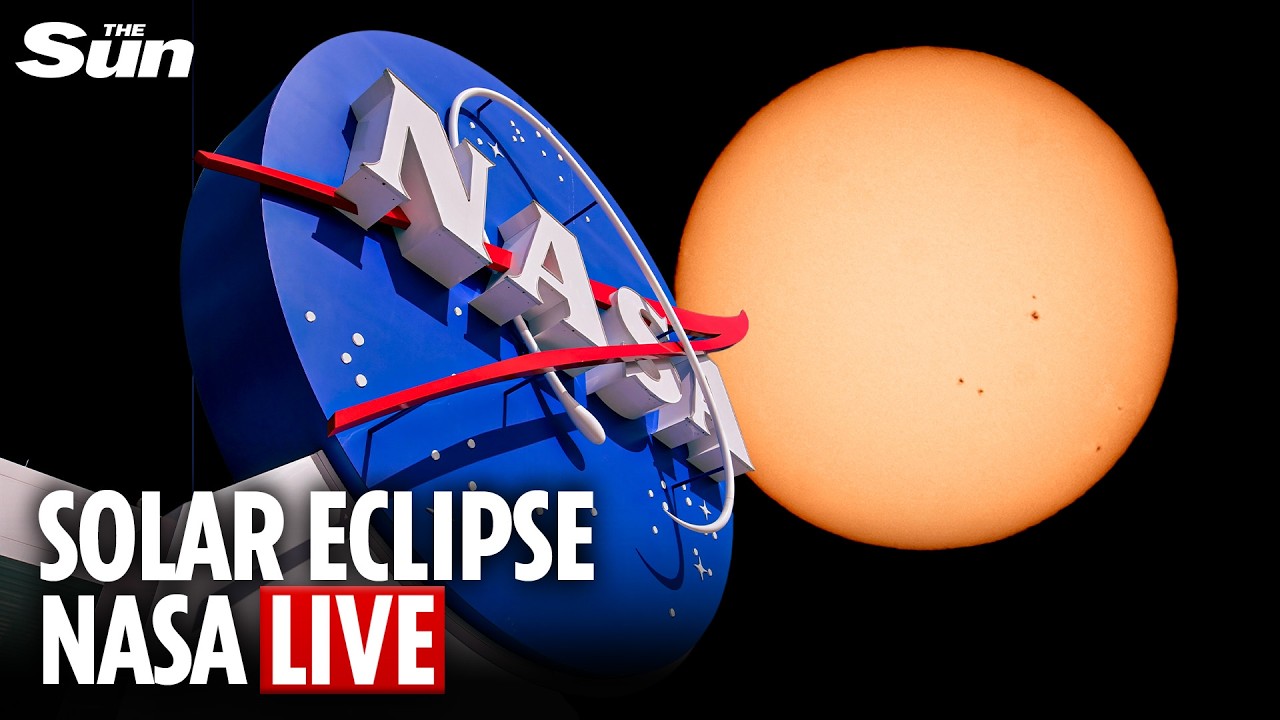
LIVE: NASA feed tracks the first total solar eclipse over mainland Europe since 1999
The Sun
19,515 views • 1 month ago Save 76 min 9 min read
Video Summary
The 2026 total solar eclipse captivated viewers across Greenland, Iceland, northern Russia, Spain, and Portugal, offering a rare glimpse of the sun's corona. NASA's live coverage highlighted the science behind eclipses, with experts explaining orbital mechanics and the significance of studying our star. Special attention was given to safe viewing practices, emphasizing the need for eclipse glasses or indirect methods.
Experiments involving high-altitude aircraft and balloons aimed to capture unprecedented data on the corona and space weather. While Iceland experienced cloudy conditions, Spain offered clear skies for a spectacular view of totality, described as a profound, full-body experience. Astronauts aboard the International Space Station also witnessed the event from orbit, providing a unique perspective on the moon's shadow. The event underscored the importance of celestial observation for scientific understanding and human inspiration.
Short Highlights
- A total solar eclipse occurred when the moon completely blocked the sun's face.
- The eclipse path crossed Greenland, Iceland, northern Russia, Spain, and a corner of Portugal.
- Safe viewing methods, including eclipse glasses, are essential.
- High-altitude aircraft and balloons conducted experiments during the eclipse.
- Spain provided clear skies for a spectacular view of totality.
- Astronauts on the ISS observed the eclipse from orbit.
- Future eclipses are scheduled for 2027 (Spain, North Africa, Middle East) and 2028 (Australia, New Zealand).
Key Details
Total Solar Eclipse Occurs [00:00:00]
- A total solar eclipse happens when the moon passes between the sun and Earth, completely obscuring the sun.
- Those within the moon's shadow, the path of totality, experience a temporary darkening of the sky.
"a total solar eclipse occurs when the moon moves between the sun and earth and completely blocks the face of the sun casting a temporary shadow on earth"
Eclipse Path and Visibility [00:01:30]
- Today's eclipse sweeps across Greenland, Iceland, northern Russia, Spain, and a small part of Portugal.
- Many areas in the Northern Hemisphere, including Canada and parts of the northern U.S., will see a partial solar eclipse.
- For Europe and Africa, the eclipse occurs near sunset, offering a rare sunset eclipse opportunity.
"today's total solar eclipse will sweep across greenland iceland northern russia spain and a small corner of portugal"
Safe Solar Viewing [00:02:50]
- It is crucial to use proper protection when viewing a partial solar eclipse.
- Safe options include eclipse glasses, handheld solar viewers, or indirect viewing methods.
- Regular sunglasses, regardless of darkness, are not safe for viewing the sun.
"when watching a partial solar eclipse you must always use the right protection"
Path of Totality Explained [00:04:10]
- The path of totality is marked by a red stripe on maps, indicating where the total eclipse will be visible.
- The much broader penumbra shadow indicates where a partial eclipse occurs.
- The umbra shadow, where totality happens, moves rapidly across the Earth.
"the red stripe is the path of totality those are the locations that will experience totality today"
Why Eclipses Don't Happen Monthly [00:10:00]
- The moon's orbit is tilted about five degrees relative to Earth's orbit around the sun.
- This slight tilt prevents the moon from aligning perfectly with the sun and Earth for an eclipse every new moon.
"the moon is not exactly on the same line that we have with the sun so the earth can view the sun pretty well"
Uniqueness of the 2026 Eclipse [00:11:30]
- This eclipse is unique due to its proximity to sunset.
- Europe experiences eclipses infrequently, with 300-400 years between occurrences in any given location.
- The rapid movement of the moon's shadow and the amount of ocean on Earth contribute to this rarity.
"this eclipse is unique because of the fact that it's near sunset"
Eclipse Seasons [00:12:30]
- An eclipse season occurs when the sun, moon, and Earth align, leading to solar or lunar eclipses.
- A solar eclipse is followed by a lunar eclipse approximately two weeks later.
"an eclipse season when eclipse happens like this that lineup means that you're going to see a solar eclipse so either a partial annular or total and then you're going to see a lunar eclipse about two weeks later"
Scientific Importance of Studying Eclipses [00:14:00]
- NASA continues to study solar eclipses because each one is unique.
- The sun's activity changes with its 11-year cycle, and the Earth's position varies.
- Studying each eclipse provides valuable data on the sun and its effects.
"because every eclipse is a little bit different the sun changes as it rotates and error changes in its 11 year cycle"
Totality Timings and Experiments [00:17:00]
- Totality in Reykjavik, Iceland, is expected around 1:48 PM ET, lasting about a minute.
- Totality in Spain is anticipated at 2:28 PM ET, lasting approximately two minutes.
- Experiments are planned on the ground and in the air in Iceland to study the sun's corona.
"we're tracking totality in reykjivik iceland at 1 48 pm eastern time or 5 48 pm local time"
Chasing the Moon's Shadow [00:18:30]
- NASA pilots in the WB-57 aircraft attempt to stay within the moon's shadow for as long as possible.
- This allows for extended observation of the sun's corona.
- The aircraft flies above most of Earth's atmosphere for a clearer view.
"nasa's pilots find a way to make it last longer trying to outrun the moon's shadow with an airplane"
Icelandic Eclipse Observations [00:23:00]
- Despite cloudy skies on the ground in Iceland, an aircraft is positioned to observe the eclipse.
- The experiment involves imaging the solar corona with four cameras, capturing data from visible to infrared wavelengths.
- The goal is to better understand how the corona is heated and its structure.
"we are going to be imaging the solar corona with an instrument that has four cameras on board"
Artemis Program Training in Iceland [00:30:00]
- Iceland's geological features are used for training astronauts for lunar and Martian missions.
- Features mimic the lunar surface, providing a realistic environment for EVA training.
- Astronauts practice geology and navigation skills in Iceland.
"we have features here in iceland that are geologically relevant and also just have a sense of scale and a sense of identity that really mimic what we know the lunar surface looks like"
Eclipse from Space: ISS Perspective [00:34:00]
- Astronauts on the ISS observed the eclipse by watching the moon's shadow projected on Earth.
- They did not need eclipse glasses as they were not looking directly at the sun.
- The view from space allowed them to see the full extent of the corona and zodiacal light.
"we look at an eclipse through earth's atmosphere and so they didn't have to see the full extent of that corona as well as the zodiacal light"
Totality in Spain [00:52:00]
- Spain experienced clear skies, allowing for a stunning view of the total solar eclipse.
- The corona was visible, described as streets of light extending from the sun.
- The brief moment of totality was an awe-inspiring experience.
"oh wow that is that is images of the sky which is so exciting wow"
Future Eclipses [01:15:00]
- The next major eclipse will be in 2027, crossing Spain, North Africa, and the Middle East, lasting over six minutes.
- Another eclipse is expected in 2028 over Australia and New Zealand.
- For the United States, totality will return in 2044 (Montana, North Dakota) and 2045 (coast to coast).
"next year there is going to be an eclipse that happens in part of spain throughout the northern africa through the middle east"
Safe Viewing Methods Demonstrated [01:25:00]
- Indirect viewing methods, such as using a pinhole projector or observing the shadow of tree leaves, are demonstrated.
- These methods allow safe observation of the eclipse without direct eye exposure.
"these are super cool and things you can use to help you view the eclipse safely without your glasses"
Astronaut Don Pettit's Experience [01:30:00]
- Astronaut Don Pettit witnessed the totality phase from Alcanices, Spain.
- He described it as a "human emotional event" as well as a scientific phenomenon.
- Pettit emphasized viewing the eclipse with one's own eyes rather than through a camera viewfinder.
"it's the the whole package that comes with a total eclipse it's the shadow phenomena that happens around you"
Impact of Space Weather [01:05:00]
- Solar activity, like coronal mass ejections, can affect technology on Earth, including GPS and power grids.
- NASA monitors space weather to protect astronauts and critical infrastructure.
- Understanding the sun's behavior is crucial for mitigating these impacts.
"those ejections can energize the particles and affect things that are in space and the things that we care about are in space are satellites"
International Space Station Flyover [00:45:00]
- The International Space Station was captured flying across the sun during the partial eclipse.
- This image provided a unique perspective of the ISS in front of the eclipsed sun.
"something new actually caught the international space station flying across the sun during the partial eclipse"
Nationwide Eclipse Ballooning Project [01:20:00]
- Student teams launched weather sensors to study the impact of the eclipse on the atmosphere.
- The project aims to measure atmospheric changes, including boundary layer collapse.
- This initiative combines education with scientific research.
"they've been launching weather sensors to study the impact of the eclipse atmosphere atmospheric science teams launch helium"
NASA Administrator's Remarks [01:10:00]
- Eclipses are powerful events that remind us of our place in the universe.
- Understanding our relationship with the sun is critical, especially for protecting technology and astronauts in space.
"understanding our relationship with our sun is so important and eclipses give us that opportunity to do that"
Roman Space Telescope Launch [01:40:00]
- The Nancy Grace Roman Space Telescope is set to launch, designed to study dark energy, exoplanets, and the universe.
- It will map vast regions of the cosmos and uncover the force driving the universe's expansion.
"this is a one-of-a-kind observatory that will help answer essential questions about dark energy exoplanets and much more about our solar system and out to the observable universe"