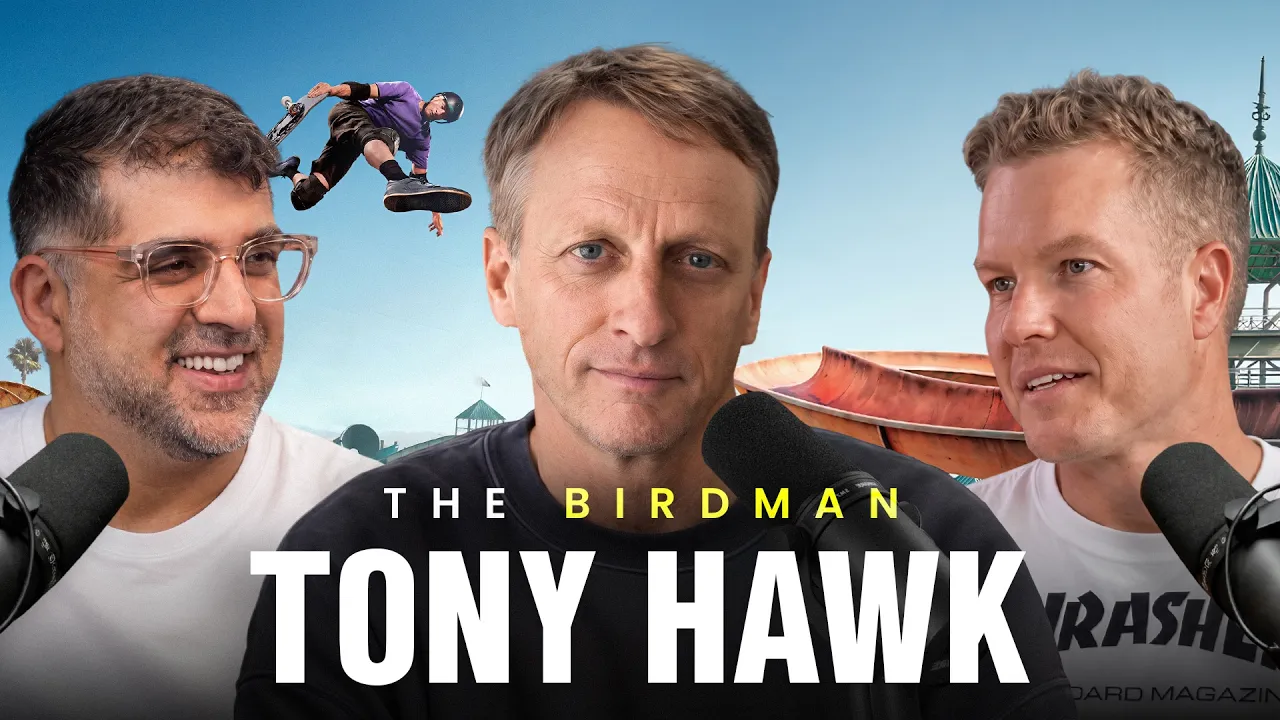
Tony Hawk inspiring us for 72 minutes straight
My First Million
454 views • 1 month ago Save 65 min 6 min read
Video Summary
Tony Hawk's legendary career, marked by groundbreaking video games and enduring passion for skateboarding, has generated over $4.5 million in royalties alone.
Despite initial skepticism about skateboarding's popularity, Hawk's video game series, "Tony Hawk's Pro Skater," became a massive success, with four of the top 10 best-selling games at one point. This success not only brought financial rewards but also elevated skateboarding's cultural status, introducing millions to the sport and its nuances. Hawk's journey highlights a dedication to passion, resilience through financial downturns, and the unexpected impact of a seemingly niche sport on mainstream culture.
Short Highlights
- The "Tony Hawk's Pro Skater" video game franchise has been a monumental financial success.
- Hawk's career demonstrates incredible resilience through financial ups and downs.
- Skateboarding's cultural impact has been significantly amplified by Hawk's influence.
- The "Tony Hawk's Pro Skater" series achieved unprecedented sales, with four titles in the top 10.
- Hawk's journey emphasizes the importance of passion and dedication in achieving success.
Related Video Summary
Key Details
The First Million: A Game Changer [00:00:00]
- The speaker recounts how a check for $4.5 million was presented, signifying a massive financial success.
- This moment is directly linked to the release of the fourth "Tony Hawk's Pro Skater" game, which, along with the first three, dominated the top 10 sales charts.
"And he slid a check across the table for $4.5 million."
Recognizing a Legend [00:00:50]
- A personal connection is made as one of the speakers grew up watching Tony Hawk skate.
- Hawk is recognized even in remote locations, such as on a mountain in Ethiopia during a Charity Water trip, highlighting his global fame.
"And this guy's like, Tony Hawk. And he recognized Tony Hawk on the side of a mountain in Ethiopia, a place where they didn't even have anything."
Charity and Impact [00:02:15]
- Tony Hawk was a significant donor to Charity Water, sponsoring a well in his daughter's name.
- The organization's success is attributed to its transparency, allowing donors to track their contributions and see the direct impact of their donations.
"And so what he was doing was, you know, if you donated, you get like a GPS tracker of exactly where in the world your thing was going."
Building Skate Parks [00:03:45]
- Hawk's personal foundation has contributed to nearly a thousand skate parks.
- The motivation stems from his own experience where skate parks served as a sanctuary and a place to find community.
"My skate park was my foundation, was my salvation. Like that was the place where I felt like I belonged."
Early Days and Determination [00:06:00]
- Hawk admits he was not initially a skilled skater, focusing more on tricks than style.
- His breakthrough came through relentless determination and competition, eventually leading to sponsorship.
"I was pretty bad. I was, I was, I was just kind of flailing."
The "Price of Greatness" [00:08:15]
- The conversation shifts to the immense dedication required for elite athletic achievement, using NBA player Joe Alexander as an example.
- Hawk describes his childhood as being consumed by skating, spending all available time at the skate park.
"As soon as the bell rang, I figured out a way to get to the skate park, that was it. I was at the skate park until, until either my mom got off work... or until they closed."
Unexpected Trajectory [00:10:30]
- Hawk initially envisioned a career as a math teacher, not a professional athlete.
- The realization of making more money than his math teacher at age 17 marked a significant shift.
"I thought I'd be a math teacher because I always helped my friends with homework."
Underestimating Success [00:11:30]
- Many highly successful individuals, including Jeff Bezos and Uber's founders, underestimated their eventual company's potential.
- Hawk's early professional earnings were modest, with $640 in his bank account after his first year as a pro.
"My first year as a professional skateboarder, I had $640 in the bank from my contest earnings."
Financial Ups and Downs [00:13:00]
- Hawk experienced a significant income drop in the early 1990s after a period of high earnings.
- He took on odd jobs, including consulting for commercials, to make ends meet.
"My income was dropping by half every month."
Parental Support and Influence [00:15:30]
- Hawk's father, who founded the National Skateboard Association, encouraged him to buy a house at 17.
- This support taught Hawk the value of encouraging children's passions, even if unconventional.
"He was the shining example of, of supporting your kids, even though they're doing something that isn't necessarily going to be a career, but to support them in their passions."
The 900: A Decade-Long Pursuit [00:20:00]
- The iconic 900 trick was a goal Hawk pursued for 14 years.
- He describes the intense mental focus and commitment required, acknowledging the significant risk of serious injury.
"I knew in that moment that you're either, I'm either going to make this trick or you're going to carry me unconscious out of this arena."
The Genesis of "Tony Hawk's Pro Skater" [00:25:00]
- Hawk initially pitched a skateboarding game with a coder in 1997, facing rejections due to perceived lack of popularity.
- Activision, under new leadership, was open to innovative game concepts, leading to the development of the groundbreaking title.
"Skateboarding isn't even popular. Why would a skateboarding video game be popular?"
Authenticity and Broad Appeal [00:28:45]
- The game featured real skate spots and professional skaters, appealing to hardcore enthusiasts.
- It successfully bridged the gap between the niche skateboarding world and a broader audience.
"It was, it was, it was pretty wild, um, because it was like authentic to like the skater nerds could talk about it. But then like anyone was into it."
The Buyout Offer [00:31:30]
- Before the first game's release, Activision offered Hawk a $500,000 buyout of future royalties.
- He declined the offer, choosing to "let it ride" based on his current financial stability and belief in the game's potential.
"At that time in my life, someone saying a half a million dollars sounded like a half a gazillion dollars."
The $4.5 Million Payday [00:33:00]
- Following the immense success of the game series, Hawk received a $4.5 million check.
- This validated the decision to decline the earlier buyout and highlighted the franchise's extraordinary impact.
"And fourth game just got released. It got to be in the top 10 sales right away. And he said, the first three are still in the top 10."
Enduring Passion and Legacy [00:37:00]
- Hawk continues to skate, finding joy in learning new tricks and spending time with his grandchild.
- His business ventures, including Birdhouse Skateboards and various investments, reflect a lifelong passion for skateboarding and entrepreneurship.
"I, I still love it. You know, even it's not, it's yes, robbed, right. It is not a profitable business. Um, but I don't care."