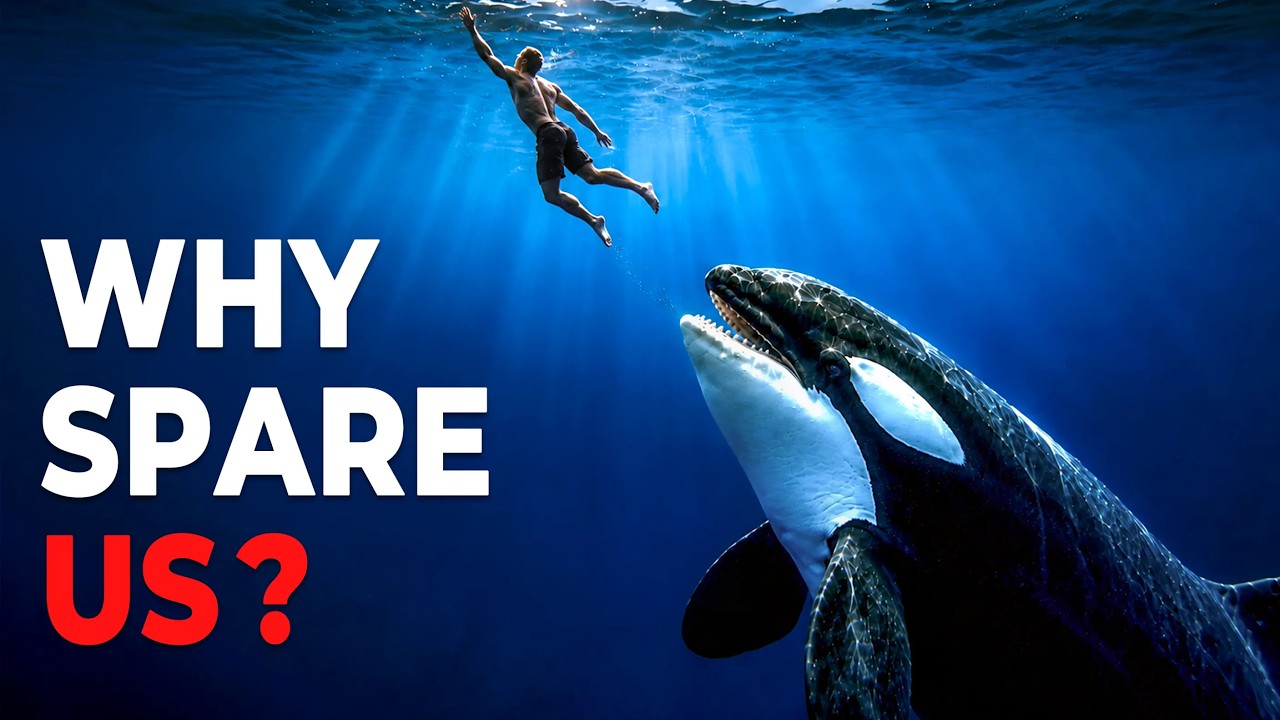
Why The Deadliest Predator in the Ocean Refuses to Kill Us
BeyondTheBlue
717,627 views • 2 months ago Save 17 min 4 min read
Video Summary
Despite being the ocean's deadliest predators, capable of taking down whales and sharks, orcas inexplicably refuse to attack humans. This isn't due to a lack of capability; humans are described as "blind, deaf, incredibly slow-moving chicken nuggets" to orcas, making them an easy target. Instead, the refusal stems from a complex interplay of factors: humans offer negligible nutritional value, lacking the dense blubber orcas need to survive in cold waters. Furthermore, orca culture dictates specific diets, and humans simply don't register as prey. Their unique acoustic signature and movement patterns also fail to trigger a predatory response.
Even incidents involving captive orcas attacking trainers or wild orcas damaging boats are not acts of predation, but rather psychological breakdowns or targeted behaviors unrelated to eating humans. The evidence suggests that orcas possess a profound level of intelligence, empathy, and cultural memory, potentially even recognizing humans as a dangerous species, leading them to exercise remarkable restraint. The ocean's apex predator, capable of immense destruction, chooses to spare humans, a stark contrast to humanity's own history of exploiting marine life.
Short Highlights
- Humans are nutritionally worthless to orcas.
- Orca culture dictates specific prey, excluding humans.
- Humans have a unique, unappetizing acoustic signature.
- Orcas possess high intelligence and empathy, recognizing humans as non-prey.
Related Video Summary
- Australia Released Ants to Kill the World’s Most Poisonous Animal — The Results Shocked Scientists
- Simulating The Strange Way Life (Likely) Started
- Iranian SURPRISE Attack Leaves Trump FUMING 2026-07-30 00:36 2026-07-30 00:36
- World In Shock! Texas Farmers Built a GENIUS Trap That Outsmarted 2 Million Wild Boars
Key Details
The Unmatched Hunter [0:00]
- Orcas are described as the deadliest apex predators in the ocean, capable of hunting great whites, drowning whales, and dismembering dolphins.
- Despite humans being slow, defenseless, and swimming in their hunting grounds, there has never been a recorded fatal attack by a wild orca.
"In all of recorded history, there has never been a single fatal attack on a human by a wild orca. Ever."
Brutal Efficiency in the Wild [1:21]
- Orcas exhibit extreme violence and calculated efficiency when hunting other animals.
- Methods include flipping sharks into a state of paralysis to drown them and coordinating to drown whale calves by blocking their blowholes.
"They literally drown it."
The Human "Chicken Nugget" [3:10]
- Physically, humans are no match for orcas, being vastly slower and smaller.
- Orcas are described as having the capability to kill a human in seconds, viewing them as an easy meal.
"To an orca, a human is essentially a blind, deaf, incredibly slow-moving chicken nugget, which is a little offensive, but mathematically true."
Nutritional Deficiency [4:40]
- Humans lack the high-fat blubber that orcas require for survival in cold waters.
- Even wetsuits are seen as an unappetizing barrier, making humans biologically "junk food."
"We're just biological junk food."
The Liver-Eating Anomaly [5:52]
- Orcas surgically extract and consume the nutrient-rich livers of great white sharks, disproving the theory that they only eat blubber-rich prey.
- This demonstrates an advanced intelligence and ability to target specific, high-calorie organs.
"A great white shark's liver is absolutely massive. It can make up to a quarter of the shark's entire body weight, and it's packed completely with squalene, which is an energy-rich oil."
Cultural Programming and Diet [7:14]
- Orca diets are dictated by strict cultural rules passed down through generations, with different pods specializing in specific prey.
- Some orca populations exclusively eat fish, ignoring marine mammals, and vice versa, showing a strong adherence to learned behaviors.
"If the matriarch of the pod didn't teach you that something is food, you don't eat it."
Acoustic Signature and Non-Prey Status [9:03]
- Orcas use echolocation to hunt, and humans produce a confusing acoustic signature due to lungs and bones, unlike fish or seals.
- Their movement and appearance also do not register as prey to orcas.
"To an orca, a human doesn't sound like a fish. We don't sound like a seal. We sound like a hollow, metallic alien bobbing awkwardly on the surface."
Restraint and Empathy [12:00]
- Captive orca attacks are attributed to psychological breakdown, not predatory behavior.
- Wild orcas attacking boats do not harm humans once they abandon ship, indicating a deliberate choice not to prey on them.
- Orcas possess highly developed brains with advanced emotional and social processing capabilities, suggesting they recognize humans as intelligent beings.
"With a brain that complex, it's entirely possible that they recognize us as another intelligent, social creature."