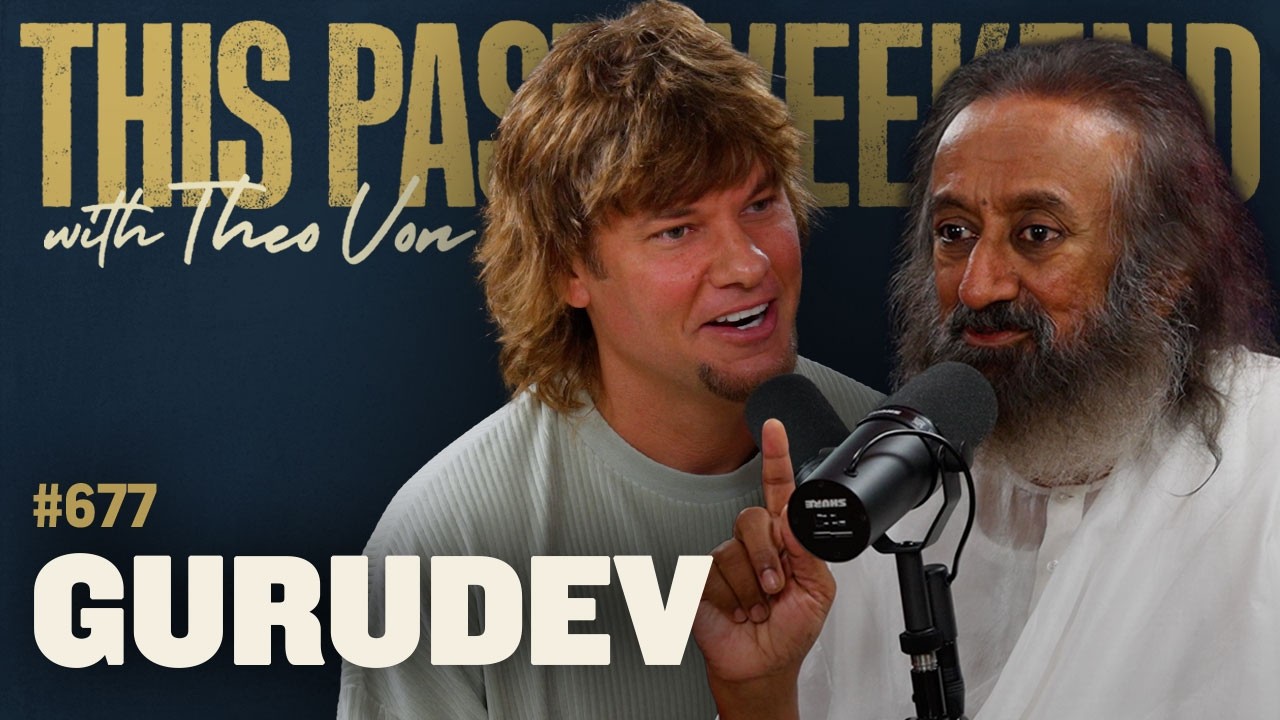
Gurudev Sri Sri Ravi Shankar | This Past Weekend w/ Theo Von #677
Theo Von
995,153 views • 1 month ago Save 78 min 17 min read
Video Summary
Gurudev Sri Sri Ravi Shankar, founder of the Art of Living movement, discusses the profound impact of breathwork and meditation on mental and emotional well-being. He explains how techniques like the Sudarshan Kriya can harmonize the connection between body, mind, and emotions, offering freedom from inner conflicts and negative habits.
Shankar also touches upon the nature of consciousness, the illusion of fear as a distorted form of love, and the importance of self-forgiveness. He shares insights into the Art of Living's global initiatives, including programs for prisoners, war veterans suffering from PTSD, and youth empowerment seminars, emphasizing the organization's goal of fostering a stress-free and violence-free society. The conversation highlights the practical application of these spiritual tools in navigating life's challenges and cultivating inner peace.
Short Highlights
- The Sudarshan Kriya breathing technique harmonizes breath, body, and emotions, releasing inner conflicts and negative habits.
- Fear is described as love standing upside down, a sensation arising from attachment to what one fears losing or not gaining.
- The Art of Living movement aims to create a violence-free and stress-free society through meditation and breathing techniques.
- Programs have been implemented for prisoners, war veterans with PTSD, and youth to foster resilience and well-being.
- Consciousness is described as an ocean of energy that has manifested everything, and it does not age.
- Self-forgiveness is crucial, as past mistakes were made from a state of ignorance, and one's true nature is unchanging goodness.
- The joy of giving is a more mature happiness than the joy of receiving, leading to greater fulfillment.
Key Details
Early Life and Spiritual Awakening [0:00]
- Gurudev Sri Sri Ravi Shankar displayed extraordinary abilities from a young age, reciting ancient texts like the Bhagavad Gita at four.
- He describes his childhood as somewhat unusual, spending more time with adults and feeling out of place with peers.
- He felt his early capabilities were a natural part of his life, not something extraordinary.
"I just felt very normal to me."
The Genesis of Art of Living [1:38]
- Shankar humorously calls himself a "guru by accident," initially just sharing what he knew, which led people to see him as a guide.
- As a teenager, he was deeply interested in both spirituality and science, finding parallels between ancient scriptures and physics.
- His teacher, who had lived with Mahatma Gandhi for 48 years, provided a significant influence, instilling values of non-violence and compassion.
"So, he is the one who taught him the Gita, the script when he came from South Africa."
The Birth of Sudarshan Kriya [4:34]
- At 23, Shankar founded the Art of Living movement, with two Supreme Court judges, one theist and one atheist, serving as trustees.
- He experienced a 10-day period of silence, after which he felt something was missing in existing meditation practices.
- This led to the development of the Sudarshan Kriya, a powerful breathing technique designed to address inner conflicts and habits.
"So, I went into a silence of 10 days. And at the end of those 10 days, I was in a remote place in India."
Spreading the Techniques Globally [6:21]
- Shankar began traveling to share his knowledge, initially facing prejudice against meditation and yoga, especially in Europe and the U.S.
- The techniques were introduced in prisons, where it was observed that every culprit is also a victim of circumstances.
- The breathing techniques proved effective in reducing anger, rage, and distress among prisoners worldwide.
"Every culprit is a victim himself or herself."
The Power of Breathwork [7:49]
- Breathwork is described as a technology that allows individuals to change their feelings and moods by recognizing the rhythm in their breath.
- Harmonizing the breath connects the body, emotions, and mind, bringing inner freedom.
- Initial benefits noticed by practitioners include calmness of mind, improved immune system, mental clarity, and better perceptions.
"Using the breathing techniques, it makes a huge difference."
Consciousness and Aging [10:10]
- Shankar suggests that while intellect matures, consciousness remains the same throughout life.
- He posits that consciousness is a reference point that cannot change, distinct from the constantly changing aspects of our being.
- He defines consciousness as the fundamental energy from which everything in the universe manifests.
"Our intellect age, our intellect becomes mature. But consciousness is the same."
Understanding and Overcoming Fear [11:39]
- Fear is explained as a sensation arising from love being "upside down," a consequence of fearing loss or unfulfilled desires.
- Shankar suggests that broadening one's consciousness and attending to the breath can help combat fear.
- He advises viewing life's challenges as a game, reducing the impact of fear.
"Fear is nothing but love standing upside down."
Societal Concerns and Technology [13:25]
- Shankar acknowledges concerns about the direction of society, particularly regarding the use of technology and its potential impact on humanity.
- He distinguishes between concern, which is a motivator for action, and fear.
- He expresses concern for the planet and the state of mental health globally, noting the rise in mental health issues among young people.
"I'm very concerned about the planet. I am very concerned about the state of mental health in this in the whole world."
Technology's Dual Nature [15:01]
- Technology is seen as a boon, making knowledge easily accessible and challenging human intellect to become more creative and original.
- Artificial intelligence, while viewed with skepticism by some, is also considered a positive force that pushes for greater human originality.
- The ease of accessing information today contrasts sharply with the past, where research was a time-consuming process.
"So knowledge is easily available in every corner of the world."
The Nature of Evil and Values [17:02]
- Shankar believes no child is born evil; negative tendencies arise from circumstances, lack of understanding, or indoctrination.
- He emphasizes the importance of values in education and suggests that evil is merely a veil over a person's goodness.
- He advocates for peace education, which is currently lacking in the global curriculum.
"There is no education there is no peace education in the world."
Past Lives and Self-Forgiveness [19:14]
- The concept of past lives is affirmed, suggesting that individuals may carry burdens from previous existences.
- Shankar uses the analogy of luggage at an airport to illustrate how one might unknowingly carry "someone else's junk."
- He addresses the difficulty of self-forgiveness, noting that people often hold onto past mistakes due to high expectations.
"Because that's a bummer because I'm just I could be dealing with somebody else's junk."
Healing Through Breath and Meditation [21:36]
- Emotions stuck in the system need to be released, and breath is presented as the most effective tool for this.
- Each emotion has a corresponding pattern in breathing, and attending to these rhythms can create significant change.
- Forgiveness, both of others and oneself, is facilitated through meditation and breathwork, releasing emotional blockages.
"The emotions which are stuck in our system that need to be released and breath is the best tool."
Working with War Veterans [24:03]
- The Art of Living has conducted programs like "Welcome Home Troops" for war veterans suffering from PTSD.
- These programs utilize breathing techniques to help veterans overcome trauma, anger, and distress, enabling them to reintegrate with their families.
- Thousands of veterans have reportedly experienced significant transformations, leading to letters of gratitude from their families.
"Thank you Gurudev we got our son back."
The Body's Memory and Healing [26:26]
- The body is described as having a "photographic memory," storing whatever it is exposed to, including negative vibes.
- Spending time in nature, like at the beach or with animals, can positively influence the body's energetic state.
- Trauma is stored in the body, and practices like meditation and nature immersion can help shift this stored energy.
"The body has a photographic memory and whatever you feed it that's what it takes."
Love, Relationships, and Interdependence [28:56]
- Shankar advises against seeking love externally, emphasizing that love is not an act but one's inherent nature.
- He suggests that greed, narcissism, and anger are distorted forms of love, often stemming from misplaced focus.
- Successful relationships are built on a common goal, mutual understanding, and giving each other space, rather than policing each other.
"When you want to love someone you should take it for granted they also love you."
Overcoming Addictions and Finding Inner Joy [34:09]
- For individuals struggling with addiction, Shankar offers a "better brand of intoxicant" through meditation and breathing techniques.
- These practices help individuals find an inner ecstasy that reduces dependence on external substances.
- The key is to replace the craving for external pleasure with a deeper, internal source of joy and fulfillment.
"So you're saying a lot of it is you have to replace it with something else of value of value of larger joy more important."
The Art of Living's Mission [37:48]
- The Art of Living aims to make life a celebration, helping people overcome anger and anxiety.
- It is a volunteer-based organization focused on creating a violence-free, stress-free society with disease-free bodies and clear minds.
- The organization works to break down inhibitions related to race, religion, and gender, fostering a sense of global family.
"The very aim is to make life a celebration."
World Culture Festivals and Global Unity [40:56]
- The Art of Living organizes World Culture Festivals every four years, bringing together millions of people from diverse backgrounds.
- These events feature massive group meditations, showcasing cultural diversity and promoting global unity.
- The festivals aim to foster a sense of shared humanity and celebration, transcending cultural and national boundaries.
"Just imagine the sea of people so silent for 20 minutes it was something that's wonderful it's powerful very powerful."
The Joy of Giving and Inner Source of Love [44:46]
- Two types of joy are discussed: receiving gifts and giving to others.
- The joy of giving is presented as a more mature and fulfilling happiness, akin to a grandmother's joy in nurturing.
- Recognizing that the source of love is within, individuals are encouraged to give love generously, which in turn attracts more love.
"The joy of giving is where we need to grow into life."
Mental Hygiene and Self-Discovery [47:41]
- Meditation and breathing practices are likened to "mental floss," essential for maintaining mental hygiene.
- Self-discovery involves negating what one is not (body, mind, emotions) to find the serene, calm, and full space within.
- This inner space, once glimpsed through meditation, provides unshakable peace and a constant smile.
"See what is not yourself you're not just your body your body's changing."
Practical Wisdom and Inner Blossoming [49:25]
- The book "Journey Within" compiles practical wisdom from discussions and questions, serving as a manual for developing a meditation practice.
- Inner blossoming is achieved through various means, including knowledge, wisdom, music, meditation, service, and expressing unconditional love.
- Shankar emphasizes that these seemingly idealistic goals are, in fact, very practical and achievable.
"It helps people too."
Free Schools and Education [50:51]
- The Art of Living has established "Free Schools" in India, Nepal, and other locations, educating hundreds of thousands of children.
- Meditation and yoga are integrated into the curriculum, alongside other subjects, to foster well-rounded development.
- The organization also runs a university known for its happy campus and emphasis on service.
"We have a university also. It's one of the very good university with the happiest campus."
Universal Well-being and Practice [51:58]
- Shankar asserts that everyone can feel better, though extreme cases may require medical attention.
- Consistent practice of breathing and meditation is key to preventing mental health issues and aiding recovery.
- He encourages integrating these practices into daily life, making them a natural habit for mental well-being.
"Practices which would first of all prevent you from getting there second it also helps you to recover."
The Persistence of Consciousness [53:25]
- Upon the end of physical life, consciousness is believed to remain alive, akin to vibrations or radiations that persist after a TV is turned off.
- Individuals are seen as the "tubes or screens" through which consciousness is projected.
- This perspective suggests the possibility of encountering others again in different forms or times.
"We are just the tubes or the screens the consciousness is what gets projected in it."
Peace Process in Colombia [54:50]
- Shankar was involved in a peace process in Colombia, aiming to help two million internally displaced people affected by the 52-year-long FARC conflict.
- He met with FARC leaders, initially facing resistance due to their Marxist philosophy contrasting with his spiritual approach.
- Through dialogue, meditation, and a forgiveness process involving victims and FARC members, a peace deal was facilitated.
"So he said, you know, our ideal is called Marx so we don't need to philosophy."
The Film "White" [56:49]
- A movie titled "White" is being made about Shankar's role in the Colombian peace process, with actor Vikrant Massey playing him.
- The process of negotiation and achieving peace in Colombia took a few months.
"There is a movie coming about this someone has made a movie really."
Relationships and Common Goals [58:34]
- Shankar advises that in relationships, focusing on a common goal is more sustainable than focusing solely on each other.
- He stresses the importance of not policing each other and giving space for individuals to grow.
- Attraction is time-bound, but a shared ambition can lead to a lasting connection.
"If they have a common goal then they go for infinity they go parallel."
The Nature of Intuition [59:57]
- The Institute of Absolute Intelligence offers an 18-day program for children and teenagers to develop their intuitive abilities or "gut feeling."
- This gut feeling is described as infallible and capable of overriding rational thought.
- Children, with their less rigid minds, are particularly adept at learning these intuitive practices.
"Gut feeling that is which is unfallible that doesn't fail."
The Art of Living's Global Reach [1:02:11]
- The Art of Living has millions of volunteers worldwide and has conducted large-scale events like the World Culture Festival.
- The festival in Washington D.C. had 1.1 million attendees, and a festival in New Delhi had 3.75 million attendees.
- These events bring together people from diverse cultures and traditions for shared meditation and celebration.
"We had 1.1 million people joined in DC."
The Difference Between Joy Types [1:04:33]
- Two types of joy are distinguished: happiness from receiving something and a more mature happiness from giving.
- The joy of giving, like that of a grandmother nurturing her family, is presented as a higher form of fulfillment.
- By focusing on giving love, one realizes the source of love is within and attracts more love in return.
"There are two types of joy. One type of happiness is that you get when you get something."
Dealing with Negative Ideas [1:06:48]
- Negative or harmful ideas can arise, tempting individuals towards behaviors they wish to avoid.
- These ideas often promise short-term joy or pleasure, making them compelling.
- Finding a greater, more lasting inner joy through practices like meditation can help overcome the allure of these negative impulses.
"It is promising some joy some pleasure yes that's part of it."
Working with Addictions [1:07:59]
- The Art of Living has trained thousands of teachers who run recovery programs, including in schools and universities.
- These programs incorporate breathing techniques and other methods to help individuals overcome addiction and stress.
- The goal is to help young people manage their moods, moving away from extremes of depression and rage.
"So that has helped you know it includes the sky breath technique in that and many other things."
Clarity, Purity, and Sincerity [1:09:33]
- Shankar's formula for a better life is clarity in mind, purity in heart, and sincerity in action.
- Sincerity in action can be achieved through spontaneity and by asking oneself reflective questions.
- These principles contribute to a more harmonious and fulfilling existence.
"Clarity in mind, purity in heart, sincerity in action."
Intuition and the Institute of Absolute Intelligence [1:10:53]
- The Institute of Absolute Intelligence offers programs to help children and teenagers develop their intuitive abilities.
- Participants learn breathing and meditation techniques to strengthen their "gut feeling."
- This intuitive sense is described as an infallible guide that can help navigate life's decisions.
"And they learn how they can use their intuitive ability the gut feeling much more stronger."
The Art of Living's Core Principles [1:12:25]
- The Art of Living aims to make life a celebration, helping individuals get over anger and anxiety.
- It seeks to create a violence-free, stress-free society with disease-free bodies, confusion-free minds, and inhibition-free intellects.
- The organization works to eliminate prejudice related to race, religion, and gender, fostering trauma-free memories and sorrow-free souls.
"Make people healthy with breathing and meditation and all the thing."
Interdependence and Conflict Resolution [1:14:19]
- Recognizing the interdependence of all humanity is crucial for resolving conflicts.
- When people understand that they need each other, the desire to harm or get rid of others diminishes.
- This sense of interconnectedness is fundamental to creating a peaceful world.
"If we do this conflicts will just evaporate."
The Nature of Evil and Harm [1:15:09]
- Harmful actions and a sense of hurt can stem from negative feelings and a lack of guidance on managing them.
- The prevalence of devices has increased awareness of harm, but also potentially caused more hurt by exposing people to it.
- Teaching children how to manage their moods is essential to prevent them from swinging between depression and rage.
"See neither at home nor at school no one teaches you how to get rid of your negative feelings."
Journey Within and Practical Wisdom [1:17:14]
- "Journey Within" is a book offering practical wisdom for life, compiled from weekly discussions and questions posed to Gurudev.
- It serves as a guide for developing a meditation practice and navigating life's challenges.
- The book's creation involved contributions from many people through their questions and interactions.
"It just brings some practical wisdom to your life and whatever you need whenever you need."
Free Schools and Education [1:18:16]
- The Art of Living operates "Free Schools" in India and Nepal, with 150,000 children currently studying in them.
- Meditation and yoga are part of the curriculum, aiming to provide a holistic education.
- These schools contribute to fostering a sense of service and happiness among students.
"And that is a k through 12 or what is the yeah okay okay."
Universal Well-being and Practice [1:19:16]
- Shankar reiterates that everyone can feel better, emphasizing the need for practice and self-application.
- He likens these practices to "mental hygiene," which, like dental hygiene, needs to become a habit.
- Consistent practice of breathing and meditation can lead to a natural state of well-being.
"Practices which would first of all prevent you from getting there."
The Illusion of Self and Consciousness [1:20:22]
- The self is not just the body or the mind, which are constantly changing.
- Through negation and introspection, one can discover a deeper, unchanging core of serenity and fullness within.
- This discovery, achieved through meditation and a relationship with consciousness, brings lasting peace.
"See what is not yourself you're not just your body your body's changing."
The Power of Giving Love [1:21:30]
- Giving love is presented as a more mature and fulfilling form of happiness than receiving it.
- When one focuses on giving love, they realize the source of love is within and attract more love in return.
- This outward expression of love, rather than seeking it, leads to greater personal fulfillment.
"So let me give love as much as I can to everybody around me."
The Nature of Relationships [1:22:16]
- Successful relationships are built on shared goals and mutual respect, not on constant policing or excessive focus on each other.
- Giving space for individuals to grow and not stifling them with love is essential.
- Attraction is temporary, but a shared ambition can foster a lasting connection.
"When both of them have a common goal to achieve not focused on each other too much."
The Persistence of Consciousness After Death [1:23:14]
- Consciousness is believed to persist after the physical body ends, similar to vibrations remaining after a signal ceases.
- Individuals are seen as vessels or screens for consciousness, suggesting a continuity of being.
- This perspective opens the possibility of future encounters or continued existence in different forms.
"If the tv is shut off but still the vibrations the radiations do remain here right."