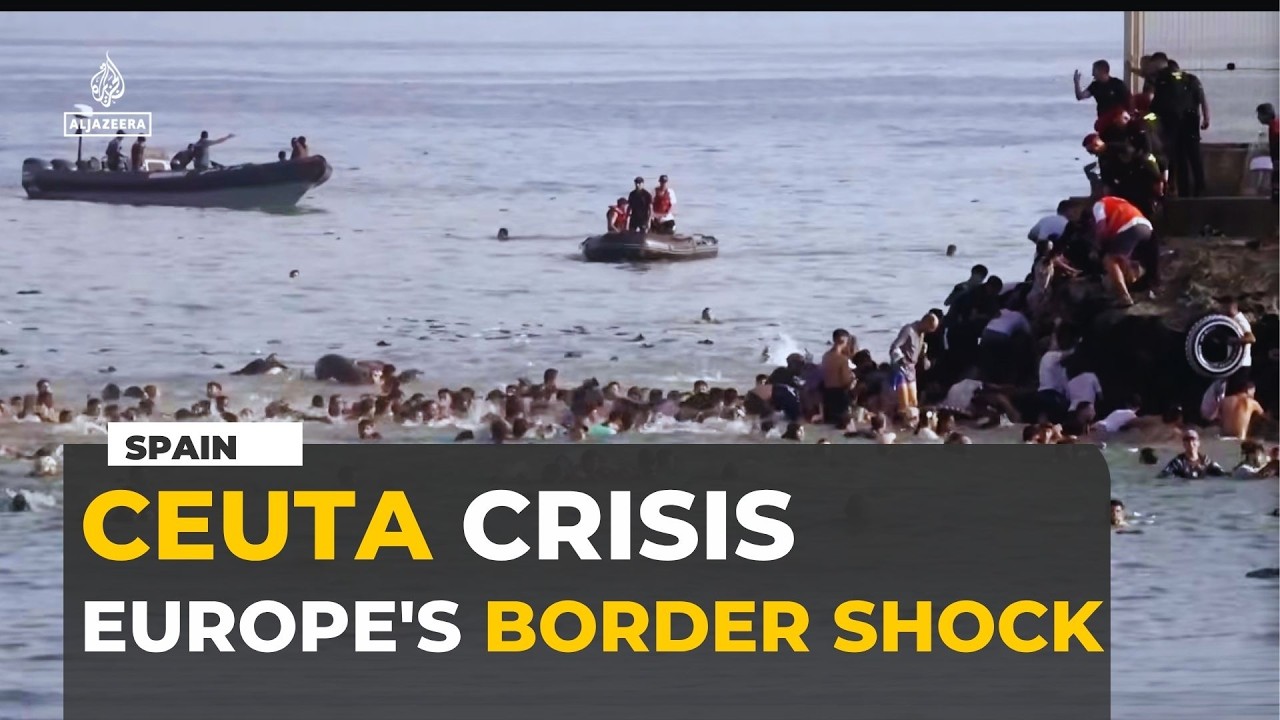
Migrant surge at Spain's Ceuta border triggers European tensions
Al Jazeera English
45,927 views • 1 month ago 4 min read
Video Summary
Italy has suspended its open border arrangement with Spain following a massive surge of migrants into the Spanish enclave of Ceuta from Morocco. Over 50,000 people reportedly crossed into Ceuta in two days, with many swimming around border fences. Tragically, at least 57 individuals are said to have died during these perilous crossings.
Spanish authorities claim most migrants have been returned to Morocco. However, the situation has triggered a strong reaction from other European nations, with France announcing tighter border controls and Germany demanding Morocco repatriate migrants. Experts note that Italy's suspension of Spain from the Schengen open border agreement is legally impossible, suggesting it's a political maneuver rather than a practical measure.
Short Highlights
- Italy suspends open border arrangement with Spain.
- 50,000 migrants crossed into Ceuta from Morocco in two days.
- At least 57 migrants died attempting the crossing.
- Legal experts state Italy cannot unilaterally suspend Spain from the Schengen zone.
Related Video Summary
Key Details
Migrant Surge into Ceuta [0:00]
- Italy has suspended its open border arrangement with Spain due to a dramatic surge in migrant crossings.
- Over 50,000 people entered the Spanish territory of Ceuta from Morocco in the past two days, primarily by swimming around a border fence.
- Spain's authorities report that most migrants have now been returned to Morocco.
- At least 57 people died while attempting the crossing.
"This is what the European Commission president called Unacceptable, images of migrants trying to get around the border fence that divides the Spanish territory of Ceuta from Morocco."
Methods of Crossing [0:29]
- Migrants employed various methods to enter Ceuta, including swimming around the border fence, scaling it, and squeezing through the wire.
- Some used inner tubes and floating devices to aid their sea crossings.
- Dozens of migrants have died since Thursday morning.
"Some try to skirt around it. Others scale the fence and try to squeeze through the wire at the top. Others take to the sea and swim around the fence, some with the help of inner tubes and floating devices."
Political Reactions [1:02]
- France announced it would implement tighter border controls with Spain.
- Italy's Prime Minister, Giorgia Meloni, is suspending the free movement of people between Spain and Italy.
- Germany's Chancellor demanded that Morocco take back what he called illegal migrants.
"Despite that, France said it would implement tighter border controls with Spain."
Spain's Explanation [1:24]
- Spain's leader attributed the surge to smugglers exploiting a Supreme Court ruling.
- The ruling limits Spain's ability to send back migrants who entered without proper documents.
"What lies behind this is the self-interested interpretation that the criminal networks trafficking human beings have made of a Supreme Court ruling."
Migrant Returns [1:43]
- Spain claims thousands of new arrivals have already returned voluntarily.
- Footage released by Spain's Interior Ministry appears to show people returning through a border crossing.
"To be honest, I don't even know why I've come. I'm heading back now. It's as simple as that."
Legal Impossibility of Suspension [2:06]
- Joris Larrick, an expert in EU and international law, stated that it is legally impossible for Italy to suspend Spain from Europe's open border agreement (Schengen).
- He explained that no single country can unilaterally suspend another from the Schengen zone, nor can it be done by common accord.
"As politically attractive as it may be for especially far-right parties, anti-immigration parties, to speak of suspending Spain from Schengen, it's legally impossible."
Passport Checks and Schengen Exclusions [2:42]
- Larrick clarified that what appears as a suspension is likely a more limited measure, such as passport checks, which are already selectively implemented between member states.
- He noted that several EU countries, including the Netherlands, have been implementing passport checks for nearly 20 months.
"So it's a political catchphrase behind which hides, actually, a much more limited measure, which is just passport checks, which are also done normally on a selective basis between member states."
Ceuta's Unique Status [3:14]
- Larrick highlighted the strangeness of the situation, noting there is no land border between Italy and Spain for passport checks, limiting them to ports and airports.
- He also pointed out that migrants arriving in Ceuta were already excluded from the passport-free Schengen travel area, meaning passport controls were already in place for them to enter mainland Europe.
"So it's really strictly ports and airports. And secondly, we're not yet talking about the migrants that have come now to Ceuta, to the enclave, being able to leave it to mainland Europe, be that Spain, Italy, or anywhere else, because passport checks, passport controls were already part of the rules there."

![Final Warning on Fed [Watch Now]](https://i.ytimg.com/vi/uXS337Waf7w/hqdefault.jpg)