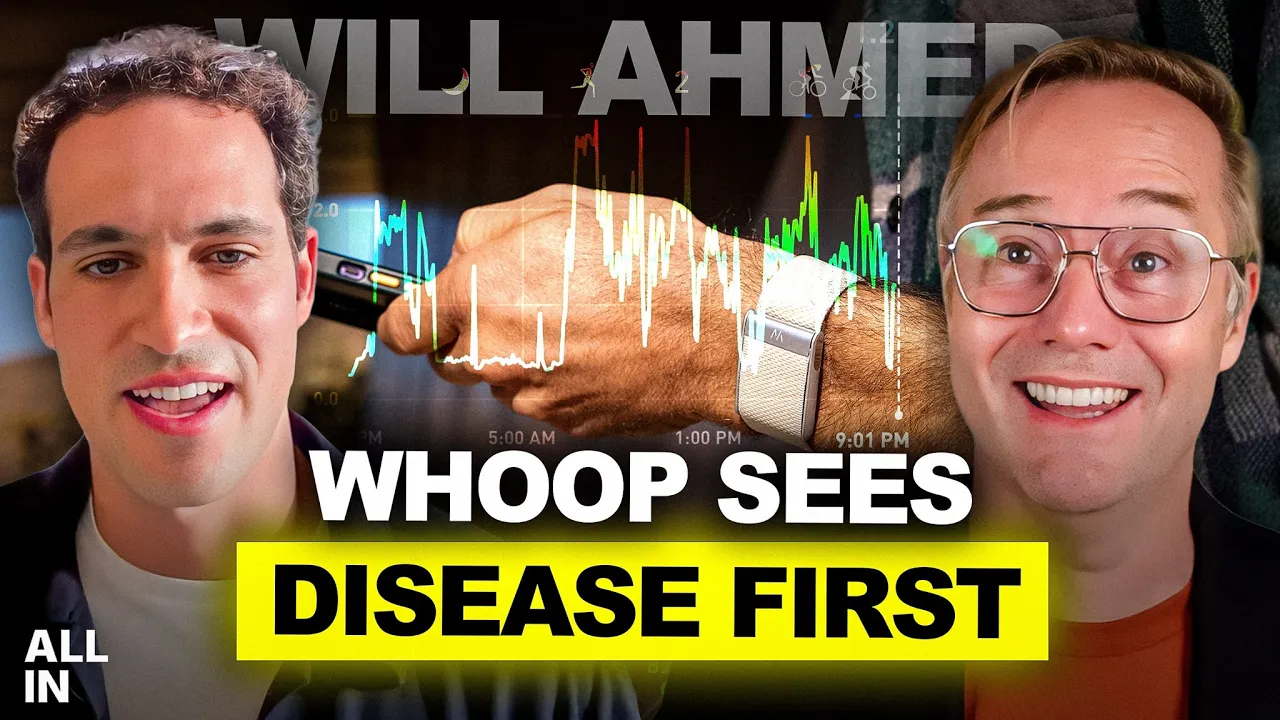
WHOOP CEO, Will Ahmed: 50B Hours of Health Data, a 4 Million Member Data Moat, & the FDA Fight
All-In Podcast
33,872 views • yesterday Save 43 min 12 min read
Video Summary
Whoop, a wearable technology company, has amassed over 50 billion hours of physiological data from its 4 million members, who wear the device for an average of 23.6 hours daily. CEO Will Ahmed shared that the company's subscription model, initiated in 2017, significantly boosted growth by lowering the entry price and shifting focus to member retention and continuous product improvement. This model incentivizes innovation, leading to features like ECG monitoring, AFib detection, advanced labs, and blood pressure insights being added to existing hardware.
Ahmed highlighted how Whoop's continuous data collection enables early detection of potential health issues, citing user testimonials of identifying serious conditions like Hodgkin lymphoma and testicular cancer through subtle physiological changes. The platform's AI coach, which learns from user feedback and physiological data, is evolving to provide personalized guidance, including travel advice and health recommendations for users on GLP-1 medication. Despite initial regulatory hurdles, Whoop has successfully integrated features like blood pressure monitoring and ECG screening, demonstrating a commitment to advancing personalized health insights.
Short Highlights
- Whoop's Growth and Business Model: The company has reached 4 million members, with a subscription model that focuses on continuous innovation and member engagement rather than frequent hardware upgrades.
- Key Health Metrics: Whoop tracks sleep, recovery, and strain, with the recovery score (red, yellow, or green) being a primary focus for users.
- Early Health Detection: The device has alerted users to potential serious health issues, including lung inflammation, COVID-19, and cancers, by detecting subtle physiological changes.
- Heart Rate Variability (HRV): This metric, measuring the time between heartbeats, offers insight into the autonomic nervous system and serves as a longevity indicator.
- The Whoop Journal: Users can log daily behaviors and lifestyle choices, allowing Whoop to provide personalized insights into how these affect recovery and overall health.
- AI Coach and Personalized Guidance: An AI coach provides tailored advice, including travel adjustments, exercise recommendations, and health management for users on medications like GLP-1s.
- LeBron James as Global Ambassador: The basketball superstar, an early adopter, now officially represents Whoop, highlighting the brand's focus on performance and longevity.
Related Video Summary
Key Details
Whoop's Scale and Data Collection [00:00:00]
- Whoop has approximately 4 million members, with projections to end the year at that number.
- Members wear the device for an average of 23.6 hours per day, contributing to over 50 billion hours of continuous physiological data.
-
"On average, a Whoop member wears Whoop 23.6 hours a day. We have just over 50 billion hours of continuous physiological data. So it's one of the largest health data sets in the world."
Subscription Model Evolution [00:01:31]
- Whoop transitioned from a one-time fee model in 2017 to a subscription model in 2018 to lower the entry price.
- This shift made Whoop a recurring revenue business, attracting investors and fostering an obsession with existing member experience and product innovation.
-
"And I think that immediately created all kinds of growth for Whoop back in 2018 and 19. And we quickly became a recurring revenue business versus a hardware business, which of course is more attractive to investors."
Continuous Product Innovation [00:04:00]
- The subscription model incentivizes Whoop to continuously improve its product, adding features like ECG monitoring, AFib detection, advanced labs, health span tracking, and blood pressure insights to existing hardware.
- This contrasts with traditional hardware businesses that push new models annually, regardless of innovation.
-
"And for us, we're actually, we're the opposite incentives. We want to launch hardware when it's really innovative and it's a step function better."
Core Whoop Metrics: Sleep, Recovery, Strain [00:07:30]
- The three main pillars of Whoop are sleep, recovery, and strain.
- Users typically check their sleep score, sleep consistency, and hours of sleep, followed by their recovery score, which ranges from 0-100% and is color-coded red, yellow, or green.
-
"The three main pillars on whoop are around sleep recovery and strain. And so most people start their day by looking at how well they slept last night."
Health Monitor and Early Alerts [00:09:21]
- The Health Monitor tracks respiratory rate, resting heart rate, skin temperature, blood oxygen, and HRV.
- One user experienced elevated respiratory rate and skin temperature for two consecutive days before developing chest pains, which Whoop had alerted him to.
-
"However, the other week, I'm going to tell you this story. It involves me going to the emergency room with chest pains."
User Experience: Chest Pains and Lung Inflammation [00:10:00]
- A user experienced chest pains and was hospitalized, where tests revealed inflammation in his lungs constricting his heart.
- He credits Whoop for alerting him to subtle physiological changes two days prior, allowing him to be on high alert.
-
"It turns out I had inflammation in my lungs, around my chest, and my heart was being constricted. So I was experiencing chest pain."
COVID-19 Detection and Early Treatment [00:12:00]
- A similar incident occurred three years prior when a user's skin temperature and HRV alerted him to a potential illness.
- This led him to test positive for COVID-19, allowing him to receive early treatment with Paxlovid.
-
"So I have two bad scores. I'm in New York with one of my daughters. And I was able to take that Pax Lovid, which you can only take if you get to it early."
Predicting Biomarkers with Physiological Signals [00:13:50]
- With extensive data, Whoop is exploring the prediction of biomarkers being out of range without direct measurement.
- This could lead to highly targeted testing recommendations for users.
-
"Through physiological signals, we might be able to predict that a biomarker is out of range without actually measuring the biomarker itself."
Case Study: Baseball Player and Hodgkin Lymphoma [00:14:20]
- A fit, healthy baseball player noticed abnormally elevated heart rates during sleep.
- Subsequent medical tests revealed he had stage four Hodgkin lymphoma, and he was able to receive treatment and recover.
-
"I got a message last week from a fit, healthy baseball player who all of a sudden saw he had these elevated heart rates while he was sleeping that looked very abnormal."
Understanding Heart Rate Variability (HRV) [00:15:30]
- HRV measures the time between successive heartbeats; higher variability generally indicates a healthier system.
- It provides insight into the autonomic nervous system's balance between sympathetic (stress) and parasympathetic (rest) activity.
-
"HRV stands for heart rate variability. It's the amount of time between successive beats of the heart and it's a little counterintuitive, but the more variability in time between successive beats of the heart, the healthier your overall system is operating."
HRV as a Longevity Indicator [00:17:00]
- HRV naturally decreases with age, but maintaining or improving HRV over time can be a sign of good fitness and longevity.
- A significant drop in HRV can indicate underlying health issues.
-
"Typically speaking, as you get older, your heart rate variability will drop."
Case Study: Testicular Cancer and HRV [00:18:00]
- An individual with a consistent HRV baseline of around 100 experienced a sudden drop to 50.
- Further medical tests revealed he had testicular cancer.
-
"This individual, they had a very steady heart rate variability that was within a specific range and all of a sudden it plummeted."
24/7 Wearability and Battery Life [00:19:30]
- Whoop's design emphasizes 24/7 wearability, including during showers and baths, with a 14-day battery life.
- A slide-on battery charger allows for continuous use without removing the device.
-
"The reason I have had so many long streaks, the only time I really stopped using this for the past couple of years is when I lost it and I had to order a new one."
Data Integration and AI Development [00:22:00]
- Whoop is developing its own foundational AI models trained on its vast physiological data, user feedback, advanced labs, and medical records.
- The goal is to predict health issues and provide highly personalized insights.
-
"So, you're using open source models or you're partnering with something? We're developing our own models."
The Whoop Journal and Behavioral Insights [00:27:00]
- Over 50% of Whoop members use the journal daily to log behaviors, lifestyle choices, and supplements.
- This data helps Whoop identify correlations between logged actions and their impact on recovery and health metrics, such as alcohol consumption or warm baths.
-
"So, the Whoop journal is essentially 100 plus different behaviors, lifestyle decisions, supplements, drugs, you name it, that someone might want to log."
Impact of Behaviors on Recovery [00:29:00]
- Logging behaviors reveals significant impacts: a warm bath can increase recovery by 7%, while alcohol can decrease it by 9%.
- Late meals (within three hours of bedtime) are shown to be detrimental to sleep and recovery across the Whoop population.
-
"So, a big wake-up call for a lot of people ends up being alcohol, because it'll show you that alcohol has this, like, hugely negative effect on your recovery."
Stress Score and Proprietary Metrics [00:34:00]
- The stress score, a proprietary Whoop metric, is primarily based on HRV but also uses other sensor data.
- Whoop excels at translating complex physiological research into user-friendly scores and designs.
-
"The stress score itself is something that we invented. Of course, we based it on physiological research."
AI Coach and Goal-Oriented Training [00:37:00]
- The AI coach, integrated less than six months ago, learns from user interactions and data to provide personalized coaching.
- It can create training programs based on user goals, such as injury prevention for skiing, and track progress with features like badges for activities like rucking.
-
"It's now the AI understands my goals, kind of coaching me and setting up plans."
GLP-1 Tracker and Muscle Preservation [00:39:00]
- Whoop introduced a GLP-1 tracker to help users manage weight loss medication effectively.
- It emphasizes maintaining muscle mass during weight loss by encouraging activity and strength training, and tracking protein intake.
-
"And, you know, so that's how sometimes people can end up getting quite frail, even though they've lost a considerable amount of weight."
FDA Relationship and Blood Pressure Insights [00:43:00]
- Whoop has navigated a complex relationship with the FDA, particularly regarding its blood pressure monitoring feature.
- Initially classified as a medical device requiring regulation, Whoop argued for its wellness application, leading to updated FDA guidelines.
-
"And so, you know, our blood pressure insights feature is still available for consumers."
FDA Cleared Features: ECG [00:47:00]
- Whoop's ECG feature, which allows users to take an electrocardiogram from their wrist, has received FDA clearance (510K).
- This demonstrates Whoop's ability to obtain medical clearances for specific features while also pursuing wellness applications.
-
"Whoop also has medical clearances from the FDA. So our ECG feature where you can literally do an ECG from your wrist by just putting your fingers on the Whoop, that's an FDA cleared product, 510K."
Data Privacy and Business Model Distinction [00:50:00]
- Whoop emphasizes strong data policies, stating they do not sell user data, and the membership, not the data, is the product.
- This differentiates them from companies like Google and Apple, whose business models rely on advertising or expensive hardware.
-
"We do not sell data. You know, you are not the product, Jason, like you're, the membership is the product."
Competition and Market Evolution [00:51:30]
- While Apple's Watch is successful, Whoop focuses on a screenless, 24/7 wearable experience.
- Many companies that entered the wearable space a decade ago, like Jawbone, Fitbit, Nike, Adidas, and Under Armour, have since exited or struggled.
-
"It's interesting, 10 years ago, there were more competitive products in the market than there are today."
Lightning Round: Preferences [00:53:00]
- Podcasting: Andrew Huberman for wider audience reach.
- Cold Therapy: Cold shower for accessibility and daily impact.
- Heat Therapy: Classic hot sauna.
- Exercise: Lifting weights is prioritized over Zone 2 cardio for longevity and muscle mass.
- Alarm: Exact time alarm for sleep consistency, especially for running a company.
- Coffee: Drink coffee first thing in the morning.
- Obsession: Recovery score.
-
"If you're on vacation, you can go with recovery or sleep, but if you're trying to run a tech company, you better pick an exact time."
LeBron James as Global Ambassador [00:57:00]
- LeBron James, an 11-year Whoop user, is now a global ambassador.
- His long-term, authentic use of the product was crucial validation for Whoop in its early stages.
-
"LeBron James is now a global ambassador for Whoop. He was one of the first hundred people to ever wear it."
Athlete Wearables in Competition [01:00:00]
- The NBA is still considering allowing players to wear devices like Whoop during games due to jewelry restrictions.
- At the Australian Open, some players were asked to remove their Whoop devices, but the International Tennis Federation (ITF) has since approved wearables for matches.
-
"Well, at the Australian Open, the tennis tournament, Yeah, I don't watch the tennis. A number of players were asked to take their whoop off while they were playing."
Late-Stage Venture and SPVs [01:03:00]
- The Syndicate has expanded into late-stage practice, facilitating investments in billion-dollar companies like Zipline and Icon Homes.
- Navigating Special Purpose Vehicles (SPVs) for secondary transactions requires coordination with company CFOs.
-
"So we started a late stage practice that we just started this year at the syndicate. Thanks for asking."
Secondary Market Caution [01:04:30]
- Be wary of secondary brokers who may fabricate share availability to create a market.
- Direct communication with the company's CFO is crucial for legitimate secondary transactions.
-
"The other thing to be wary of are these secondary brokers who they claim they've got shares from someone at a price."
Investment Opportunities and AI Impact [01:06:00]
- The current market presents interesting investment opportunities, with AI expected to significantly impact various sectors.
- Companies in the "anti-AI trade" like DoorDash and Uber are being closely watched.
-
"Lots of great investment opportunities. We'll see you all next time on the All-In Interview Program."