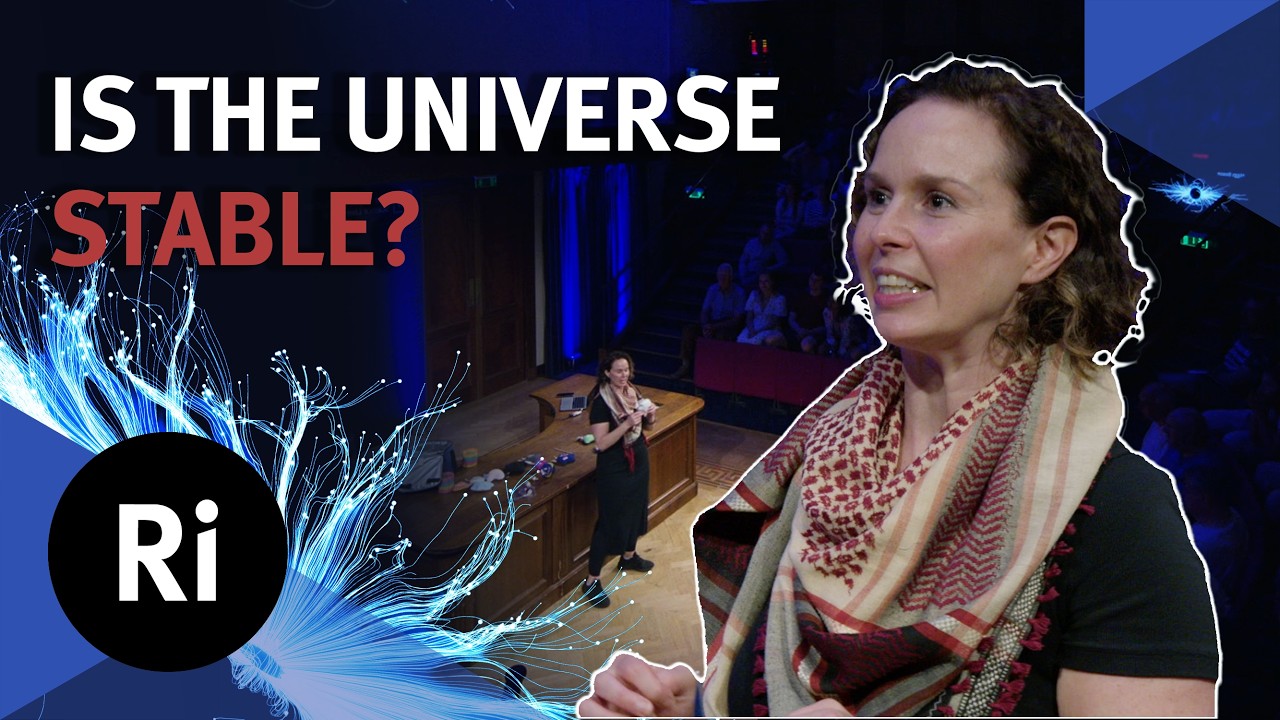
Is the top quark a threat to the universe? | with Kate Shaw
The Royal Institution
24,131 views • 1 month ago Save 40 min 5 min read
Video Summary
The talk explores the fundamental particles of the universe, starting with the Large Hadron Collider (LHC) which collides protons at near light speed to recreate conditions of the Big Bang. It delves into the discovery of quarks, their properties, and how they form protons and neutrons. The discussion then shifts to the Higgs boson, explaining its role in giving mass to particles and its connection to the top quark. Finally, it touches upon the stability of the universe, suggesting that the masses of the Higgs and top quarks might indicate a metastable state, and introduces the Future Circular Collider (FCC) as a next-generation accelerator to further investigate these mysteries.
Short Highlights
- The Large Hadron Collider collides protons to study fundamental particles.
- Quarks are fundamental particles that form protons and neutrons.
- The Higgs boson gives mass to particles, interacting with them to varying degrees.
- The masses of the Higgs and top quarks may indicate the universe's stability.
Key Details
The Large Hadron Collider and Particle Collisions [00:00:00]
- The Large Hadron Collider (LHC) accelerates protons to near the speed of light and collides them.
- These collisions recreate conditions similar to the Big Bang, allowing scientists to study fundamental particles.
- The LHC operates at extremely low temperatures, colder than outer space, using superconducting magnets.
"So the LHC is actually one of the coldest places in the universe."
The Discovery of Quarks [00:03:00]
- Early 20th-century physics progressed from understanding atoms to discovering subatomic particles like electrons and protons.
- The discovery of numerous new particles led to the development of the quark model by Murray Gell-Mann in the 1960s.
- Quarks are fundamental particles that combine to form composite particles like protons and neutrons.
"He explained that actually most of these particles, not all of them, the electron is definitely fundamental."
Quarks and Their Properties [00:06:00]
- Protons are composed of two 'up' quarks and one 'down' quark, while neutrons are made of one 'up' quark and two 'down' quarks.
- Up quarks have a charge of +2/3, and down quarks have a charge of -1/3, resulting in protons having a charge of +1 and neutrons a charge of 0.
- Quarks are confined within hadrons and cannot exist independently, held together by gluons via the strong force.
"So if the electric charge of the up quark is plus two thirds, and the electric charge of the down quark is minus a third, what is the charge of your proton?"
The Strong Force and Confinement [00:09:00]
- The strong force, mediated by gluons, binds quarks together.
- Unlike gravity or electromagnetism, the strong force increases as quarks are pulled apart, a phenomenon known as confinement.
- This force is so strong that attempting to separate quarks creates new particles from the vacuum.
"And when they're inside the protons, they're more or less free. They're close together. So they can move around and they can do their thing."
Particle Jets and the Top Quark [00:12:00]
- High-energy collisions produce sprays of particles called jets, which are challenging to analyze.
- The top quark, discovered in 1995, is the heaviest known fundamental particle and has a very short lifetime.
- Due to its short lifetime, the top quark decays before it can hadronize, allowing direct study of the bare quark.
"And it took 17 years for us finally to find it. And as you'll see with the other particle experiments, it does always take this long."
The Higgs Boson and Mass [00:15:00]
- The Higgs boson is associated with the Higgs field, which permeates the universe and gives particles mass through interaction.
- Particles that interact more strongly with the Higgs field gain more mass, while those that don't, like photons, remain massless.
- The mass of the top quark is crucial for predicting the mass of the Higgs boson.
"So the mass of electron about 0.5 MeV. If you're a bigger particle, like a top quark, you interact more strongly."
The Fate of the Universe and the Higgs Potential [00:18:00]
- The stability of the universe may depend on the Higgs potential and the masses of the Higgs and top quarks.
- A metastable state could mean the universe might transition to a lower energy state, with catastrophic consequences.
- Quantum tunneling allows particles to pass through energy barriers, potentially causing such a transition.
"So is the Higgs potential in its lowest minima or, which we think where it's here now, or could it get enough energy or quantum tunnel to an even low minima?"
Future Accelerators and Unanswered Questions [00:21:00]
- The Future Circular Collider (FCC) is a proposed next-generation accelerator designed to make more precise measurements.
- The FCC aims to investigate the stability of the universe, dark matter, dark energy, and the quantum description of gravity.
- New discoveries, possibly of new particles, could resolve current theoretical inconsistencies and confirm the universe's stability.
"FCC, Future Circular Collider. It's going to be 100 kilometres in circumference built again under the Swiss fence border."