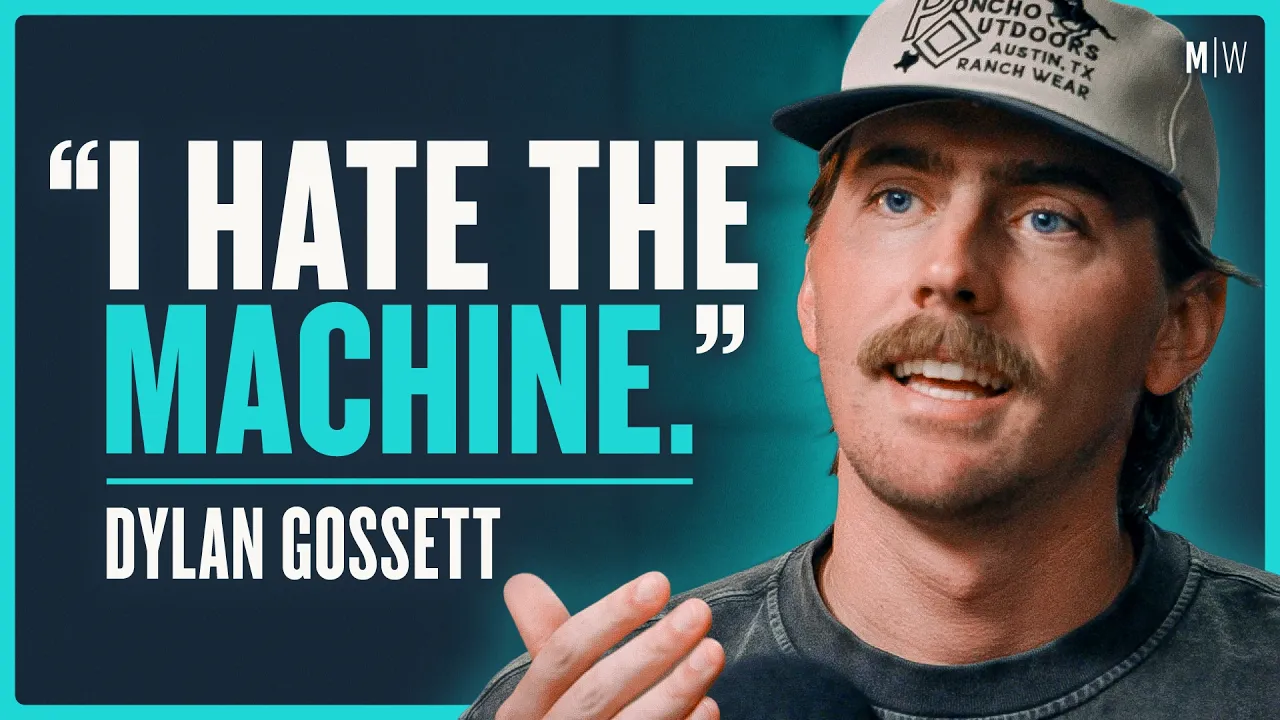
How To Make Your Creativity Beat The Algorithm - Dylan Gossett (Live Performance)
Chris Williamson
48,948 views • yesterday Save 81 min 8 min read
Video Summary
The artist discusses the creation of his hit song "Cole," revealing it was written in a mere 25 minutes and initially sat unreleased for two years. He reflects on the song's unexpected viral success after being posted on TikTok, contrasting his initial reluctance to engage with social media with the platform's power to launch his career.
Gossett also delves into the music industry's evolving landscape, touching on the challenges of authenticity in a world of algorithm-driven promotion, the increasing cost of live music, and the impact of AI on creative processes. He shares his personal philosophy on songwriting, emphasizing the importance of genuine emotion and lived experience, even when it means facing difficult or sad themes, as he believes hard-won experiences create more meaningful art than easy successes.
Short Highlights
- "Cole" was written in approximately 25 minutes.
- The song sat unreleased for two years before gaining viral traction on TikTok.
- Gossett initially avoided social media promotion but "Cole"'s success changed his perspective.
- He discusses the difficulty of maintaining authenticity in music promotion.
- The increasing cost of concert tickets and its impact on live music.
- The role of AI in music creation and the debate around its use.
- The importance of genuine emotion and lived experience in songwriting.
Key Details
The Genesis of "Cole" [00:00:00]
- The song "Cole" was conceived and written very quickly, with the artist estimating about 25 minutes.
- The initial spark for the song came from the phrase "pressure makes diamonds."
- The artist typed out lyrics on his phone while at home, keeping his musical endeavors private from most friends.
"They say pressure makes diamonds have to hit. You know, I was like, that's, that's great. That's a song we got to build around it."
A Song Unreleased [00:00:00]
- Despite its rapid creation and his wife's enthusiasm, the song "Cole" was not released for about one to two years.
- The artist was not active on social media platforms during this period, which contributed to the delay.
"No way. You sat on that. You sat on a song that did like half a billion streams?"
The TikTok Catalyst [00:00:00]
- A camping trip with friends led to the song being heard by Caden, who recognized its potential.
- Caden's encouragement and his wife's suggestion to post on TikTok eventually led to the song's release.
- The artist was initially hesitant about using TikTok, viewing himself as "not a TikToker."
"My wife was like, Dylan, you should just post on Tik TOK. And I was like, well, I'm not, you know, I'm not a Tik TOKer."
"Cole" Goes Viral [00:00:00]
- The song "Cole" became a significant success, amassing hundreds of millions of streams.
- The artist reflects on how this unexpected virality contrasted with his previous lack of social media presence.
"And then Cole became this thing, which is insane."
Austin and Personal Struggles [00:00:00]
- The song "Cole" is set in Austin, Texas, and reflects a difficult period for the artist.
- He was working event operations at the Circuit of the Americas racetrack, enduring long hours.
- The lyrics also touch upon personal or family struggles during that time.
"So I was living in Austin. I worked in, are you talking about Cole? Yeah. Cole."
The "Input-Output" Equation [00:00:00]
- The artist relates the song's theme to the feeling of working hard without seeing immediate rewards.
- He describes this as accumulating "reps" and building "latent leverage" over time.
- The top comment on YouTube for "Cole" resonated with this feeling of loneliness and perceived failure despite self-improvement.
"The top comment says, this song has the feeling when you're working on yourself and making progress, but you still feel lonely and like a failure."
Growth Through Struggle [00:00:00]
- Gossett believes that the struggles he experienced, including his job at the racetrack, provided a crucial frame of reference.
- He feels these experiences were necessary to navigate the music industry and write authentically.
"Without going through that job and understanding even personal relationships outside of college, like just kind of real world items, like, I don't know. I feel like I can't even imagine being thrown into the music industry..."
The Business of Art [00:00:00]
- The artist highlights that being a musician involves significant business management beyond just creating music.
- He uses the analogy of a baker who loves making cakes but gets caught up in the business operations.
"I feel there's at times where I feel a lot more like a business manager than, than an artist for sure."
The E-Myth and Focus [00:00:00]
- He references Michael Gerber's "The E-Myth Revisited" and its story about a baker losing touch with her passion.
- The core message is the importance of saying "no" to distractions to focus on what made one successful.
"And before she knows it, she hasn't made a fucking cake in years."
The Puritan Work Ethic vs. Deep Work [00:00:00]
- The artist contrasts the visible productivity of tasks like answering emails with the less tangible benefits of "deep work" like taking long walks.
- He questions the value placed on constant busyness over periods of reflection and contemplation.
"And we go, well, how useful is it for you to go fishing for an afternoon with nothing else happening?"
Shifting Goalposts [00:00:00]
- Success changes expectations, making it harder to appreciate the initial passion for creating.
- The artist notes that the raw recording of "Cole" on his laptop would sound like a "demo" to him now.
"And now it's like, dude, like three years, three and a half years later, or I guess from Cole writing, it's like five years. But looking back, like if I wrote that exact same song today and I, like if I hear the version of Cole right now, I would be like, what is this demo?"
Hedonic Treadmill and Evolving Problems [00:00:00]
- The concept of the "hedonic treadmill" applies not just to possessions but also to goals and problems.
- What once seemed like a significant problem (e.g., needing a team to tune a guitar) becomes a new set of challenges as life progresses.
"And you get accustomed to a different quality of life, a different, you know, level of, of ease or something."
The "Porch Version" Dilemma [00:00:00]
- Gossett struggles with audience preference for his raw, acoustic "porch versions" over more produced studio recordings.
- He feels pressure to stick to what's known rather than experimenting with new sounds, citing Billy Joel and Bob Dylan as artists who evolved their styles.
"And everyone's like, just, just don't change it. Give me the porch version. Give me the porch. You know, and it's like, I think you have to try to expand your sound."
Audience Capture and Criticism Capture [00:00:00]
- The artist explains "audience capture," where creators tailor content to audience feedback, potentially losing their own voice.
- He also discusses "criticism capture," where creators act defensively to avoid negative feedback.
"And it's like, hold on. We're the millionaires. Where's fucking, where's, where's gossip AI?"
The Value of Hard Wins [00:00:00]
- Gossett emphasizes the idea that "easy wins are forgettable, hard ones change you."
- He believes that genuine accomplishment comes from overcoming challenges, contrasting this with AI-generated content.
"Do hard shit, not because it's fun, but because the win actually means something. You bled for it. You broke for it. You earned it."
The "Ick Radar" and AI [00:00:00]
- He discusses the ethical line regarding AI in creative work, referring to an "ick radar" for what feels wrong.
- While acknowledging AI's utility, he draws a line at using it for artistic or sentimental creation, preferring human effort.
"I think there are people that are just going to always push the envelope of be like, well, what am I, what am I allowed to do?"
Male Sadness in Country Music [00:00:00]
- Gossett theorizes that male sadness in country music provides a safe outlet for men to express emotions.
- He observes that this vulnerability is accepted in songs but often not in direct personal conversation among men.
"It feels like it's guys, uh, almost like a dude therapy session."
"Clothesline" and Creative Process [00:00:00]
- The artist performs "Clothesline" from his upcoming album, noting his preference for a less formulaic release strategy.
- He misses the era when albums were released with no pre-released singles, allowing fans to discover the entire body of work at once.
"A part of me misses the way of like, when an artist puts out an album, you don't know what the songs are. They've not waterfall released five in advance."