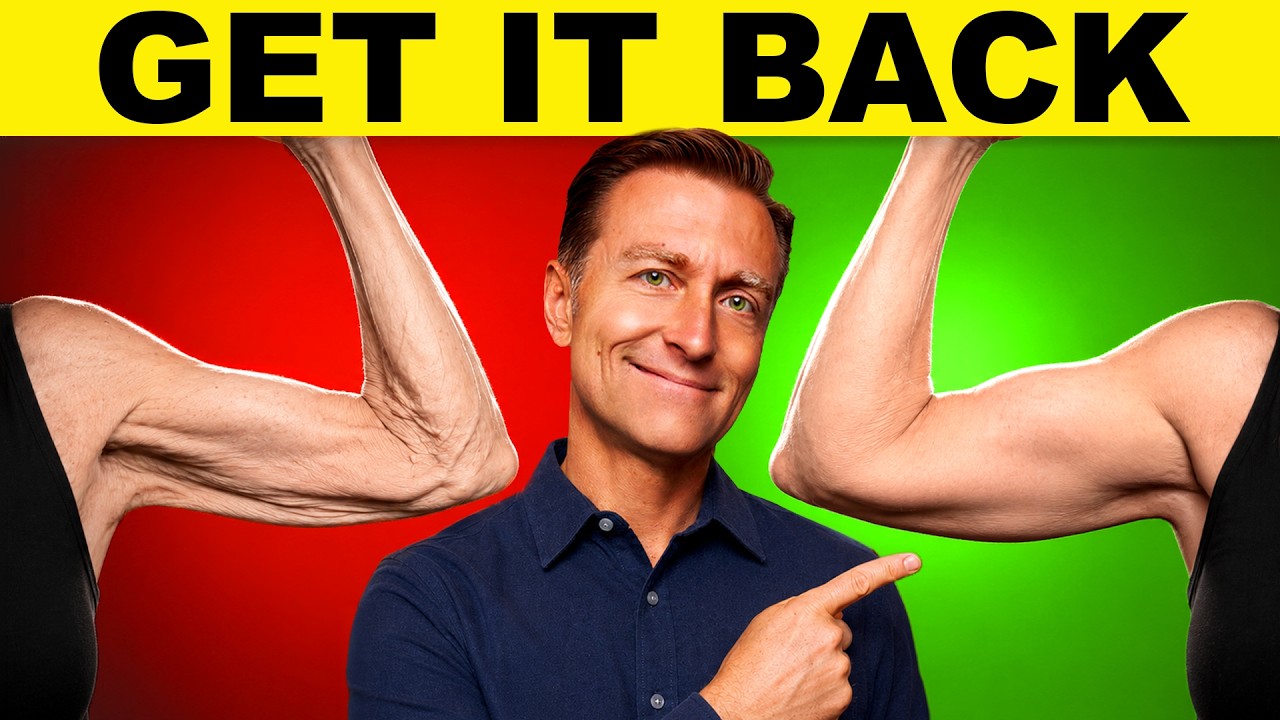
Losing Muscle After Menopause? Protein Isn’t Enough (Do THIS 2x a Week)
Dr. Eric Berg DC
261,814 views • 1 month ago Save 8 min 4 min read
Video Summary
This video explains why women lose muscle after menopause and how to regain it. Muscle loss is linked to hormonal changes, particularly a drop in estrogen, which leads to anabolic resistance. The key to rebuilding muscle involves a combination of adequate protein intake, specifically leucine, and targeted exercise. Heavy lifting, even for older women with bone density issues, has shown significant muscle and bone mass recovery. The video emphasizes that it's never too late to start, but early intervention is crucial to avoid irreversible muscle and nerve damage. It also touches on the importance of other nutrients like creatine, vitamin D, omega-3s, and magnesium for muscle health.
Short Highlights
- Women can experience significant muscle loss in the three years after menopause due to hormonal changes.
- Leucine, an amino acid, is crucial for muscle growth, and its requirement increases with age.
- Heavy resistance training, even for older women, can significantly improve muscle and bone mass.
- Adequate protein intake, creatine, vitamin D, omega-3s, and magnesium support muscle health.
Related Video Summary
Key Details
The Menopause Muscle Loss Window [0:00]
- Women can lose more muscle in the three years after menopause than in the previous 20 years combined.
- This muscle loss occurs as women transition from pre- to post-menopause, even with healthy eating and exercise.
"There's a three-year window in a woman's life where she can lose more muscle in that period of time than the previous 20 years combined."
Understanding Muscle Growth Signals [1:00]
- Muscle growth is signaled by the amino acid leucine, with a requirement of 3-4 grams per serving.
- Leucine acts as a message, but other protein components are needed for the actual building process.
- The need for leucine and protein increases with age, especially for muscle maintenance.
"But within the muscle, there's really only one thing in that muscle that tells the muscle to grow."
Hormonal Impact and Anabolic Resistance [2:00]
- Post-menopausal muscle loss is primarily due to hormonal changes, particularly the drop in estrogen.
- Estrogen helps conserve muscles, and its decline contributes to difficulty in building muscle mass.
- This condition is medically termed anabolic resistance, where muscles become less responsive.
"One of the purposes of estrogen is not to build muscle. It helps you conserve your muscles."
The Role of Exercise [3:00]
- Exercise is essential to make muscles responsive to protein and hormones, opening the door for growth.
- Without exercise, dietary protein and hormones have limited impact on muscle building.
- The "LiftMore" trial showed significant muscle and bone mass recovery in post-menopausal women through heavy lifting.
"Exercise actually opens a door to allow for the dietary protein to actually go in there and build the muscle."
Exercise Benefits and Age Irrelevance [4:00]
- A study comparing older runners with those who started exercising in their 50s found the latter group caught up in muscle mass.
- This suggests it is never too late to start exercising for muscle gain.
- However, severe muscle loss can lead to sarcopenia, involving loss of muscle, nervous system function, and connective tissue, potentially reaching a point of no return.
"So I believe it's never too late to get started."
Inactivity and Muscle Atrophy [5:00]
- Inactivity rapidly causes muscle atrophy; reducing daily steps significantly within two weeks led to measurable muscle loss.
- Even short periods of bed rest can result in substantial leg muscle loss.
"And within just two weeks, there was significant measurable muscle loss and weakness."
Protein Intake Recommendations [7:00]
- Protein requirements increase with age, with women needing 35-45 grams per meal post-menopause.
- High-quality animal protein sources are recommended for their leucine content.
- Whey protein, chicken leg, beef, tuna, and cottage cheese are discussed as protein sources with varying leucine levels.
"When you get older, you need 35 to 45 grams of protein per meal to keep this muscle system intact."
Supplements and Nutrient Support [9:00]
- Creatine supplementation, combined with exercise, has shown significant strength and muscle gains in older women.
- Vitamin D deficiency is linked to increased muscle loss.
- Omega-3 fatty acids and magnesium (specifically magnesium glycinate) are also important for muscle function and energy production.
"Creatine is something that actually can fuel the muscle and give you more energy to work out."