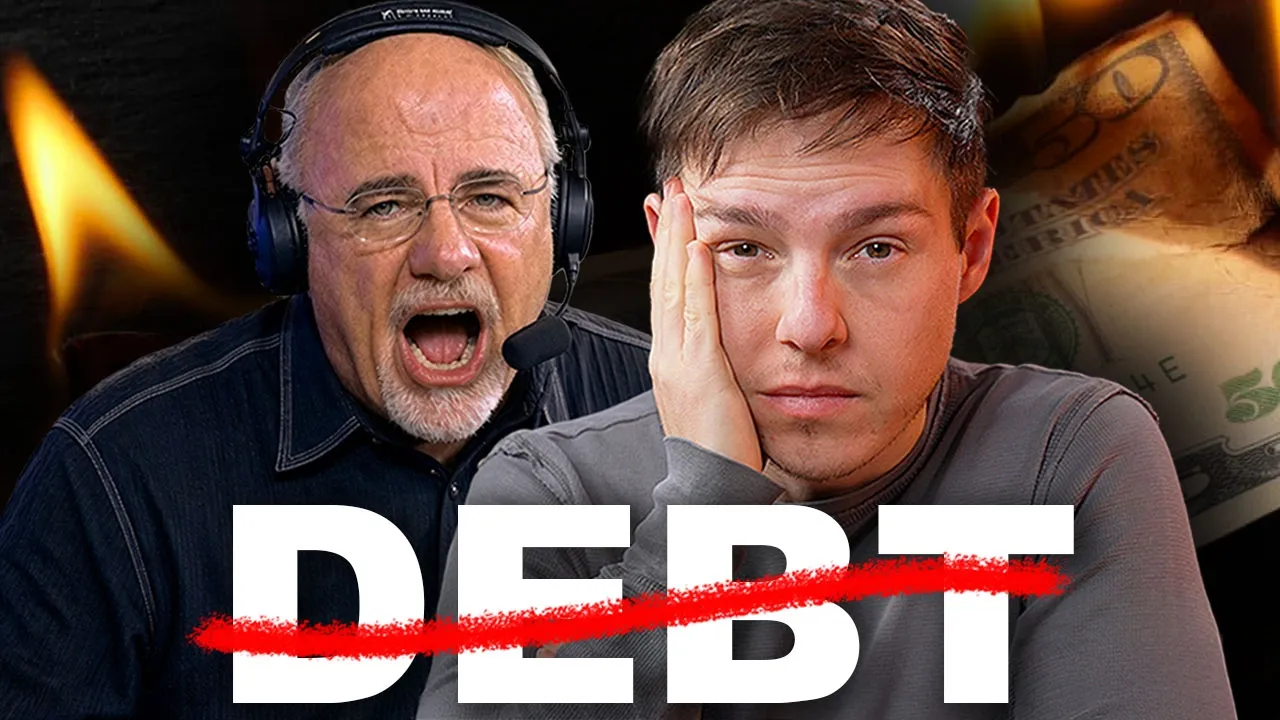
I Paid Off My 2.875% Mortgage…Dave Ramsey Was Right
Graham Stephan
1,208,284 views • 4 days ago Save 11 min 5 min read
Video Summary
For years, financial advice centered on maximizing returns by investing low-interest debt, like 3% mortgages, rather than paying them off. The logic was sound: borrow at a low rate and earn more in the market. However, the speaker, who previously championed this strategy, reveals a surprising shift after paying off three low-interest mortgages himself.
He discovered that the psychological burden of debt, regardless of its interest rate, significantly impacted his mental clarity and decision-making. Research supports this, showing reduced anxiety and improved cognitive function after debt elimination. While mathematically suboptimal, the emotional relief and peace of mind derived from being debt-free proved more valuable than the potential market gains, leading him to reconsider the true cost of debt beyond just interest rates.
Short Highlights
- The Conventional Wisdom: For years, the prevailing financial advice was to avoid paying off low-interest debt (e.g., 3% mortgages) and instead invest the difference in the market to achieve higher returns.
- A Personal Reversal: The speaker, after years of advocating this strategy, unexpectedly paid off three low-interest rate mortgages.
- The Emotional Impact: Eliminating debt, even at low rates, provided a profound sense of relief and mental clarity that couldn't be quantified by financial calculations.
- Research Backs the Feeling: Studies indicate that paying off debt, regardless of interest rate, leads to reduced anxiety, better decision-making, and improved cognitive performance.
- Beyond the Math: While mathematically, paying off low-interest debt might seem suboptimal, the emotional benefit of peace of mind is a significant, often overlooked, factor.
- Prioritizing Mental Well-being: The speaker now suggests a balanced approach: secure an emergency fund, get employer 401k matches, pay off high-interest debt, and then consider paying down mortgages for mental clarity if desired.
- A New Perspective: The value of simplicity and reduced stress can outweigh the optimization of every dollar and spread, especially as one gets older.
Key Details
The Conventional Wisdom: Don't Pay Off Low-Interest Debt [0:00]
- For years, the speaker advised against paying off low-interest debt, advocating for market arbitrage to earn more.
- Mathematically, it made sense to invest money earning higher returns than the interest rate on debt like a 3% mortgage.
-
"Mathematically, we all know it makes sense not to pay off the 3% mortgage because you could earn way more money in the stock market."
The Unthinkable Act: Paying Off Mortgages [1:05]
- The speaker reveals he recently paid off three low-interest rate mortgages, a move that goes against his previous advice.
- This action brought an unexpected sense of relief, a feeling he hadn't anticipated.
- His Twitter poll showed that out of millions of views and thousands of replies, almost no one regretted paying off low-interest mortgages.
Early Financial Philosophy: Debt is Bad [2:19]
- Growing up, the speaker was taught that all debt was bad and that purchases should be made with cash.
- He avoided credit cards and loans, relying only on a debit card and savings account.
-
"That was basically my entire financial education before turning 18."
A Turning Point: The Power of Credit [3:05]
- At 21, while trying to buy real estate, he was denied a loan solely because he had no credit history, despite having the funds.
- This experience flipped his philosophy, showing him that debt and credit are tools to be used strategically.
- He realized that using leverage could make millions.
The Arbitrage Strategy: Borrow Low, Earn High [4:30]
- The speaker learned to leverage debt by borrowing at low interest rates (e.g., 5%) and investing in assets with higher returns (e.g., 12%).
- This strategy involved opening numerous credit cards and quickly boosting his credit score to secure mortgages at low rates (e.g., 3.375%, 3.5%, 3.6%).
-
"If I could borrow money at 5% and invest it into something making 12%, that's 7% that I earn for money that was never mine to begin with."
The Shift: Emotional vs. Mathematical Debt Payoff [7:50]
- Despite the mathematical logic, the speaker found that the outstanding obligation of debt created a mental burden.
- After selling properties and paying off mortgages, he experienced a profound sigh of relief and a freeing feeling.
- He realized that while mathematically it might be the wrong choice, the emotional benefit of being debt-free was significant.
-
"It was as though something was taking up mental space in my head that I didn't even know existed until it was gone."
The Uncalculated Value: Peace of Mind [9:00]
- Research shows that paying off debt leads to reduced anxiety, better decision-making, and improved cognitive function, even for high earners.
- The speaker concludes that paying off a low-interest mortgage is an emotional decision, not a financial one, buying peace of mind.
-
"What you are actually buying by paying down the loan, it's hard to put a price on this, but it's simply peace of mind."
Finding Balance: Cash Buffer and Debt [11:00]
- While debt-free is good, having no cash on hand is detrimental; cash reserves predict life satisfaction better than income or net worth.
- The ideal approach is to maintain a cash buffer first, then pay down debt.
- Paying down a low-interest mortgage at the expense of retirement accounts or high-interest debt is often a mistake, costing 11-17 cents on the dollar.
-
"The best thing that you could do is simply maintain a cash buffer on the sides at all times, no matter what, and then pay down debt second."
The Future Approach: Prioritizing Simplicity [12:30]
- The speaker now prioritizes a shorter list of things to think about and fewer financial complexities.
- He would now strongly consider paying off a mortgage early when moving.
- His future advice prioritizes an emergency fund, employer 401k match, high-interest debt, and then, for mental clarity, paying down mortgages.
-
"At a certain point, you really just have to ask yourself what all of this is eventually for."