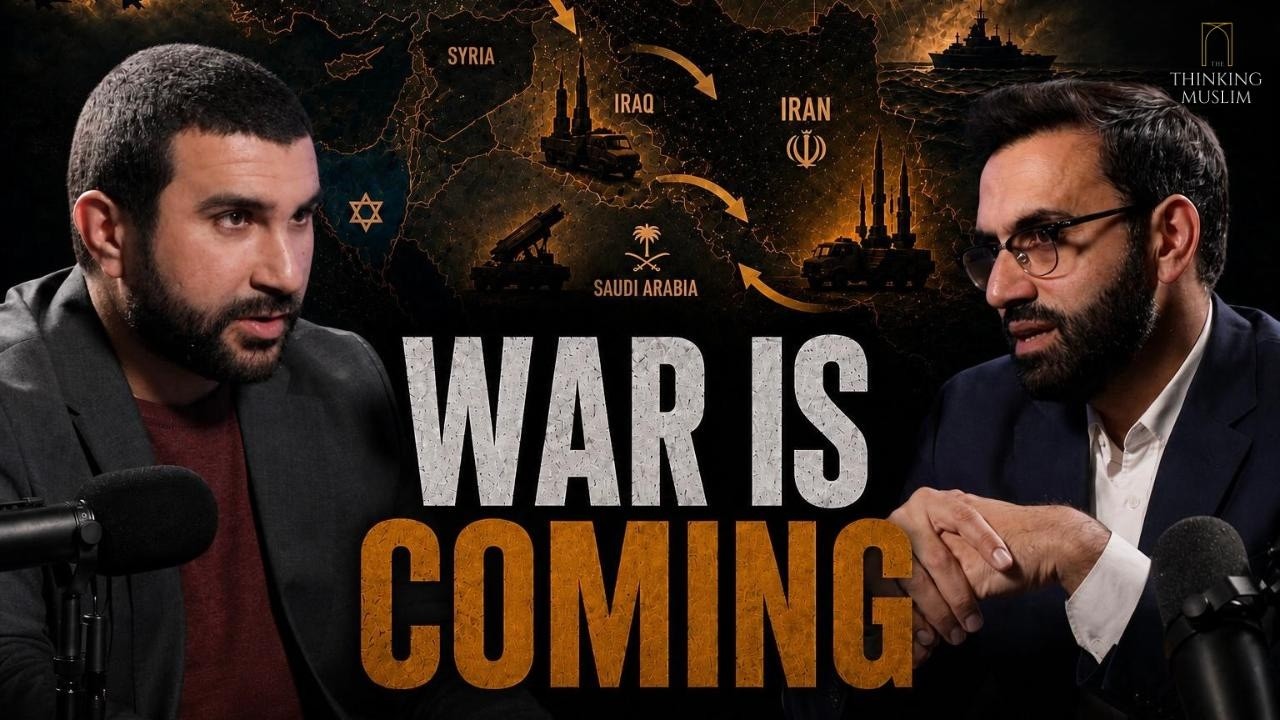
The Next Middle East War Has Already Begun | Sami Hamdi
The Thinking Muslim
207,935 views • Save 76 min (7 min read) • 9 days ago
Video Summary
The Prophetic Strategy Summit in Istanbul served as a platform for individuals involved in community projects to connect and share insights. Discussions ranged from combating anti-Semitism in France and xenophobia in South Africa to addressing political divisions in Malaysia and the challenges of AI development in the Muslim world. A significant portion of the conversation focused on the geopolitical tensions between Iran and the US, with an analysis of Iran's leverage points and the strategic maneuvering of Donald Trump. The summit also highlighted the importance of diverse perspectives and interdisciplinary approaches, drawing parallels to historical polymaths and emphasizing the need for collaboration to understand complex global issues. The discussion also touched upon the shifting political landscape in the US and UK regarding support for Israel, with speakers noting a growing public sentiment against Israeli policies, particularly among younger generations.
Short Highlights
- The Prophetic Strategy Summit convened individuals from diverse backgrounds to discuss community projects and global issues.
- Geopolitical analysis focused on US-Iran tensions, Iran's leverage, and Donald Trump's strategies.
- Discussions covered AI development, combating xenophobia, and political divisions in various regions.
- A shift in US and UK political opinion regarding support for Israel was noted, with growing criticism of Israeli policies.
Key Details
Reflections on the Prophetic Strategy Summit [00:01:30]
- The summit's utility lies in bringing together individuals involved in community projects from across the Ummah.
- It offers a condensed learning experience on current events and community engagement in various regions.
- Participants share insights on mobilizing communities and addressing contemporary challenges.
The utility of the conference is that people from all over the Ummah who are involved in projects that engage the community and mobilize the community.
Combating Discrimination and Division [00:03:00]
- In France, efforts to equate criticism of Israel with anti-Semitism are being countered.
- South Africa faces challenges with xenophobia, partly due to political pressure on President Ramaphosa.
- Malaysia is experiencing division among Muslim parties, impacting its economic stability and independence.
You have for example like South Africans who come and discuss the xenophobia attacks that are taking place because President Ramaphosa is too fearful to go up against the Americans who are heavily pressuring South Africa because they went to the ICJ case and therefore they are threatening the free trade agreement, they're threatening the eco agreement and therefore the president needs to find a different scapegoat for the economic issues instead of blaming the Zionists and the Americans who are putting that economic pressure on South Africa instead of blaming the Muslim world.
Legal and Technological Challenges [00:06:00]
- Discussions addressed legal tactics used to defend individuals against politically motivated charges.
- The development of AI in the Muslim world is hindered by a lack of freedom and participation.
- There's a need to understand and develop AI to counter its potential misuse, such as in warfare.
The idea being at TPSS is are there any narratives is there anything that we can do in order to push back against that hate towards something that is justice towards something that is right.
The Importance of Diverse Perspectives [00:10:00]
- The summit emphasizes learning from different worlds and finding common ground, akin to historical polymaths.
- Conversations with individuals from various fields reveal overlapping insights and potential collaborations.
- The goal is to build a complete picture by integrating diverse perspectives, mirroring the concept of the Ummah.
My view on career's life more generally because one of the questions especially you get from the from the younger cohorts is you know what advice do you have for me and my career moving forward is that i i do think that everybody assumes a career is linear and i'm not entirely sure where that seemed to come into our lives we're given that when you read about ibn al-Sina or Abu Hamad al-Ghazali they were polyvots they were people who did so many things at once they did medicine they were philosophers they did you know algebra they did algorithms it there wasn't necessarily a set career per se they were famous one thing while doing other things as well al-Biruni and Ulubag and all these others as well
US-Iran Tensions and Strategic Levers [00:18:00]
- The US-Iran memorandum of understanding appears to have ended, marked by retaliatory strikes.
- Iran's leverage includes control over the Strait of Hormuz and its influence over Lebanon.
- Donald Trump faces pressure due to upcoming midterm elections, seeking a deal that avoids appearing as an American defeat.
There is a a military saying in Chinese warfare that if you're going to besiege an enemy, leave them one door open for them to be able to escape so that they don't end up lashing out and fighting like a trapped animal
Trump's Strategy and Iran's Response [00:23:00]
- Trump attempts to mitigate Iran's leverage by creating alternative shipping routes and engaging the Lebanese government.
- Iran responds by targeting ships and insisting on Lebanon's inclusion in negotiations.
- The conflict escalates as both sides try to weaken each other's positions.
Trump wants a deal but not in these circumstances Trump wants a deal in which he gets breathing space Trump wants a deal in which I'm not time bound by the midterm elections I have another two years and therefore he's trying to weaken one of the two leverages first he's going off to the hormonal straight by which he says okay Iran thinks he can squeeze me I'll go on the romani side and I will create a route where ships can go through and that way the Iran won't have that greater leverage the oil prices will come down gas prices will come down shipping will continue again and that means I can breathe the economic impact of that hormonal straight will no longer be brought to bear on the American people and therefore I'm not under pressure domestically to come to a deal I can focus on the midterm elections when he created that route I'm not saying he did it with the umanis the umanis are sort of you know trying to balance between the two the iranians when they saw the ships start to take that route they sent drones and hit the ships they said we don't care what the Americans promised you we don't care the route they made you go through the route that we made now this is a humiliation for the Americans like imagine telling ships that you can go through and America is going to protect you and then the moment you go through the iranians with these cheap drones they send drones they hit you which means you have to turn it's humiliating for Donald Trump
Shifting Political Landscapes in the US and UK [00:40:00]
- Ram Emanuel's speech in Tel Aviv acknowledged a significant shift in American public opinion against Israel, particularly among those under 30.
- He suggested conditionality on US weapons sales to Israel and sanctions on violent settlers.
- In the UK, Andy Burnham acknowledged the Labour Party's slow response to Gaza, indicating a potential shift in party stance.
He went as far as to say that the Americans should put conditionality to the weapons that it sells to to Israel and that potentially the Americans should sanction Israel for some of its excesses and he cited the excesses in the region but as well as um uh in the west bank
Analysis of Political Shifts [00:45:00]
- JD Vance's public statements reflect a growing