It Started: The BIGGEST Wealth Transfer Of Our Lifetime Has Just Begun!
Graham Stephan
544,605 views • 5 days ago Save 11 min 4 min read
Video Summary
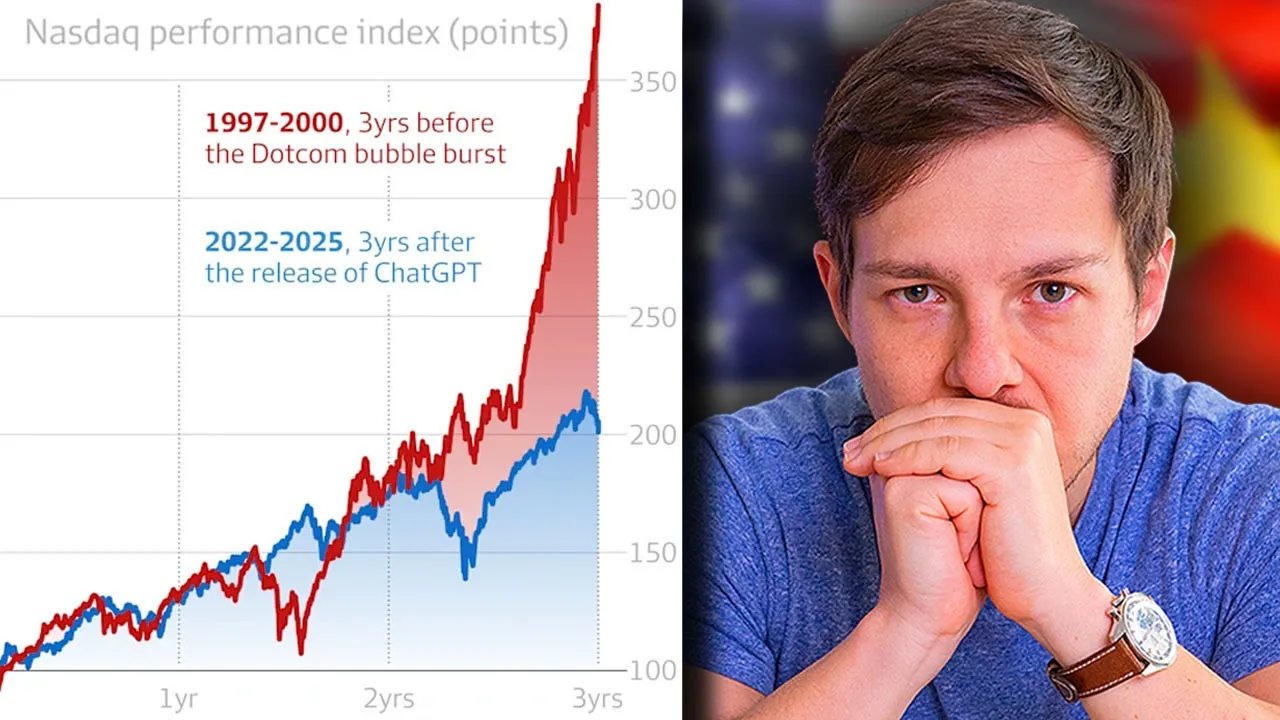
The next few years could usher in an unprecedented economic boom, potentially creating more wealth than ever imagined, but only if current challenges are navigated successfully. Despite concerns over inflation, national debt, and massive tech spending on AI, historical patterns suggest a significant market upswing following midterm elections. The key to profiting lies not in predicting market movements but in disciplined investing, particularly by buying during downturns, as missing just the best trading days can drastically reduce long-term returns.
Artificial intelligence is poised to be a major catalyst, not just for AI companies but for any business that leverages it to boost productivity and cut costs. This could lead to record economic growth without the inflationary pressures of the past. For individuals, mastering AI to enhance personal output may prove more valuable than investing in AI stocks. Ultimately, the path to wealth involves consistent investment and resilience during market dips, rather than trying to time the market.
Short Highlights
- The next few years could be the biggest wealth-building opportunity of a generation.
- Historical data shows the S&P 500 has been higher one year after every midterm election since 1946.
- Artificial intelligence is expected to drive significant productivity gains and economic growth.
- Despite high valuations and inflation concerns, corporate earnings are growing rapidly.
- The key to profiting is consistent buying during market downturns, not timing the market.
- Diversification across assets like stocks, real estate, and cryptocurrency is crucial.
- Consumers stand to benefit from falling inflation and growing real wages.
Related Video Summary
Key Details
The Looming Economic Boom [0:08]
- The current period is framed as a potentially massive wealth-building opportunity.
- Despite potential headwinds like data center expansion limits and AI bans, an economic boom is on the horizon.
- The biggest beneficiaries may be everyday investors, not just tech billionaires.
"And if it goes the way I think it will, the biggest winners aren't going to be the tech billionaires in large companies, but instead, everyday investors who recognize what's happening and make a move before the rest of the world even realizes what's going on."
Potential Obstacles to Growth [1:15]
- Oil prices, influenced by the conflict with Iran, remain a significant economic wildcard.
- Persistent inflation is a concern, with consumer prices rising faster than paychecks.
- The national debt and a $2 trillion annual deficit necessitate continuous money printing, risking economic instability.
"Believe it or not, consumer prices are now up 3.7% from a year ago, while paychecks only grew 3%."
Data Centers and AI Spending [2:35]
- Major tech companies are investing heavily in capital expenditures, particularly for AI.
- A question arises about the return on investment if AI spending doesn't yield expected results.
- Recent earnings reports for the "Magnificent Seven" fell short of estimates, while spending continues to increase.
"Amazon, Alphabet, Meta, Microsoft, and SpaceX are on track to spend somewhere between $803 and $828 billion this year alone on CapEx, which now raises a very good question."
Historical Market Trends Post-Midterms [4:45]
- Historically, the S&P 500 has shown strong performance in the year following midterm elections.
- Since 1946, the S&P 500 has been higher one year later every time, averaging a 14.4% gain.
- This trend is attributed to reduced investor uncertainty after elections.
"So far, historically, after midterms end, like they just did, since 1946, the S&P 500 has been higher one year later every single time, with an average gain of 14.4%."
Navigating Market Volatility [6:06]
- Market gains are not always linear; significant drops are common.
- The S&P 500 experiences 10% or more drops about every 18 months and 20% or more drops about every 6 years.
- Historically, buying during steep declines has led to substantial average returns (52% in 12 months after a 20%+ drop).
"The S&P 500 has fallen 10% or more about once every 18 months, and 20% or more about once every 6 years."
The Role of AI and Consumer Strength [14:04]
- AI is seen as a major driver for future growth, reducing administrative hours and operating costs.
- The benefits of AI extend beyond big tech to all companies aiming to decrease costs and increase productivity.
- Strong job growth and falling unemployment, coupled with potentially falling inflation, could boost consumer spending.
"We're talking fewer administrative hours, faster software development, and lower operating costs for almost every company in the country."