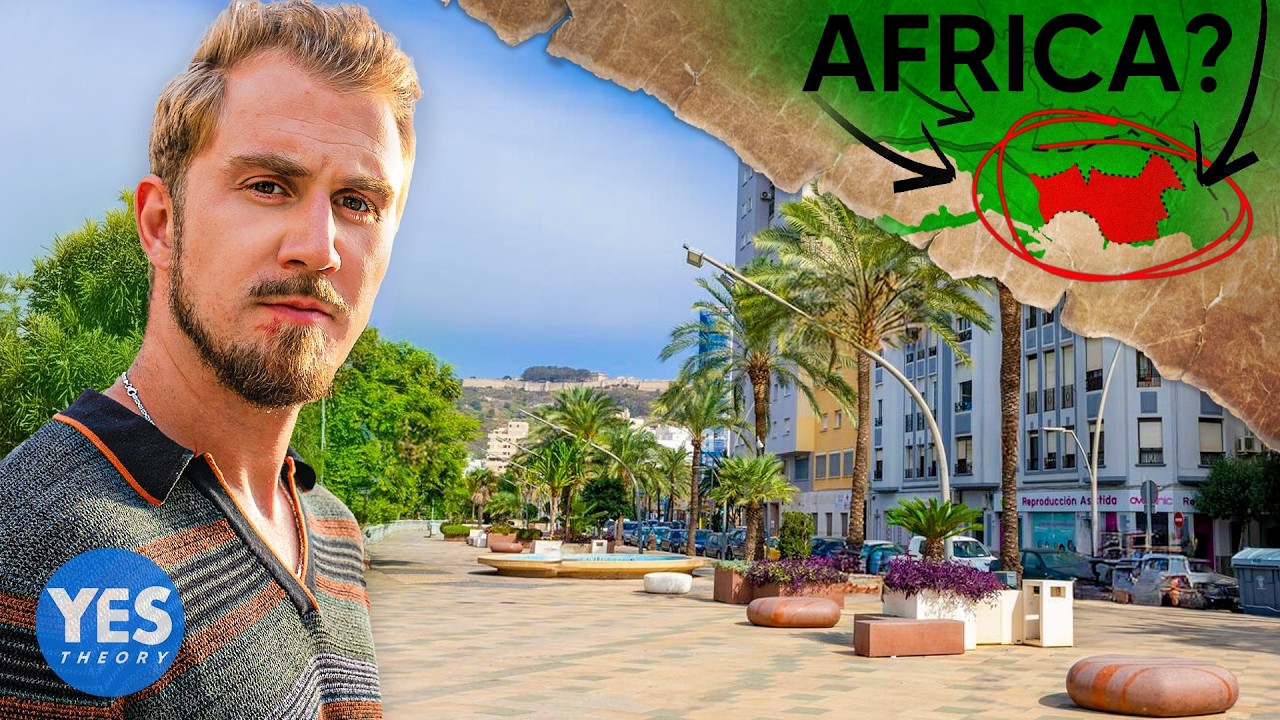
Why is There Still a European City in Africa? (we went to find out)
Yes Theory
2,694,871 views • 1 year ago Save 16 min 5 min read
Video Summary
Two Spanish towns, Ceuta and Melilla, are located on mainland Africa, creating a unique European territory with heavily fortified borders. Despite their strategic importance and complex history, these enclaves are largely unknown to the outside world. The video explores the multicultural reality of Melilla, where Spanish, Moroccan, Jewish, and Christian cultures intertwine, evidenced by diverse architecture and a "Square of the Four Cultures." However, this idyllic coexistence is juxtaposed with the harsh reality of its heavily militarized border with Morocco, a site of desperate migrant attempts and a tragic incident known as the "Melilla Massacre." Crossing into Morocco reveals a stark cultural shift, yet locals express a pragmatic view, emphasizing that while the border has become more difficult, coexistence is possible.
The journey highlights the profound contrasts within Melilla, from its ancient fortress history to its modern status as a European outpost. The narrative underscores the human element, with encounters revealing a deep sense of community and mutual respect among residents of various backgrounds. The stark visual of the multi-layered, barbed-wire-laden border serves as a potent symbol of global tensions, contrasting sharply with the everyday lives and aspirations of the people living in these border towns. Ultimately, the experience leaves a lasting impression of a place defined by both its stunning natural beauty and its challenging geopolitical position.
Short Highlights
- Melilla is one of only two European territories on mainland Africa, belonging to Spain.
- The city is a multicultural hub, blending Spanish, Moroccan, Jewish, and Christian influences.
- Its border with Morocco is heavily fortified and a site of significant migrant activity.
- The "Melilla Massacre" in 2022 highlighted the dangers faced by migrants at the border.
Key Details
Europe's African Enclaves [0:00]
- Melilla and Ceuta are Spanish towns located in northern Morocco, representing Europe's only mainland territories in Africa.
- These cities are described as Europe's southernmost and most fortified borders.
- The journey aims to explore the lives of residents and the reasons behind these unique territories.
"Ceuta and Melilla are two towns in the north of Morocco that technically belong to Spain."
First Impressions of Melilla [0:35]
- Upon arrival, the speaker notes the quiet atmosphere and the challenge of finding people to speak with.
- Melilla is characterized as a hybrid city, with architecture that feels both Spanish and distinctly not.
- The city has been Spanish for 500 years and holds the status of an autonomous city with its own government and culture.
"And our first impressions were as confusing as you might expect."
Exploring Melilla's History [1:24]
- The fortress of Melilla, dating back over 2,700 years, played a crucial role in Spain's claim to the territory.
- Originally a Phoenician colony named Rusadir, it served as a military outpost controlling Mediterranean trade routes.
- Spain officially claimed Melilla in 1497, fortifying it against larger forces.
"Like the Spanish people know about the history of Malaysia. They don't know it."
The Border's Origin [2:34]
- The border between Melilla and Morocco was determined by the range of cannons fired from the fortress.
- The cannon's reach defined the defensive perimeter, establishing the border line.
- The surrounding landscape is identified as Morocco, emphasizing Melilla's isolated position.
"So the way that they chose the border of Melilla with Morocco, when the country of Morocco was formed, was they shot the cannons from this fortress and how far the cannon could reach, that's where they drew the border."
Multicultural Coexistence [3:14]
- Melilla is noted for its diverse population, including Christians, Muslims, and Jews, with various cultural and religious sites visible.
- The "Plaza de las Culturas" (Square of the Four Cultures) symbolizes this blend of Arab, Jewish, and Catholic influences.
- Despite the cultural mix, the afternoon siesta tradition makes the city streets deserted.
"It's like everything coexisting here in North Africa in a small, small city. It's stunning."
The Fortified Border [5:02]
- The border between Melilla and Morocco is described as a heavily fortified fence, separating Europe from Africa.
- It's a critical point for migrants seeking asylum in Europe, with numerous fences and barbed wire.
- The "Melilla Massacre" in 2022, where dozens of African migrants reportedly died during a border crossing attempt, is highlighted.
"This heavily fortified fence is what separates Europe from Africa."
Crossing into Morocco [7:21]
- Crossing the border involves multiple checkpoints and takes a significant amount of time, with filming prohibited.
- Upon entering Morocco, a distinct cultural shift is immediately noticeable.
- Locals in Morocco express a pragmatic view on Melilla, focusing more on the difficulties of border crossings than on the existence of the Spanish enclave itself.
"It doesn't seem, based on the few people that we've spoke to, that the existence of Melilla bothers people around."
Reflections on Coexistence [9:00]
- The experience in both Melilla and Morocco reveals a sense of unity and shared humanity among ordinary people.
- Melilla is characterized as a city of contrasts, with clashing yet coexisting cultures and a mix of beauty and tension.
- The video concludes by emphasizing the importance of coexistence, mutual respect, and openness to other beliefs as essential for global harmony.
"We're all, we're all one."


![Final Warning on Fed [Watch Now]](https://i.ytimg.com/vi/uXS337Waf7w/hqdefault.jpg)
