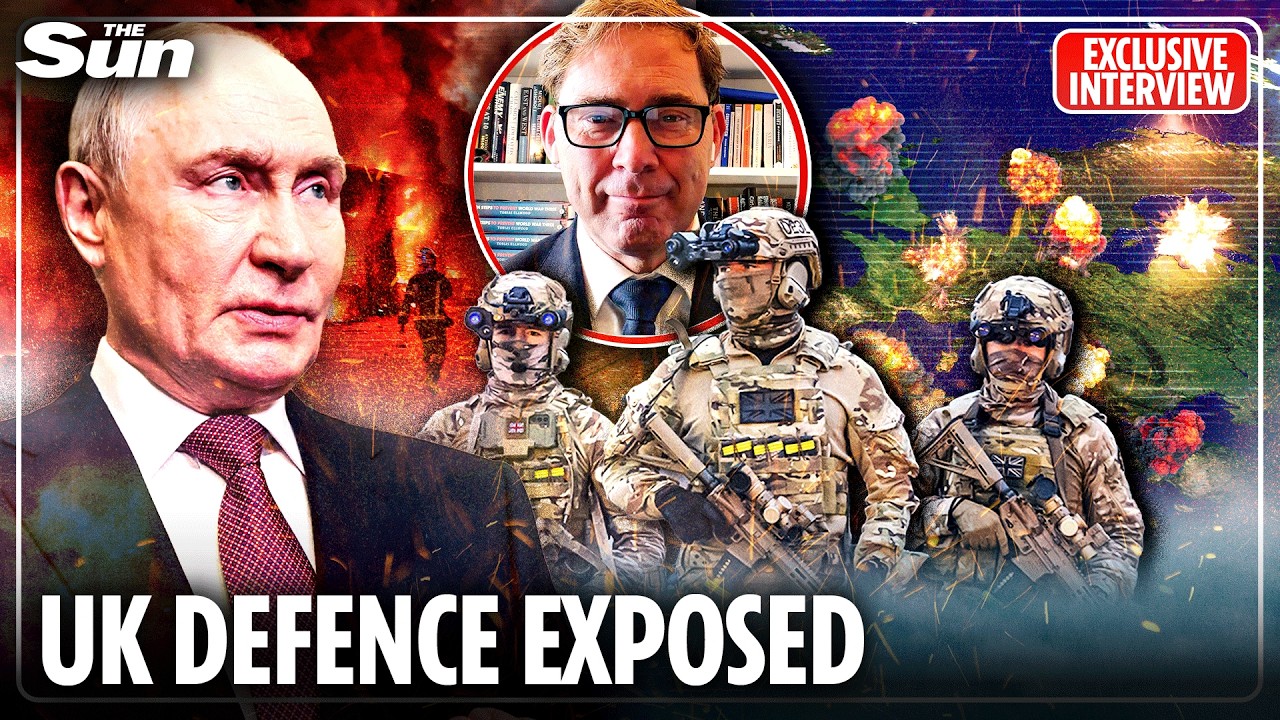
Is UK prepared for World War III? | Tobias Ellwood interview
The Sun
122 views • 16 hours ago Save 7 min 4 min read
Video Summary
The world has entered a new, precarious era of insecurity, marked by escalating geopolitical tensions and novel forms of warfare that defy traditional military strategies. Unlike the relatively stable past three decades, the present is characterized by the paralysis of international institutions like the UN and WTO, and the withdrawal of US support for the established global order. This vacuum is being filled by rising powers like China and Russia, who are forging rival visions and expanding their influence, as evidenced by recent BRICS meetings. The speaker warns that World War III will not resemble World War II with nuclear weapons, but will instead encompass conflict across space, cyber, and economic domains, potentially augmented by AI and quantum technologies.
Western military capabilities are described as a "1990s tribute band," struggling to adapt to rapid technological advancements seen in Ukraine, where 3D-printed drones can be deployed within weeks while Western procurement takes years. This lag leaves nations vulnerable to "grey zone warfare," including cyberattacks on critical infrastructure and economic coercion. The speaker advocates for a modern form of national service focused on homeland resilience, emphasizing the need to protect vital assets like undersea cables, which Russia is reportedly mapping for potential disruption. The current approach to defense and international alliances, like NATO, is deemed insufficient and too timid to deter aggression, echoing the hesitations that preceded past global conflicts.
Short Highlights
- The world is entering a new era of insecurity, surpassing the relative stability of the last 30 years.
- International institutions are paralyzed, and the US is withdrawing support for the rules-based order.
- New alliances, including China, Russia, and Iran, are forming rival visions and expanding influence.
- World War III will involve warfare in space, cyber, economic domains, and potentially AI and quantum technologies, not just nuclear weapons.
- Western military procurement is slow and outdated compared to rapid technological advancements like 3D-printed drones.
- Nations are vulnerable to "grey zone warfare," including cyberattacks on critical infrastructure and economic coercion.
- A modern form of national service focused on homeland resilience is needed to protect critical infrastructure and respond to emergencies.
Related Video Summary
Key Details
A New Era of Insecurity [0:00]
- The last three decades were relatively mild compared to the insecurity the world is now entering.
- Parallels are drawn to 1937 with forming dangerous alliances and rearmament.
- International institutions like the UN and WTO are unable to hold nations to account.
-
"The United Nations is paralysed. The World Trade Organization doesn't work anymore."
The Shifting Global Order [0:49]
- America is withdrawing support for the international rules-based order, with many countries ignoring it.
- Rising tensions are evident globally.
- The world is splintering into the Western block and a rival vision crafted by China, Russia, Iran, and other countries.
-
"And look where we might go, we need to do something about it."
Evolving Warfare and Military Lag [1:25]
- New forms of warfare are emerging, requiring a shift away from the old idea of World War III as nuclear.
- Warfare will occur in space, cyber, economic domains, monopolies, arguments over minerals, AI, and quantum technologies.
- Western military and security capabilities are described as a "1990s tribute band" due to slow procurement processes.
-
"You've got these other realms of competition, which we simply haven't got our heads around."
Vulnerability to Grey Zone Warfare [3:16]
- Russia's aim is to cause economic harm and societal chaos through targeting critical national infrastructure.
- Cyberattacks on companies like Jaguar Land Rover have caused significant financial losses and job cuts.
- 62 major undersea cables connect Great Britain to the continent and US; fracturing a few could cause complete mayhem.
-
"So they could easily cause mayhem. And our economy would lose billions overnight."
The Need for Homeland Resilience [5:02]
- A modern form of national service is advocated to build homeland resilience.
- This service would involve protecting critical national infrastructure and knowing how to act in major emergencies.
- Local councils are often unprepared for the types of threats on the horizon.
-
"But they are simply not prepared for the type of threats like this that are definitely coming over the horizon."