Jim Bianco on The K-Shaped Economy & A.I. Revolution
Bianco Research
594 views • 9 months ago 6 min read
Video Summary
The current economic landscape presents a stark contrast: a booming tech and AI sector, marked by record stock market highs and significant investment in data centers, coexists with widespread financial strain for a majority of Americans. Inflation has outpaced wage growth, leaving many living paycheck to paycheck and unable to cover unexpected expenses. This divergence is described as a "K-shaped economy," where the top income brackets benefit from rising asset values while the lower end experiences a decline in purchasing power. Despite concerns about potential bubbles and massive capital expenditure in AI, the prevailing sentiment among analysts is that this tech-driven growth, particularly in AI, is in its early stages and could continue for several years, potentially reshaping the economy similarly to past industrial revolutions.
An intriguing aspect is that a significant portion of Americans, 59%, report being unable to come up with $1,000 for an emergency.
Short Highlights
- The economy is described as "K-shaped," with the top of the income spectrum benefiting from rising home prices and stock market highs, while the bottom struggles with inflation.
- 59% of Americans cannot come up with $1,000 for an emergency.
- Inflation has risen 27% since 2020, while wages have only increased by 21% in the same period.
- The current tech boom is seen as a "fourth industrial revolution" led by AI, with US tech outperforming China.
- Projections suggest the tech bull market, driven by AI, could continue for another few years.
- Concerns about massive spending on AI data centers, with an estimated $8 trillion in capex, are raised, questioning the potential return on investment.
- Some analysts view the current AI investment phase as akin to the early days of the internet, suggesting long-term transformative potential despite short-term corrections.
- It is suggested that only 3% of US companies have adopted AI, indicating the revolution is still in its early stages, comparable to the "top of the third inning" of a baseball game.
Key Details
The K-Shaped Economy: A Tale of Two Realities [00:00]
- The economic outlook is characterized by "cognitive dissonance," with the tech and AI sectors experiencing unprecedented growth and record highs, while a significant portion of Americans face financial hardship due to persistent inflation.
- This phenomenon is referred to as a "K-shaped economy," where the top income brackets see their wealth increase through rising home prices and stock market gains, leading to strong GDP and retail sales numbers.
- Conversely, the bottom of the K faces challenges, with 59% of the public unable to muster $1,000 for emergencies.
- Inflation has significantly outpaced wage growth, with prices up 27% since 2020 and wages only 21%, forcing many to live paycheck to paycheck and experience a decline in their purchasing power.
- The concern is that if prices are not controlled, public anger will escalate, and the stock market may cease to be viewed as an indicator of the broader economy.
"It is it is screaming the cognitive dissonance, right? Some people are doing really well. Um stock market, anything related to tech, AI, I mean, it just seems there is no limit to it right now. But you've got Americans struggling to keep up. You've got inflation that has over time built to such a level that I think years ago none of us would have thought we would have been in this position, right?"
The AI Revolution: A Fourth Industrial Leap [01:53]
- The current economic surge is being driven by an AI revolution, considered a "fourth industrial revolution" led by the US, which is seeing its tech sector lead China for the first time in 30 years.
- This tech-led market is characterized by strong performance in companies like Nvidia and Microsoft, though its impact on the broader economy remains uneven.
- Analysts predict this tech bull market, fueled by AI advancements, could persist for several more years, potentially impacting upcoming midterms.
"Look, this is an AI revolution. It's a fourth industrial revolution that's being led by the US. I mean, US is headed China for the first time in 30 years when it comes to tech."
Massive AI Investment and Potential Bubble Concerns [03:09]
- The immense spending on AI, particularly on data centers, is being likened to the impact of railroads over a century ago, with trillions of dollars being invested.
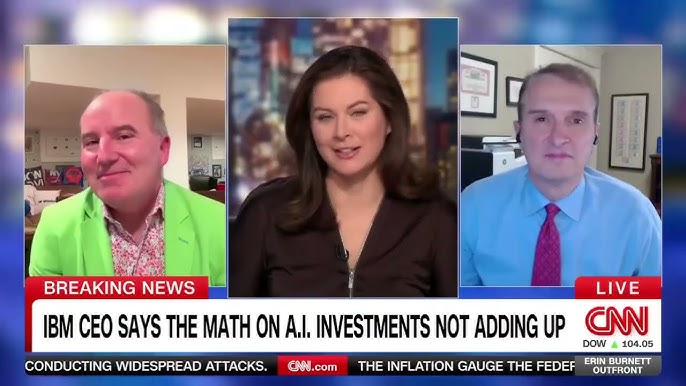
- A sobering assessment from IBM's CEO suggests that the projected $8 trillion in capital expenditure for AI data centers may not yield adequate returns, estimating that $80 billion is needed to fill a one-gigawatt data center.
- The calculation indicates that $8 trillion in capex would require approximately $800 billion in profit just to cover interest, raising questions about the financial viability of such extensive investments.
"It takes about $80 billion to full to fill up a one gawatt data center. If I look at the total this things the total commits in the world on this space of the chasing AGI seem to like 100 gawatt at these announcements that's 8 trillion of capex there's no way you're going to go get a return on that is my view because 8 trillion of capex means you need roughly 800 billion of profit just to pay for the interest."
The Long Game of AI: Revolution or Speculation? [04:14]
- Despite the concerns about massive spending and potential bubbles, the current AI boom is viewed by some as a generational shift, analogous to the internet revolution.
- Just as the internet's initial correction in 2002 paved the way for new technological advancements like Meta, Uber, and Airbnb, the current AI investment is expected to yield similar long-term benefits.
- The argument is that companies must participate in this AI race to avoid being left behind, as AI is poised to be a significant positive force for everyone in the long run.
- The idea of a bubble is considered overblown, with only about 3% of US companies having adopted AI, suggesting it's still early in the "game."
- The massive spending on data centers, estimated at $3 to $4 trillion, represents the early stages of AI's impact, and the benefits are expected to unfold over time, much like a party that has just begun.
"And I think that this is the same thing here. Everybody's got to play this game because the loser is going to be somebody who's not playing. But if you're not, you know, an investor in this, what do you what you're going to be left with AI at the end of it. And that's going to be a big positive for everybody."