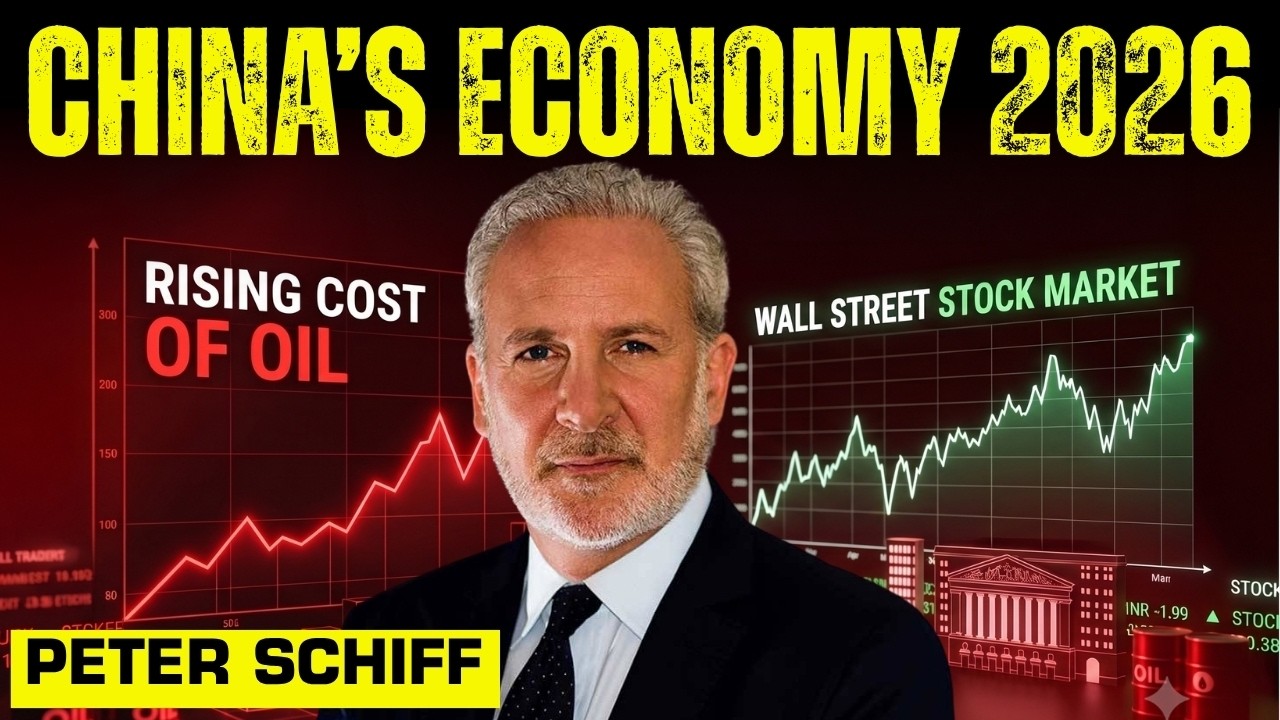
LIVE:Everything You Need To Know About China’s Economy l Peter Schiff @peterschiff
iChongqing
39,098 views • Save 33 min (3 min read) • 3 days ago
Video Summary
Peter Schiff discusses the current state of the U.S. economy, emphasizing that unsustainable debt, deficit spending, and monetary policy are driving inflation and threatening the dollar's status as a reserve currency. He argues that the government's reliance on printing money rather than taxing to fund operations and military conflicts is eroding the standard of living for average Americans. Schiff warns that as foreign nations de-dollarize and reduce their holdings of U.S. debt, the U.S. will face higher interest rates, reduced purchasing power, and potential economic instability.
Regarding investments, Schiff maintains that gold and silver remain essential hedges against inflation and geopolitical uncertainty, despite recent price volatility. He also expresses skepticism toward the high valuation of SpaceX, noting that the company lacks significant earnings and is currently priced for perfection in a speculative market environment.
Short Highlights
• U.S. national debt has surpassed $39 trillion, with interest payments reaching approximately $1.6 trillion annually. • Central banks are increasingly purchasing gold as a strategy to de-dollarize and mitigate risks from U.S. sanctions. • The U.S. economy faces a potential decline in living standards as foreign demand for the dollar and U.S. debt instruments wanes. • SpaceX is criticized for its high valuation relative to its lack of significant earnings.
Key Details
Economic Impact of War and Debt [0:02:18]
• The U.S. deficit increased by 34% year-over-year, partly driven by military spending. • Annualized interest payments on federal debt have reached $1.6 trillion. • > Iran is saying that it won't develop a nuclear weapon. What they're not saying is they're going to give up all their uranium enrichment.
Inflation and the Consumer [0:06:55]
• The cost of living crisis is attributed to excessive government spending and money printing. • The average American faces a declining standard of living as the dollar loses purchasing power. • > The cost of living problem is a cost of government problem. Government is too expensive and the average American is bearing the consequences of that.
Oil Market Outlook [0:09:05]
• Oil prices are expected to remain high due to supply chain damage and increased demand from governments replenishing reserves. • The end of the war is unlikely to provide significant relief at the pump. • > I think, in fact, I think oil's headed back over a hundred dollars a barrel.
Gold and Silver as Safe Havens [0:12:15]
• Gold and silver are viewed as essential inflation hedges despite recent market volatility. • Wars are typically funded through inflation, which is fundamentally bullish for precious metals. • > The war is bullish for gold, not just because of uncertainty, but because of how wars are paid for.
Global De-dollarization [0:15:00]
• Central banks are diversifying reserves away from the U.S. dollar due to concerns over fiscal irresponsibility and potential sanctions. • Foreign creditors are increasingly wary of holding U.S. Treasuries. • > Since we're not going to prevent the crisis, he wants an emergency plan to deal with it.
Consequences for the U.S. Economy [0:19:30]
• A loss of reserve currency status would force the U.S. to reduce trade deficits and import less. • The economy faces potential structural unemployment as consumption-based jobs decline. • > The average American owes his standard of living to the dollar and its role as a reserve currency.
SpaceX Valuation [0:23:15]
• SpaceX is described as being significantly overvalued, trading at approximately 100 times revenue without consistent earnings. • Comparisons are made between Elon Musk's wealth and historical figures like John D. Rockefeller. • > It's priced for perfection, which it won't likely achieve.