Ibaraki & Tochigi: The Bounties of Spring - CYCLE AROUND JAPAN
NHK WORLD-JAPAN
43,501 views • 2 months ago Save 45 min 4 min read
Video Summary
Crossing 350 kilometers of diverse Japanese terrain, cyclist Michael Rice discovers that the true heartbeat of Ibaraki and Tochigi lies in the resilience of local traditions. From the sandy, nutrient-rich soil of Kamisu—where farmers cultivate exceptionally sweet 'peanut peppers'—to the industrial revival of the Meguro motorcycle in Nasu-Karasuyama, the journey reveals a landscape defined by people fiercely protecting their heritage against the pressures of modernization and an aging workforce.
Whether it is the meticulous preservation of wild bird habitats at Lake Kitaura or the labor-intensive production of high-quality sod in the shadow of Mount Tsukuba, the trip highlights a profound connection between the land and its stewards. As spring blossoms across the prefectures, Rice finds that the enduring pride of these rural communities offers a deeper, more rewarding experience than any scenic route alone could provide.
Short Highlights
- Discover the unique local industries and natural wonders of Ibaraki and Tochigi:
- Peanut peppers in Kamisu, prized for their sweetness due to the region's sandy soil.
- Wild bird habitats at Lake Kitaura, which hosts 80 species of birds annually.
- High-quality sod production in Tsukuba, a legacy of post-war agricultural adaptation.
- The restoration of the historic Meguro motorcycle, a symbol of industrial pride in Nasu-Karasuyama.
- Experience the physical challenge of a 350-kilometer journey through varied terrain, including riverbanks, coastal beaches, and mountain climbs.
- Witness the intersection of traditional lifestyles and modern environmental challenges, such as the conversion of farmland into solar sites.
Key Details
Mito Station and Lake Kitaura [0:15]
- Michael Rice begins a 350-kilometer cycling journey through Ibaraki and Tochigi to welcome the arrival of spring.
- At Lake Kitaura, bird watcher Kawamata Toshihiko explains how the lake supports 80 species of birds, including the near-threatened great crested grebe.
There are a bird in the forest. There is a bird in the middle. It's a bird in the middle. You can see it there.
The Beaches of Kamisu [2:57]
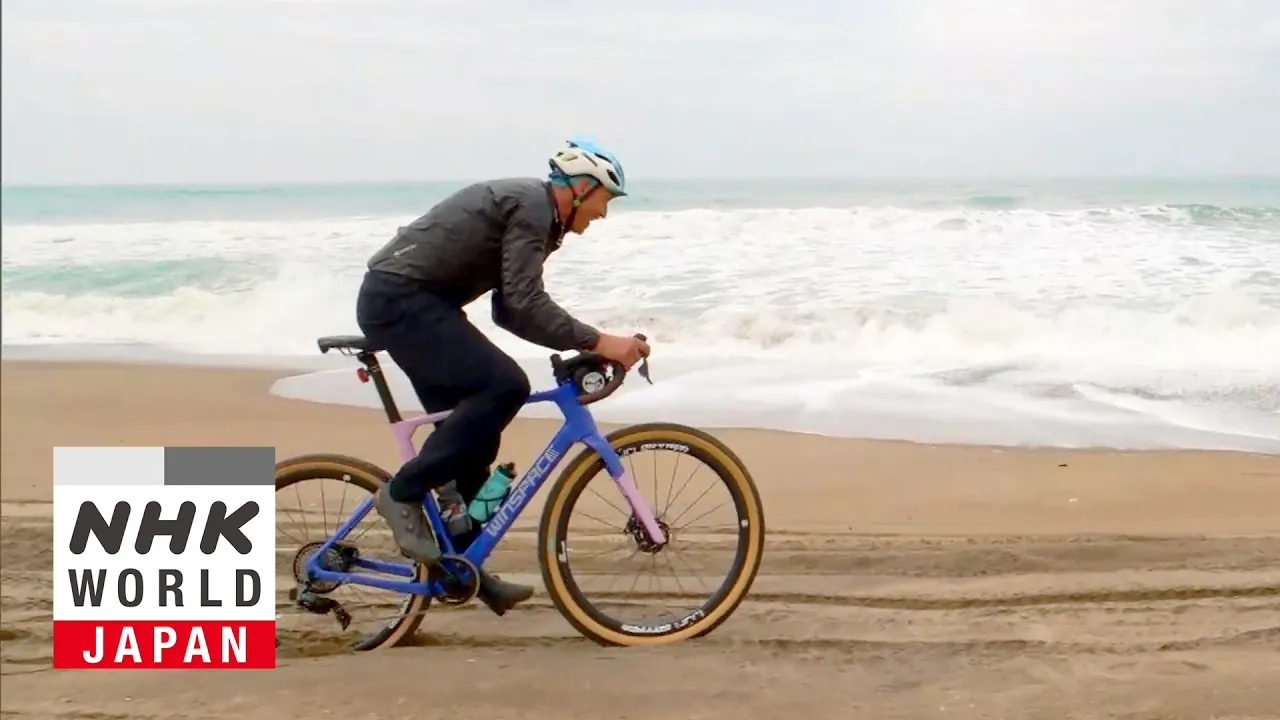
- Michael attempts to ride his bike on the sand at Nikawa Hama beach, finding it significantly more difficult than expected.
- The challenging terrain provides a strenuous workout while showcasing the rugged coastal landscape.
Oh, this is tricky. This is tricky. That was way higher. Now I'm scared of the waves.
Farming in Kamisu [3:34]
- Farmers Hideyoshi and Noriko Hada explain the cultivation of unique 'peanut peppers' in the city's sandy soil.
- The peppers are noted for their sweetness, which results from the plants storing nutrients to protect themselves in the well-draining soil.
The water just flies off. It's so juicy and the water is flying. It's amazing.
Tsukuba's Sod Industry [5:58]
- Michael observes fields of Japanese sod near Mount Tsukuba, a crop vital to the region's agricultural identity since the post-war era.
- Local farmer Matsumoto shares the struggle of maintaining traditional sod farms amidst an aging workforce and the rise of solar farm conversions.
When I was driving, I thought I couldn't make anything. But it was actually a shiba.
Entering Tochigi Prefecture [7:31]
- The journey continues north along the Kinugawa River, where early plum and cherry blossoms signal the late arrival of spring in mountain villages.
- The peaceful rural scenery offers a stark contrast to urban life, emphasizing the history embedded in the local landscape.
It really makes my heart feel calm when I'm cycling in a place like this. You can feel the history.
The Meguro Motorcycle Legacy [8:19]
- In Nasu-Karasuyama, Michael encounters a custom shop dedicated to the Meguro motorcycle, a brand that once led the 1964 Tokyo Olympics torch relay.
- Local workshops collaborated over three years to restore a vintage model to revitalize local pride and interest among younger generations.
It's a city that has nothing to do, so if you think of something that is a joyous thing, then the young people would love this city.
Community Restoration [9:39]
- Sato Masaki and other local artisans recount the technical challenges of sourcing parts and assembling the restored motorcycle.
- The project culminated in a public display and community rides that successfully reconnected residents with their industrial history.
I felt that it was the first time to get the engine off. I felt that the engine was not able to get the engine off.
The Final Ascent [10:35]
- Michael finishes the trip with a grueling climb against strong winds, eventually reaching a vantage point overlooking both Ibaraki and Tochigi.
- The journey concludes with a reflection on the value of preserving local heritage and the warmth of the people met along the way.
It's never easy getting to the top, but it's always worth it. Always worth the climb.