“DEVASTATING Defeat!” Trump Plans ‘Massive’ Iran Attack + Piers Morgan vs Cancelled Cornell Student
Piers Morgan Uncensored
490,564 views • Save 70 min (5 min read) • yesterday
Video Summary
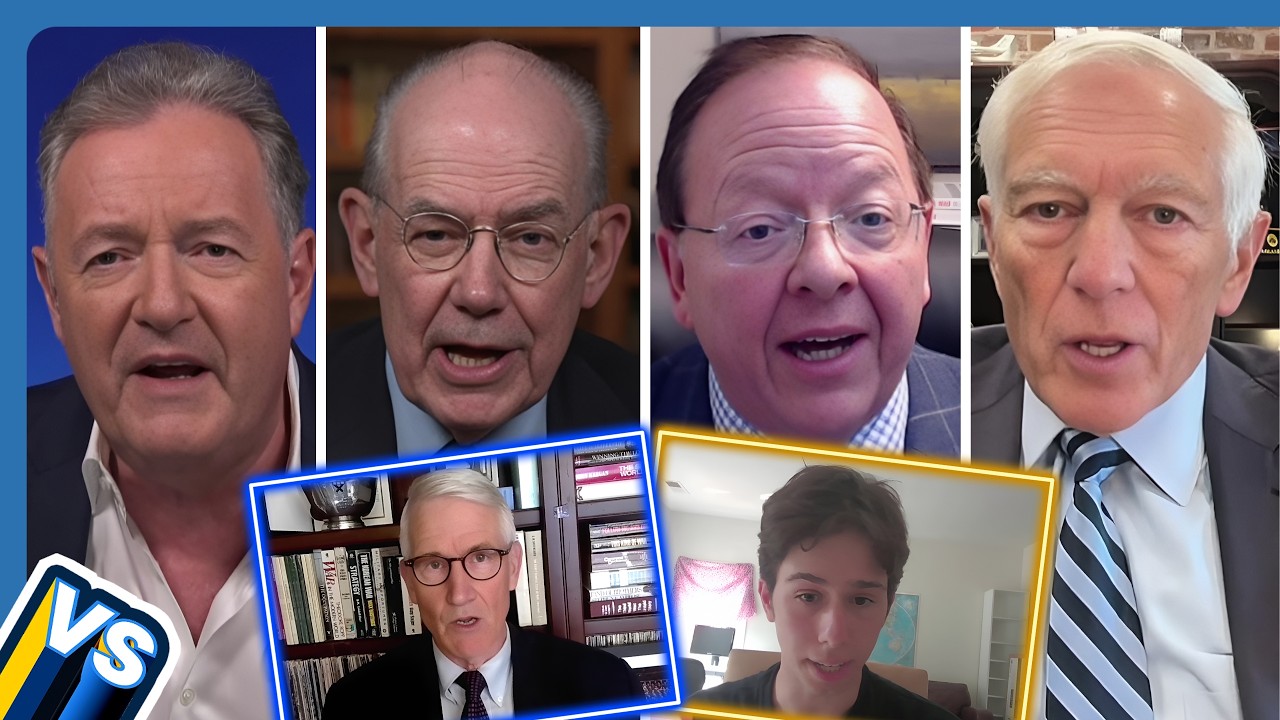
The transcript features a discussion on the Iran war, with Professor John Mearsheimer arguing it's a "catastrophic defeat" for the US, failing on all four initial goals. He suggests Trump should seek a new memorandum of understanding, but anticipates difficulty due to Iranian leverage. General Wesley Clark and General Mark Kimmitt offer contrasting views on military options and US objectives, with Clark advocating for a harder stance on the Strait of Hormuz and Kimmitt suggesting a declaration of victory while focusing on the Strait. The conversation also touches on the potential for escalation, the role of Russia and China, and the political implications for Trump's presidency. A separate segment discusses a Cornell student's antisemitic remarks and the subsequent backlash, with the student defending his views based on personal experiences and a broader critique of Israeli policy, while the interviewer strongly condemns his statements as antisemitic and hypocritical.
Short Highlights
- US has suffered a "catastrophic defeat" in the Iran war, failing on all objectives.
- Experts debate military options, with some advocating for escalation and others for a strategic focus on the Strait of Hormuz.
- A student's antisemitic remarks and subsequent defense highlight issues of free speech, prejudice, and cancel culture.
Key Details
US Defeat in Iran War [00:00]
- Professor John Mearsheimer states the US has suffered a "devastating defeat" in the Iran war, failing on all four initial goals: regime change, eliminating uranium enrichment, ending support for proxies, and stopping the long-range missile program.
- He notes the destruction of the US basing and alliance structure in the region and warns of potential global economic collapse.
- Mearsheimer argues there is no military solution and suggests Trump should seek a new memorandum of understanding, but anticipates difficulty due to Iranian leverage.
We've suffered a devastating defeat.
Military Options and Escalation [05:00]
- General Wesley Clark suggests going "in harder" but not with ground forces, focusing on operations within a limited box off the Gulf and continuous ISR.
- General Mark Kimmitt disputes Mearsheimer's claims about US objectives and regional alliances, stating the US has achieved some success in slowing Iran's nuclear program and missile capabilities.
- Kimmitt proposes declaring victory and focusing exclusively on the Strait of Hormuz.
One word, scale, scale.
Geopolitical and Economic Consequences [10:00]
- The discussion touches on the potential for escalation involving Ukraine and European allies, as well as the impact on Saudi oil facilities and desalination plants.
- Economic pressures on Gulf states are highlighted, with Bahrain and Kuwait facing significant challenges due to the Strait of Hormuz closure.
- The potential for Iran to acquire nuclear weapons and become a Middle East superpower is raised as a long-term concern.
This is a catastrophic defeat.
Trump's Political Situation and Saudi Nuclear Deal [15:00]
- The political imperatives for both Trump and Netanyahu are discussed, with the upcoming elections influencing their decisions regarding the war.
- The potential for Trump to become a "lame duck" president if the war continues unresolved is mentioned.
- The US deal with Saudi Arabia allowing uranium enrichment is debated, with arguments for and against it based on deterrence and regional stability.
It's here. I talked to Trump this morning.
Ukraine Conflict and Russian Victory [20:00]
- Professor Mearsheimer maintains his position that Russia will win the war in Ukraine, citing Russian advances and Ukrainian manpower problems.
- He dismisses Western claims of Ukraine turning the tide as propaganda.
- The strategic importance of Odessa for Ukraine and Russia's blockade of the port are discussed.
No, on the contrary.
Antisemitic Remarks and Backlash [25:00]
- Cornell student Austin Franco sent an email stating he was "not interested in working for a Jew."
- This remark led to a media firestorm and calls for him to be made unemployable.
- Franco defends his comments, citing negative personal experiences with Jewish individuals at Cornell and a broader critique of Israeli policy.
Not interested in working for a Jew thanks
Defense of Antisemitism and Hypocrisy [30:00]
- Franco argues for freedom of association and compares his stance to not wanting to live in New York or be around "jocks."
- The interviewer, Piers Morgan, strongly condemns Franco's statements as antisemitic and hypocritical, particularly his application of his logic to the Iran war.
- Franco claims he is not antisemitic, citing past relationships with Jewish people and a distinction between personal preference and hatred.
I want you to admit you're just a brazen anti-Semite.
Escalation Trap and Future Predictions [35:00]
- Professor Robert Pape describes the situation as an "escalation trap" where America is losing control.
- He predicts that if there is no demonstrable victory by the midterms, Democrats may end the war, potentially making Trump a lame duck.
- Pape emphasizes the "scale problem" of drone warfare and the difficulty of solving it within a short timeframe.
Scale, scale.
Conventional vs. Revolutionary War [40:00]
- General Kimmitt argues that the US is fighting a conventional war while Iran is fighting a revolutionary war, which depends on patience and resistance.
- He suggests that the US is making the "original sin" of believing conventional warfare can change the Iranian regime's behavior.
- Kimmitt advocates for patience and focusing military force on military targets, not civilian infrastructure.
We have suffered a devastating defeat.
Final Thoughts and Decision Points [45:00]
- The experts are asked if Trump would have initiated the war if he knew the outcome.
- Clark suggests it's difficult to answer but emphasizes the importance of finishing wars and focusing on the Strait of Hormuz.
- Pape believes Trump would not have initiated the war, and Kimmitt argues the war was inevitable as economic sanctions and diplomacy had failed.
It's not that hard but to finish it and end it is really difficult.