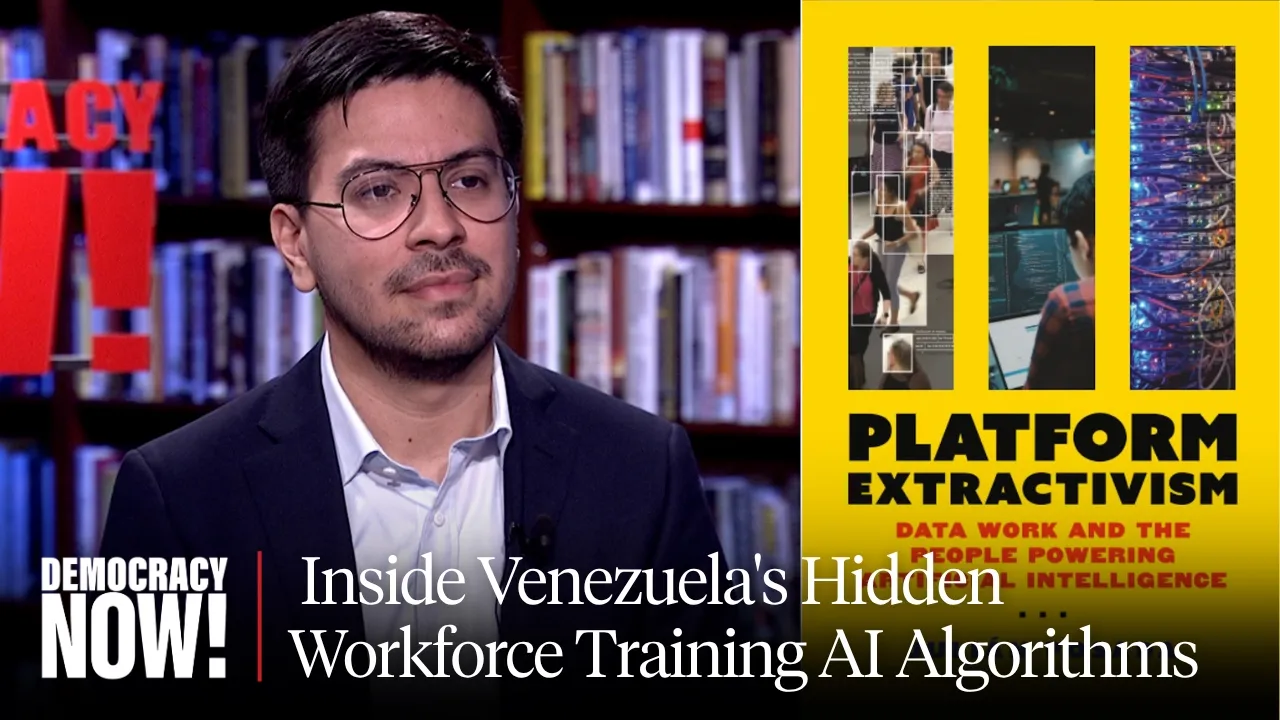
"Platform Extractivism": Inside Venezuela's Hidden Workforce Training AI Algorithms for Pennies
Democracy Now!
30,467 views • 2 months ago Save 4 min 5 min read
Video Summary
In Venezuela, a hidden workforce powered early AI development, driven by severe economic hardship and a unique societal structure. Julian Posada's research reveals that hyper-inflation and unemployment pushed many to seek online data annotation tasks, often earning as little as 50 cents per hour. This work, crucial for training AI like facial recognition algorithms, was facilitated by government-provided computer infrastructure and strong family and community support networks that sustained workers through difficult times.
Despite the critical role these workers played, their efforts were largely invisible. They often lacked knowledge of the major tech companies they served, working through intermediaries and with algorithms acting as managers. Pay varied significantly, with some workers using VPNs to mask their location and earn more. As AI development shifted towards large language models, demand for this type of work in Venezuela decreased, with many workers returning to other activities as the country's economic situation slightly improved.
Short Highlights
- Economic Crisis as a Catalyst: Venezuela's severe economic conditions, including hyper-inflation and high unemployment, particularly exacerbated by the COVID-19 pandemic, drove many citizens to seek data annotation work.
- Unique Infrastructure and Support: The availability of government-provided computers from the Hugo Chávez era and strong family and community support systems were crucial for enabling this workforce.
- Exploitative Pay and Conditions: Workers earned extremely low wages, sometimes as little as 50 cents per hour or $2-$5 per week, often paid per task in a piecework system.
- Invisibility and Lack of Transparency: Workers were largely unaware of the major tech companies they were assisting or the specific AI applications they were training, often working through outsourcing companies.
- Algorithmic Management: Algorithms acted as managers, controlling workflows, monitoring task completion times, and assessing accuracy, with the threat of being banned from tasks.
- Shift in AI Focus: The demand for Venezuelan data workers decreased as AI development shifted from computer vision to large language models, requiring different skill sets and often favoring workers in English-speaking countries.
Key Details
The Rise of Data Work in Venezuela [00:00:00]
- Julian Posada's research focuses on the "hidden data workforce" powering artificial intelligence, with a deep dive into data work and workers in Venezuela.
- Venezuela became a prominent location for data workers around 2020 due to a confluence of factors.
"So when I started this project, I actually wanted to focus on Latin America where I grew up."
Reasons for Venezuela's Prominence [00:01:15]
- The first key reason was the dire economic conditions in Venezuela, marked by a prolonged crisis, hyper-inflation, and high unemployment, further worsened by the COVID-19 pandemic.
- A second factor was the country's existing technological infrastructure, including computers distributed during the Hugo Chávez years, which families retained and used for data work.
- The third reason involved the strong social fabric of Venezuelan families and communities, where households collectively supported a single breadwinner engaged in data work.
"And then the third reason, which is also an interesting one, is the composition of families in Venezuela."
Wages and Working Conditions [00:03:30]
- Salaries for data workers were extremely low, with some platforms paying as little as 50 cents per hour, while others paid per task, resulting in earnings of around $2 to $5 per week.
- Some workers used VPNs to mask their IP addresses, pretending to be in countries like the United States to receive higher pay for the same work.
- It was difficult to accurately estimate the number of workers or their precise pay rates due to these variations and masking techniques.
"So salaries were either very low."
Lack of Transparency and Algorithmic Management [00:05:00]
- Workers rarely knew which major tech companies they were working for, often operating through outsourcing companies like Scale AI, which then used platforms like Remotasks.
- Workers had little understanding of the purpose of the tasks or the AI they were helping to train, with one worker speculating they might be tagging objects for a military complex.
- Algorithms served as managers, controlling the workflow, timing tasks, estimating accuracy, and banning workers suspected of spamming or providing inconsistent results.
"So from the perspective of the worker, you would just see the tasks."
Evolution of Data Work and a Shift in Demand [00:08:00]
- Initially, Venezuelan workers excelled at tasks like image labeling for computer vision applications, such as facial recognition and object detection, often without needing English proficiency.
- Following the rise of large language models (LLMs) and the release of ChatGPT in 2023, the focus of AI investment shifted, leading to a decrease in demand for the type of work prevalent in Venezuela.
- This shift caused many data annotation tasks to move to countries like the Philippines and India, where English proficiency was often required, and simultaneously, Venezuela's economic situation saw a slight improvement, allowing some workers to return to their previous activities.
"Then post-2023, when the investments started to focus on large language models, this is when chat-GPT came out, then."